What Is Tinder? A Simple Guide for Beginners
⚠️ SAFETY FIRST
Tinder is designed to catch fire easily, which also means it can ignite very quickly and unexpectedly.
Only practise fire lighting where fires are permitted and under appropriate supervision. Keep flammable materials away from unintended sources of ignition and always have a safe way to extinguish a fire.
Never collect or burn unknown materials, and don’t use materials that could release harmful fumes when burned.
What Is Tinder?
Tinder is a small amount of fine, easily ignited material used to help start a fire.
It is usually the first material that catches fire.
The flame produced by the tinder is then used to ignite slightly larger materials called kindling.
The basic progression is:
Tinder → Kindling → Fuel
For someone learning about fire lighting, understanding tinder is one of the most important places to start.
💡 EXPLAIN IT SIMPLY
Think of tinder as the bridge between a spark and a fire.
A spark is tiny.
A log is large.
Tinder sits in between.
Spark → Tinder → Kindling → Fuel
Each stage produces enough heat to ignite the next.
Why Is Tinder Needed?
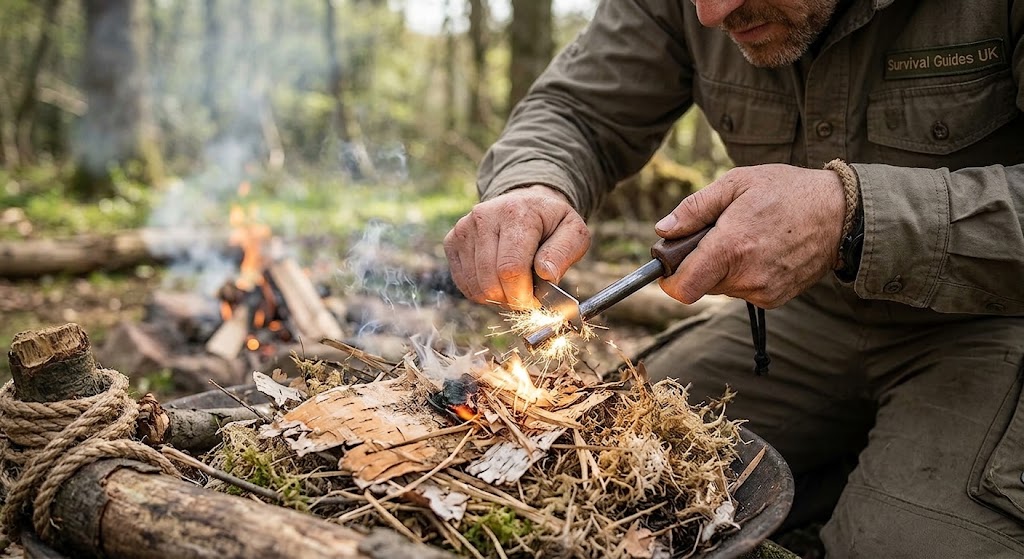
A spark from a firesteel, lighter or other ignition source is very small.
Trying to use that tiny spark to ignite a large piece of wood is unlikely to work.
Tinder solves the problem by being:
- Fine
- Lightweight
- Easily ignited
- Able to produce a small flame
- Suitable for transferring heat to kindling
Once the tinder is burning, it produces a larger and longer-lasting flame.
That flame can then ignite the kindling.
What Makes Good Tinder?
Good tinder generally has several characteristics.
It should ignite easily
Tinder needs to catch from a relatively small ignition source.
It should be dry
Moisture makes ignition much harder.
It should be fine
Fine fibres and small pieces have more surface area exposed to heat.
It should burn long enough
The tinder needs to stay alight long enough for the kindling to catch.
It should be suitable for the environment
What works in a dry woodland may not work particularly well in wet conditions.
The Fire Lighting Progression
A useful way to understand fire lighting is to think about the gradual increase in fuel size.
1. Ignition Source
This could be something such as a match, lighter or suitable firesteel.
↓
2. Tinder
Very fine, easily ignited material.
↓
3. Fine Kindling
Small dry pieces that catch from the tinder.
↓
4. Larger Kindling
Slightly larger pieces that build the heat.
↓
5. Fuel
Larger pieces of wood that maintain the established fire.
This gradual progression is sometimes called building a fuel ladder.
🔥 THE FUEL LADDER
Spark
↓
Tinder
↓
Small kindling
↓
Larger kindling
↓
Fuel wood
The aim is to avoid asking a tiny flame to do too much too soon.
Natural Tinder
Natural tinder comes from materials found in the environment.
Depending on the location and conditions, examples can include:
- Dry grass
- Dry leaves
- Birch bark
- Dry seed heads
- Fine plant fibres
- Certain dry fungi
- Shavings from suitable dry wood
Not every natural material makes good tinder.
The key is finding material that is dry, fine and readily combustible.
Birch Bark as Tinder
Birch bark is often associated with traditional fire lighting.
The outer bark contains compounds that can make it relatively easy to ignite, even when the outside of the bark appears somewhat damp.
However, this doesn’t mean you should strip bark from living trees.
If birch bark is to be used, fallen material should be preferred where appropriate and permitted.
You should also consider local environmental rules and avoid damaging living trees.
Dry Grass
Dry grass can make useful natural tinder when conditions are right.
It’s:
- Fine
- Lightweight
- Easy to gather
- Capable of producing a flame quickly
However, grass can burn very rapidly.
That means you need suitable kindling ready before lighting it.
Otherwise, you may end up with a brief flame that disappears before the larger materials catch.
Wood Shavings
Fine shavings from dry wood can also make useful tinder.
The shavings create lots of exposed surface area, helping them catch and transfer heat.
A common bushcraft skill is learning to create fine wood shavings from suitable dry wood.
However, always use appropriate tools safely and make sure the material you’re working with is suitable for burning.
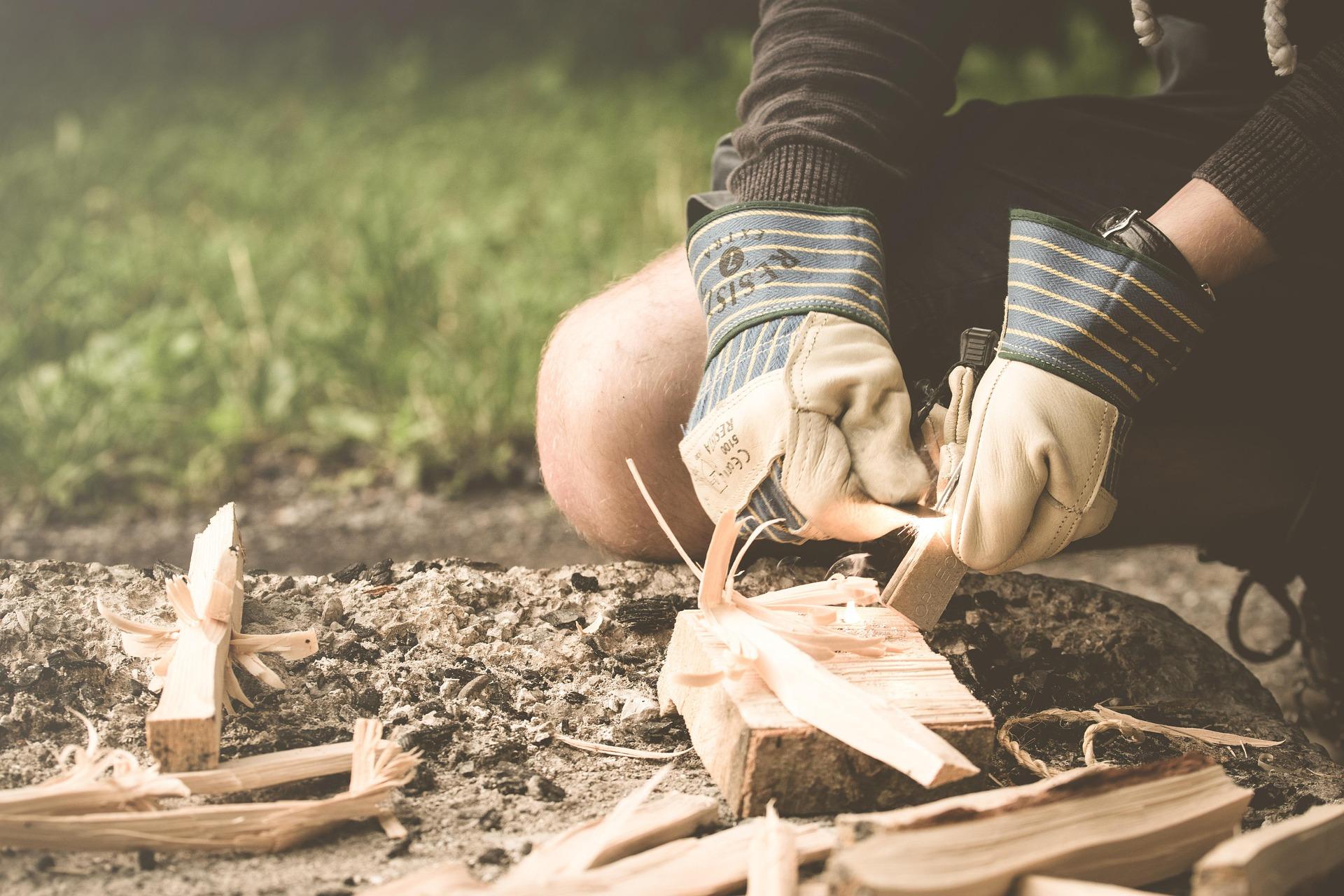
Feather Sticks
A feather stick is a piece of wood that has been shaved to create thin curls while leaving them attached to the stick.
These thin curls increase the exposed surface area and can help the wood catch more easily.
Feather sticks are a popular bushcraft technique because they demonstrate an important principle:
The finer the material, the easier it can be to ignite.
They can also be useful when naturally dry tinder is limited.
Commercial Tinder
Tinder doesn’t have to come from the natural environment.
There are many commercially produced fire-lighting materials.
These might include:
- Fire-lighting cubes
- Wax-based firelighters
- Prepared wood wool
- Commercial tinder products
- Other purpose-made fire starters
For camping, commercially made tinder can often be a simple and reliable option.
There’s nothing inherently more skilful about using natural tinder.
The important thing is understanding how fire works and using materials safely.
🧠 GOOD SURVIVAL THINKING
Reliable doesn’t mean cheating.
If you’re going camping, carrying suitable commercial firelighters may be much more sensible than relying entirely on finding natural tinder.
Skills are useful.
Preparation is better.
Tinder vs Kindling
These two terms are often confused.
Tinder
Very fine material used to catch the initial spark or flame.
Kindling
Slightly larger material used to build the fire from the tinder.
For example:
Dry grass → Tinder
Small dry twigs → Kindling
Larger branches → Fuel
The exact boundary between tinder and kindling isn’t always fixed.
The important thing is the size and purpose of the material.
Does Tinder Need to Be Tiny?
Not necessarily.
Tinder generally needs to be fine enough to ignite easily, but different materials have different characteristics.
A handful of dry grass and a small piece of commercial firelighter are both examples of tinder, even though they look completely different.
What matters is whether the material can:
Catch → Produce heat → Transfer that heat to the next stage.
Why Does Dry Tinder Work Better?
Water absorbs heat.
If tinder is damp, some of the energy from your ignition source is used to evaporate that moisture rather than heating the material enough to ignite it.
This is why wet tinder can be frustrating to light.
Dry material generally requires less energy to reach ignition.
That’s also why experienced outdoor people often spend time preparing and protecting their tinder before they need it.
What If Everything Is Wet?
Wet conditions make fire lighting much harder.
Instead of immediately trying to light whatever material is lying on the ground, look for ways to keep your tinder dry.
For example, material protected from rain may be drier than material exposed directly to the weather.
The inside of some fallen wood can also be considerably drier than the outside.
However:
Don’t assume that something is safe to burn simply because it looks dry.
Avoid treated, painted or otherwise unknown materials.
Can You Make Your Own Tinder?
Yes.
Learning to prepare tinder is a useful outdoor skill.
You can practise making suitable tinder from safe, appropriate materials.
For example:
Wood Shavings
Create fine shavings from suitable dry wood.
Feather Sticks
Create thin curls on a piece of wood.
Natural Fibre Bundles
Gather suitable dry fibres and form them into a loose bundle.
The aim is always the same:
Create fine, dry material that can catch and transfer heat.
Why Make a Tinder Bundle?
A tinder bundle is a collection of fine tinder arranged so that it can catch and sustain a flame.
It shouldn’t be packed tightly.
A loose structure allows air to move through it.
This is important because fire needs oxygen.
A useful tinder bundle might look more like a loose bird’s nest than a tightly compressed ball.
Airflow and Tinder
Tinder needs oxygen just like the rest of the fire.
If you squeeze it into a dense lump, you may restrict airflow.
If you make it too loose, the material may not retain enough heat.
The goal is a loose, airy structure.
This is another reason why fire lighting is more than simply finding something that burns.
You are trying to create the conditions where a small ignition source can become a sustained flame.
Tinder and Fire Lays
The tinder is usually positioned at the centre or base of the fire lay.
The kindling is arranged around or above it in a way that allows:
- Airflow
- Heat transfer
- Gradual fuel progression
For example:
Tinder
↓
Fine kindling
↓
Larger kindling
↓
Fuel
The fire lay provides the structure.
The tinder provides the initial flame.
Tinder and Different Ignition Methods
Different ignition sources produce different amounts of heat.
You might use:
- Matches
- A lighter
- A firesteel
- Other suitable fire-lighting equipment
A firesteel produces a shower of hot sparks, but those sparks are brief.
That makes fine, dry tinder particularly important.
A lighter produces a sustained flame, which gives you more time to transfer heat into the tinder.
Understanding the characteristics of both your ignition source and your tinder makes fire lighting much easier.
Common Tinder Mistakes
Using damp material
Wet tinder can be extremely difficult to ignite.
Using material that’s too large
A large piece of wood isn’t suitable tinder simply because it burns.
Using too little tinder
A tiny amount may burn out before the kindling catches.
Packing tinder too tightly
This can restrict airflow.
Not preparing kindling first
You should have the next stage ready before you light the tinder.
Lighting tinder in unsuitable conditions
Wind can rapidly spread flames or blow burning material away.
Using unknown materials
Some materials can produce harmful fumes when burned.
Do You Need Natural Tinder to Be Good at Bushcraft?
No.
This is worth emphasising.
Bushcraft is about developing useful knowledge and skills.
Using a commercial firelighter doesn’t make someone a poor bushcrafter.
In fact, knowing when to use:
Natural tinder
versus:
Reliable prepared tinder
is itself good judgement.
Tinder and Survival
Tinder can be a valuable survival skill because fire can provide:
- Warmth
- Light
- Cooking capability
- A way to dry materials
- Morale
But remember that fire isn’t always the answer.
In a survival situation, your priorities depend on the circumstances.
If you’re lost, injured or facing dangerous weather, getting to safety and obtaining help may be much more important than trying to light a fire.
Tinder and Scouts
Learning about tinder can be a useful Scouting activity because it teaches several concepts at once:
- Fire safety
- Natural materials
- Observation
- Preparation
- Patience
- Environmental awareness
Younger sections can learn the concepts and fire safety principles, while older Scouts and Explorers can develop practical skills under appropriate supervision.
The activity should always follow the relevant rules and guidance for the location and organisation.
How Much Tinder Do You Need?
There’s no magic amount.
It depends on:
- The type of tinder
- The ignition method
- Weather conditions
- Wind
- The kindling available
- The size of the fire
As a general principle:
Have enough tinder to give your kindling a good chance of catching, rather than relying on a tiny handful.
And prepare the kindling before lighting anything.
Tinder Storage
If you’re carrying tinder with you, keeping it dry is important.
You can protect suitable tinder in:
- A waterproof container
- A dry bag
- A sealed pouch
- Other appropriate waterproof packaging
This is particularly useful on wet-weather camping trips.
A small amount of protected, reliable tinder can be much more useful than discovering that everything you collected outside is soaked.
A Simple Tinder Test
When assessing a potential tinder material, ask:
Is it dry?
Is it fine?
Will it ignite from my chosen ignition source?
Will it burn long enough to ignite my kindling?
Is it safe to burn?
Is collecting it permitted and environmentally responsible?
If the answer to those questions is yes, you may have suitable tinder.
Tinder Checklist
Before lighting a fire, make sure you have:
Final Thoughts
So, what is tinder?
At its simplest:
Tinder is fine, easily ignited material that helps turn a small spark or flame into a larger fire.
It’s the first step in the fuel progression:
Tinder → Kindling → Fuel
Good tinder is generally:
Dry.
Fine.
Easy to ignite.
Able to transfer heat.
Natural materials can make excellent tinder, but commercial firelighters can be just as useful — and often more reliable.
The important lesson isn’t memorising dozens of different tinder materials.
It’s understanding why tinder works.
Once you understand that, you’ll start to recognise suitable materials and understand how they fit into the wider process of fire lighting.
🔥 THE SIMPLE DEFINITION
Tinder is the small, easily ignited material that turns a spark into a flame.
Get the tinder right, and you’ve given the rest of your fire a much better chance of getting started.
🔗 Explore More Fire Skills
- What Is a Fire Lay? — understand how tinder, kindling and fuel are arranged.
- How to Light a Fire Safely — a beginner’s guide to starting a fire safely.
- Fire Safety — understand the risks involved with outdoor fires.
- Fire Maintenance — learn how to manage an established fire.
- Campfires — understand how to plan and manage a safe campfire.
- Extinguishing Fires — learn how to make sure your fire is properly out.
- Staying Warm — explore other ways of managing warmth outdoors.
🔒Ready to test your survival skills?
Join Survival Guides UK for free, complete challenges, earn badges and increase your Survival Level.
JOIN FREE →
CRAIG BURR
FOUNDER · SURVIVAL GUIDES UK
I'm Craig, the person behind Survival Guides UK. I created SGUK because I wanted somewhere people could learn real outdoor skills in a practical, straightforward way — from lighting a fire and tying knots to navigation, campcraft and everything in between.
You can read more about the story behind SGUK here as well as our approach here.