What Is a Fire Lay? A Simple Guide for Beginners
⚠️ SAFETY FIRST
Fire can be useful outdoors, but it can also cause serious burns, wildfires and environmental damage.
Only light fires where they are permitted and where it is safe to do so. Follow local rules, campsite instructions and any fire restrictions.
Keep fires small and controlled, have suitable means of extinguishing them available, and never leave a fire unattended.
Make sure the fire is completely extinguished before leaving.
What Is a Fire Lay?
A fire lay is the way you arrange your fuel and kindling before and during the lighting of a fire.
In simple terms, it’s the structure of the fire.
Instead of throwing pieces of wood into a pile and hoping they burn, you arrange them in a particular way to help:
- Air reach the fire
- Heat build up
- Kindling catch
- Larger fuel ignite
- The fire burn in a controlled way
Different fire lays are designed to achieve different results.
💡 EXPLAIN IT SIMPLY
Think of a fire lay like building the framework of a fire.
The arrangement of the wood affects:
Air + Heat + Fuel = How the fire burns
A good fire lay helps those three things work together.
Why Does a Fire Lay Matter?
A fire needs three basic things:
Heat
Fuel
Oxygen
This is commonly represented by the fire triangle.
If there isn’t enough oxygen, the fire may struggle.
If the fuel is too large for the available heat, it may not catch.
If the arrangement is too compact, air may not circulate properly.
A fire lay helps you arrange the fuel so that these elements work together.
Is a Fire Lay the Same as a Campfire?
No.
A campfire is the actual fire.
A fire lay is the arrangement of the fuel used to create and manage it.
You can think of it like this:
Fire lay → helps create the fire
Fire → provides heat/light/etc.
There are many different ways of arranging fuel, depending on what you want the fire to do.
The Basic Parts of a Fire Lay
Although fire lays vary, they often contain three broad levels of fuel.
Tinder
Tinder is the easiest material to ignite.
Examples might include suitable dry natural materials or commercially made firelighting materials.
Its job is to produce the first small flame.
Kindling
Kindling is slightly larger.
It catches from the tinder and produces enough heat to ignite the main fuel.
Fuel Wood
The larger pieces provide the sustained fuel for the fire.
The important principle is:
Start small and gradually increase the size of your fuel.
Trying to light a large log directly with a tiny flame usually doesn’t work very well.
🔥 REMEMBER
A simple progression is:
Tinder → Kindling → Fuel
Each stage helps provide enough heat for the next.
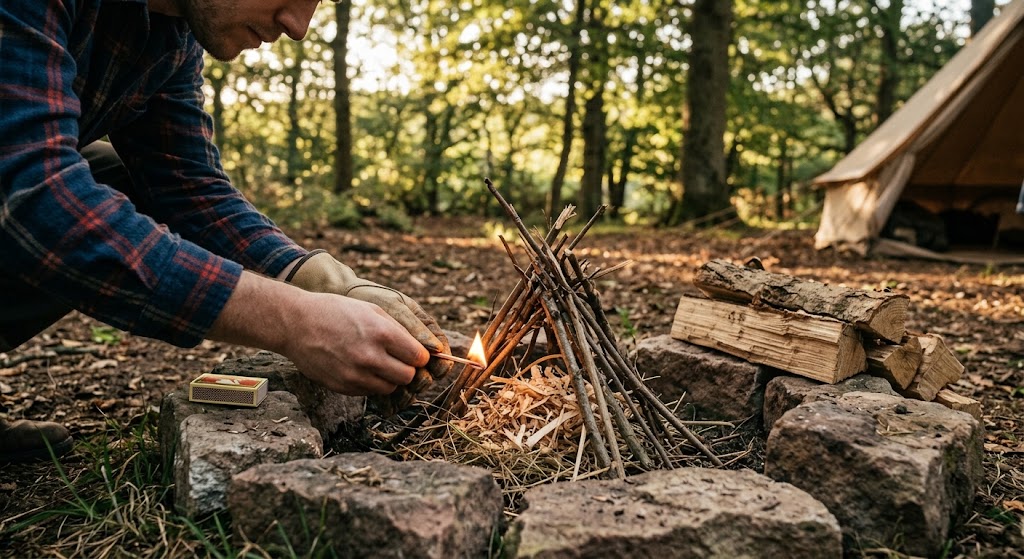
What Is a Tepee Fire Lay?
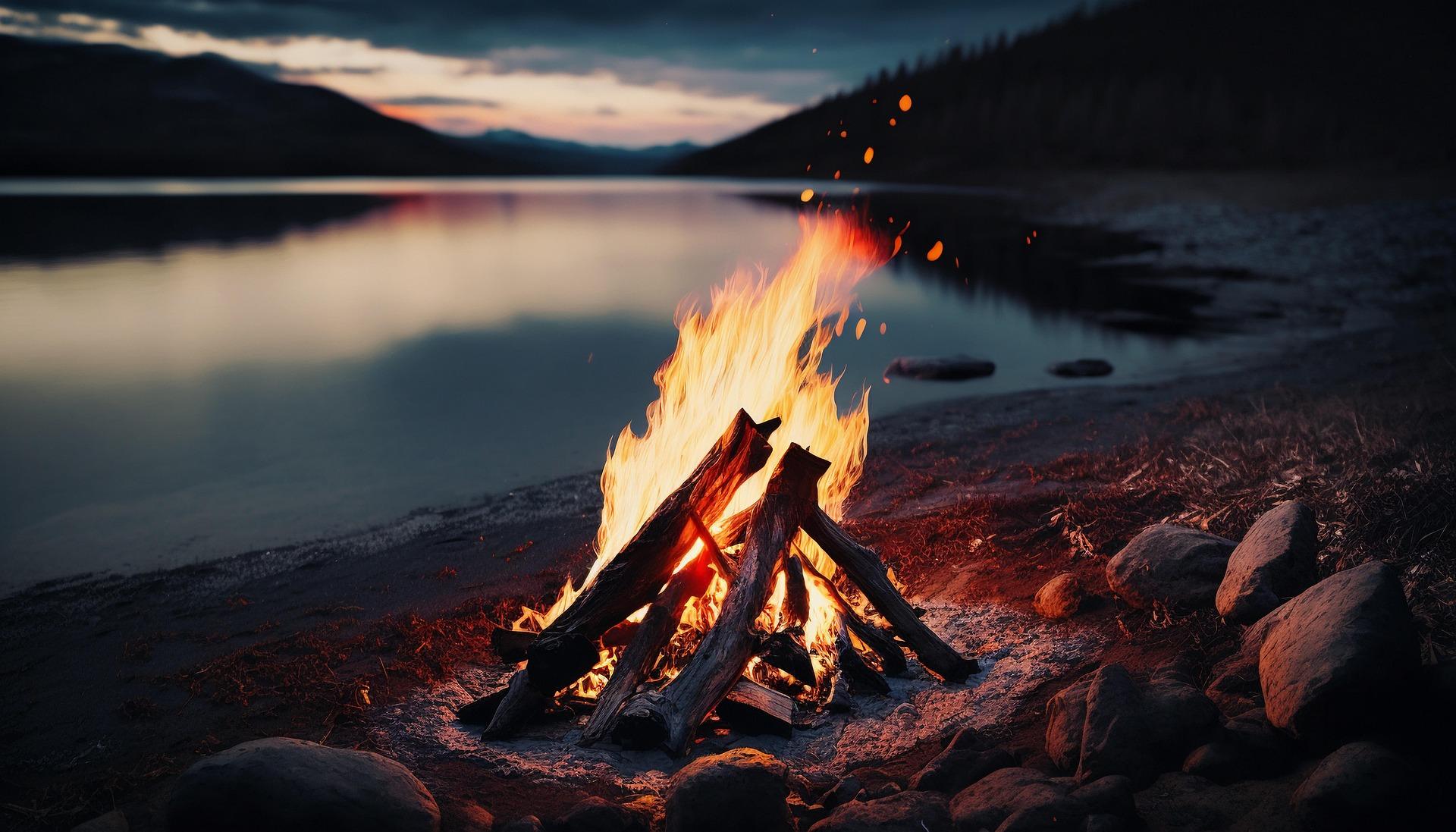
The tepee fire lay is one of the most recognisable fire lays.
The kindling and fuel are arranged around the tinder in a roughly cone-shaped structure.
As the fire burns, the flames rise through the centre and heat the surrounding wood.
Why use it?
A tepee-style arrangement can:
- Encourage upward airflow
- Concentrate heat around the centre
- Help smaller kindling ignite surrounding fuel
- Be relatively quick to construct
It’s often used when the aim is to get a fire established fairly quickly.
What Is a Log Cabin Fire Lay?
A log cabin fire lay uses pieces of wood arranged in alternating layers.
The pieces are placed roughly parallel to one another, with the next layer running across them.
The result looks a little like a miniature log cabin.
Why use it?
The structure can:
- Allow airflow
- Create a stable arrangement
- Provide space around the centre of the fire
- Build a larger fire gradually
It can be particularly useful when you want a more substantial fire structure.
What Is a Lean-To Fire Lay?
A lean-to fire lay uses a larger piece of wood as a support.
Smaller pieces of kindling are arranged leaning against it, with the tinder underneath or within the protected area.
Why use it?
A lean-to arrangement can be useful when:
- You want to protect the initial flame
- Wind is affecting the fire
- You need a simple structure
- You’re working with limited material
The important consideration is always safe airflow.
Don’t pack the fuel so tightly that oxygen can’t reach the fire.
What Is a Long Fire?
A long fire is designed to produce a longer area of heat rather than concentrating everything into one small central fire.
It can be useful in some outdoor and bushcraft situations, particularly where people need warmth along the length of a shelter.
However, this type of fire requires considerable care.
It needs:
- Appropriate space
- Good fire management
- Suitable fuel
- Careful supervision
- A safe method of extinguishing it
A long fire isn’t appropriate for every campsite or environment.
What Is a Star Fire?
A star fire uses several larger logs arranged with their ends meeting towards the centre.
The logs can be moved towards the centre as they burn.
This means the fire can be maintained without constantly adding lots of smaller pieces of wood.
Star-style fires can be useful when a controlled, longer-burning fire is required.
However, they still need proper supervision and a suitable location.
What Is a Platform Fire Lay?
A platform fire lay uses a layer of fuel or suitable material to create a base on which the main fire is built.
This can be useful where the ground is:
- Damp
- Wet
- Cold
- Snow-covered
The raised structure can help separate the fire from wet ground and provide a more suitable surface for the initial fire.
The exact construction should depend on the environment and local fire rules.
What Is a Dakota Fire Hole?
A Dakota fire hole is a type of below-ground fire arrangement involving connected holes that allow air to reach the fire.
It is sometimes described as a discreet or efficient fire.
However, it is important not to assume that because a fire is below ground it is automatically safe.
It can still:
- Cause burns
- Spread underground
- Damage roots
- Damage soil
- Be difficult to extinguish completely
Before considering any type of below-ground fire, check whether fires are permitted and whether digging is allowed.
Which Fire Lay Should You Use?
There’s no single “best” fire lay.
The right choice depends on:
- What you need the fire for
- Available fuel
- Weather
- Wind
- Ground conditions
- Fire regulations
- Location
- How long the fire needs to burn
For example:
|
Fire Lay |
Typical Strength |
|---|---|
|
Tepee |
Quick initial fire |
|
Lean-to |
Simple and adaptable |
|
Log cabin |
Stable, good airflow |
|
Star |
Longer-burning fire |
|
Long fire |
Extended warmth |
|
Platform |
Useful on damp ground |
These aren’t strict rules. Different fire lays can be adapted to different circumstances.
Fire Lay vs Fire Lighting
These are two different things.
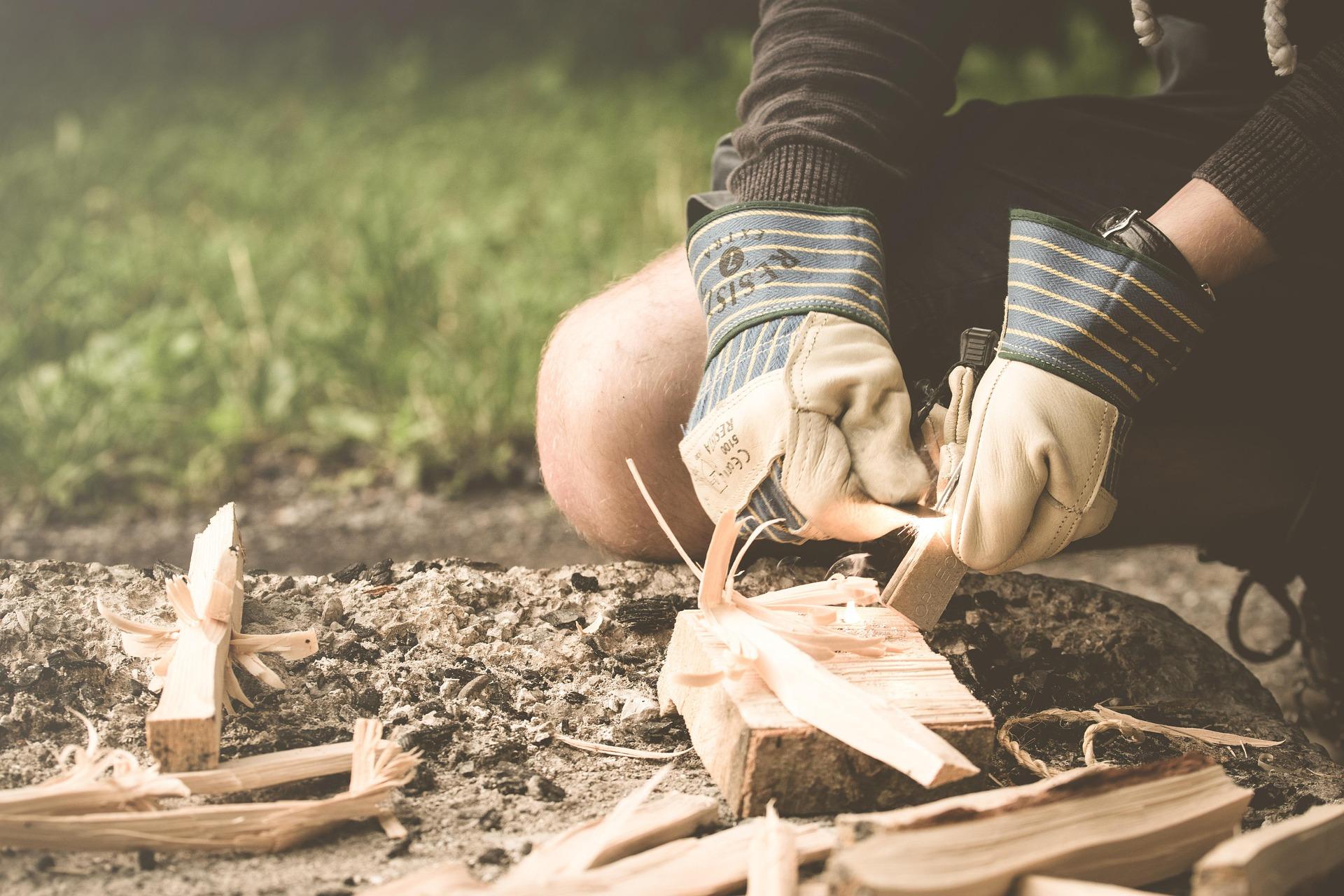
Fire lighting is the process of getting the fire started.
Fire lay is the arrangement of the materials used to help it burn.
For example:
You might use a firesteel to create a spark.
That’s fire lighting.
You might arrange tinder and kindling in a tepee shape.
That’s the fire lay.
Together, they help you establish the fire.
Fire Lay and the Fire Triangle
Understanding the fire triangle makes fire lays much easier to understand.
The three parts are:
Heat
The fire needs enough heat to ignite the next stage of fuel.
Fuel
Something has to burn.
Oxygen
The fire needs oxygen to continue burning.
A fire lay helps manage the relationship between these three things.
Too much fuel packed together can restrict airflow.
Too little fuel can allow the fire to die before it develops.
The goal is to create an arrangement where the fire can grow gradually.
🧠 A GOOD FIRE LAY
A good fire lay doesn’t simply contain lots of wood.
It provides:
Enough fuel + enough airflow + a sensible progression from small to larger material.
Why Does Airflow Matter?
Fire needs oxygen.
That’s why you shouldn’t simply create a dense pile of wood.
A fire lay creates spaces between pieces of fuel.
These spaces allow air to move through the structure.
This is particularly important when starting a fire.
If the arrangement is too tightly packed, the fire may:
- Smoulder
- Produce lots of smoke
- Struggle to grow
- Go out
If it’s too open, the small flame may not generate enough heat to ignite the next stage of fuel.
It’s about finding the right balance.
Does More Wood Mean a Bigger Fire?
Not necessarily.
Adding too much fuel too quickly can actually make a new fire less effective.
The smaller flame may not be able to heat the larger pieces enough to ignite them.
This is why good fire management generally involves gradually increasing the size and amount of fuel.
Think:
Small → Medium → Large
rather than:
Tiny flame → Huge pile of logs
Fire Lays and Cooking
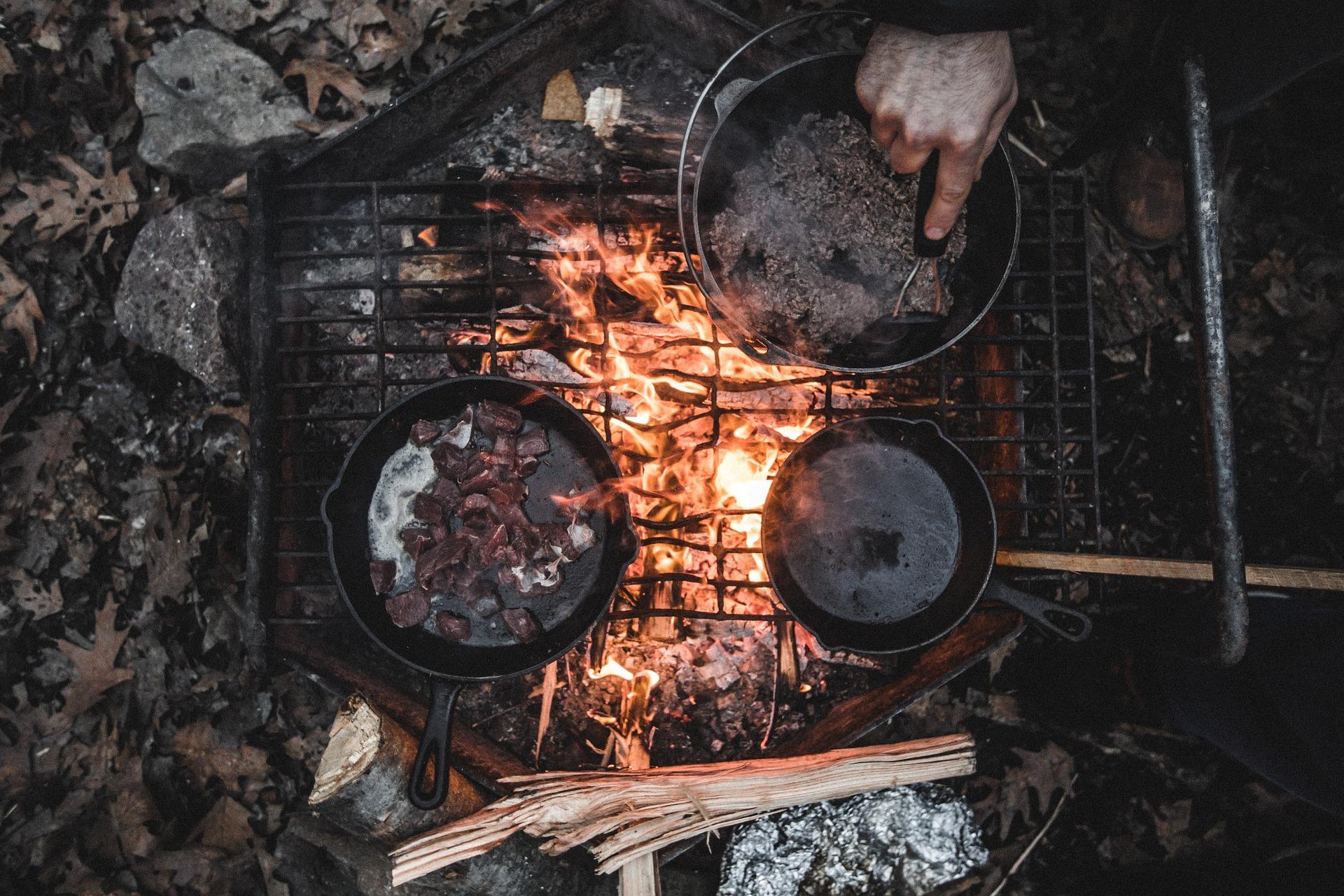
The best fire lay for warmth isn’t necessarily the best arrangement for cooking.
Cooking often benefits from:
- A stable fire
- A suitable bed of embers
- Controlled heat
- A safe cooking position
For some cooking methods, a large flame is actually less useful than a good bed of hot embers.
This is another reason why understanding how a fire develops is more important than simply knowing the names of different fire lays.
Fire Lays and Warmth
If your main objective is warmth, you may want to think about:
- Where people will sit
- Wind direction
- The size of the fire
- The distance from the fire
- Whether a reflector is appropriate
- How long the fire needs to burn
Remember that a fire should never be placed where it could ignite a shelter, vegetation or other combustible material.
Fire Lays and Wind
Wind can dramatically affect a fire.
It can:
- Increase the rate of burning
- Blow sparks
- Spread embers
- Make lighting difficult
- Change the direction of flames
Before lighting a fire, consider:
Where is the wind coming from?
Where could sparks travel?
What is around the fire?
Could the fire spread?
A fire lay should never be used as an excuse to ignore dangerous conditions.
If conditions aren’t suitable for a fire, don’t light one.
Do Fire Lays Work With Wet Wood?
A fire lay can’t magically make wet wood burn well.
Wet fuel requires more energy to evaporate the moisture before it can burn effectively.
This is why understanding fuel selection and preparation is just as important as the arrangement of the wood.
Dry, suitable tinder and kindling are particularly important when establishing a fire.
Common Fire Lay Mistakes
Using fuel that’s too large
A tiny flame won’t easily ignite a large log.
Packing everything too tightly
The fire may not receive enough oxygen.
Adding too much wood
You can smother a developing fire.
Ignoring wind
Wind can turn a small fire into a serious hazard.
Building too large a fire
More isn’t necessarily better.
Choosing the wrong location
Even a perfectly constructed fire lay can be dangerous in the wrong place.
Leaving the fire unattended
Never assume a fire is safe simply because it looks small.
Do You Need to Know Lots of Fire Lays?
No.
For beginners, understanding the principles is more important than memorising dozens of names.
If you understand:
Tinder → Kindling → Fuel
and:
Heat + Fuel + Oxygen
you already understand the foundations.
From there, you can learn different fire lays and understand why they work.
Fire Lays and Scouts
Fire lays are a great practical way for Scouts and other young people to learn about fire behaviour.
They can demonstrate:
However, activities involving fire should always be carried out under appropriate adult supervision and according to the relevant Scouting and site rules.
The emphasis should be on safe fire management, not simply getting the biggest fire.
A Simple Way to Think About Fire Lays
Rather than memorising:
“This is a tepee.”
“This is a log cabin.”
“This is a star.”
ask:
What do I want the fire to do?
Do I need:
A quick-starting fire?
A stable fire?
A longer-burning fire?
A cooking fire?
A fire for warmth?
Then consider which arrangement best suits the situation.
That’s much more useful than simply knowing a list of fire lay names.
Fire Lay Checklist
Before lighting an outdoor fire, ask:
Final Thoughts
So, what is a fire lay?
At its simplest:
A fire lay is the way you arrange tinder, kindling and fuel to help a fire start and burn effectively.
Different arrangements have different advantages.
A tepee can help concentrate heat and encourage upward airflow.
A log cabin provides a stable structure with spaces for airflow.
A lean-to can help protect a small starting fire.
Other arrangements can be designed for longer burning or particular outdoor conditions.
But the name of the fire lay isn’t the most important thing.
Understanding heat, fuel and oxygen is.
And above all, remember that a well-built fire isn’t necessarily a safe fire.
Location, conditions, supervision and extinguishing the fire properly are just as important as how you arrange the wood.
🔥 THE SIMPLE DEFINITION
A fire lay is simply the arrangement of materials that helps a fire start, grow and burn in a controlled way.
Start small, allow airflow, add fuel gradually and always put safety first.
🔗 Explore More Fire Skills
This article would work particularly well as part of your existing fire content:
- What Is Bushcraft? — an introduction to practical outdoor skills.
- Fire Safety — understand the risks before lighting a fire.
- How to Light a Fire Safely — the basics of getting a fire started.
- Fire Maintenance — keeping an established fire under control.
- Campfires — planning and managing a safe outdoor campfire.
- Extinguishing Fires — making sure a fire is completely out.
- Staying Warm — other ways to manage warmth outdoors.
🔒Ready to test your survival skills?
Join Survival Guides UK for free, complete challenges, earn badges and increase your Survival Level.
JOIN FREE →
CRAIG BURR
FOUNDER · SURVIVAL GUIDES UK
I'm Craig, the person behind Survival Guides UK. I created SGUK because I wanted somewhere people could learn real outdoor skills in a practical, straightforward way — from lighting a fire and tying knots to navigation, campcraft and everything in between.
You can read more about the story behind SGUK here as well as our approach here.