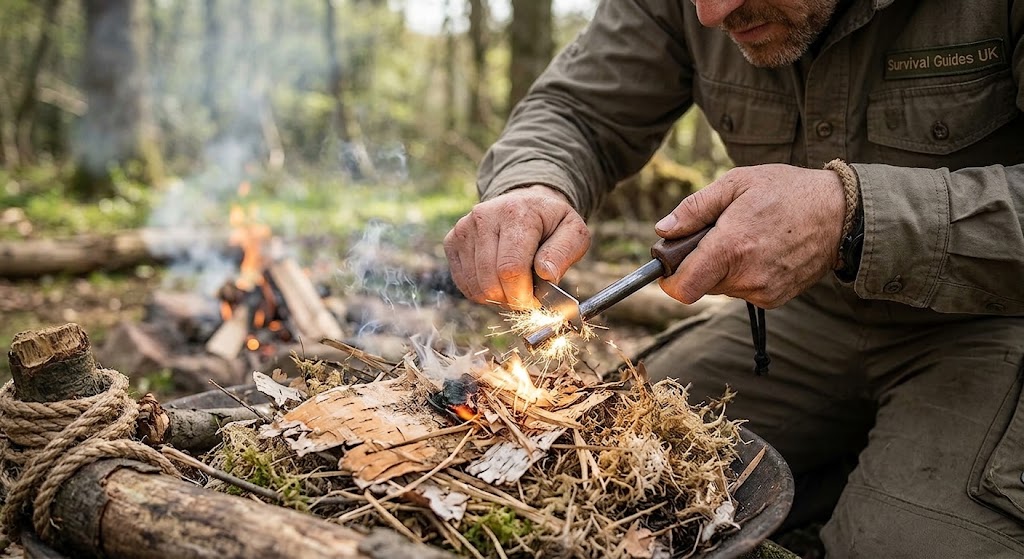
Fire Safety in Windy Weather
Wind can make an outdoor fire much more difficult to manage.
A fire that appears calm in still conditions can behave very differently when the wind picks up. Flames can lean to one side, sparks can travel further and burning material can be disturbed or carried away from the main fire.
For Scouts and leaders, understanding the effect of wind is an important part of responsible fire safety. It isn’t simply a matter of building the fire differently. Sometimes the safest decision is to reduce the fire, postpone the activity or not light it at all.
Why Is Wind a Fire Hazard?
Wind supplies a fire with plenty of oxygen, which can cause it to burn more vigorously.
It can also push flames towards nearby objects and carry sparks and embers beyond the fire area.
This creates several potential problems.
A fire can become hotter and more difficult to control, while dry grass, leaves, wood or other combustible materials nearby may be more likely to catch.
Wind can also change direction or become stronger during an activity, so conditions need to be monitored rather than assessed only once.
Check the Wind Before Lighting a Fire
The first question should be whether the conditions are suitable for a fire at all.
Look at the strength and direction of the wind before starting.
Consider whether the wind is:
A light breeze may be manageable in an appropriate location, but stronger or unpredictable winds can make a fire increasingly difficult to control.
If conditions are unsuitable, don’t light the fire.
Look at What Is Downwind
Wind direction is particularly important.
Identify what is located downwind of the proposed fire site.
This could include:
If a spark or ember travels in the direction of these hazards, the consequences could be serious.
A suitable fire site needs enough separation from combustible materials in all relevant directions, not just immediately around the fire.
Sparks Can Travel Further Than You Expect
A small spark may not appear dangerous when it leaves a fire.
However, wind can carry sparks and embers surprisingly far.
An ember landing in dry grass or other combustible material can potentially start another fire.
This is why windy conditions require a particularly careful assessment of the surrounding area.
Don’t rely on the fire itself remaining small.
Watch for Dry Vegetation
Wind and dry vegetation can create a particularly dangerous combination.
Dry grass, leaves, bracken and other dead vegetation can ignite readily.
If wind is carrying sparks towards these materials, the risk increases.
During periods when vegetation is particularly dry, leaders should consider whether an outdoor fire is appropriate at all.
Wind Can Change Direction
Don’t assume that the wind will remain in the same direction throughout the activity.
Outdoor wind can change as weather conditions develop or as local terrain affects airflow.
A fire that initially appears to have a safe downwind area may become less suitable if the wind changes.
Continue monitoring conditions throughout the activity.
Gusts Are Particularly Difficult
A steady breeze is generally easier to anticipate than sudden gusts.
A gust can cause flames to flare unexpectedly or send sparks beyond the usual fire area.
If the wind is gusting strongly, the fire may be difficult to manage safely.
This is a situation where postponing the activity can be the most sensible decision.
Don’t Build a Bigger Fire Than Necessary
Wind can make a fire burn more strongly.
Adding more fuel can therefore create a much larger fire than intended.
Keep the fire appropriately sized for its purpose.
A cooking fire doesn’t need to become a large campfire, and a demonstration doesn’t need a substantial amount of burning fuel.
Small, controlled fires are generally easier to manage than unnecessarily large ones.
Don’t Use Improvised Windbreaks
It can be tempting to build a makeshift wall from tarpaulins, branches, wood or other materials to protect a fire from the wind.
This can create additional hazards.
Combustible materials placed close to a fire can catch alight, while fabric or synthetic materials can melt or ignite.
Don’t use a structure as a windbreak unless it has been specifically designed and approved for that purpose and the arrangement is appropriate for the activity.
If the wind is too strong for the fire to be safely managed, the answer isn’t necessarily to shield it.
It may be better not to light it.
Keep Tents Well Away
Wind can carry sparks towards tents and shelters.
Camping fabrics may ignite or melt when exposed to heat and flames.
Make sure tents, shelters and camping equipment are positioned safely away from the fire and take wind direction into account.
Remember that the safe distance may need to be greater when conditions are windy.
Keep Firewood Away From the Fire
Extra firewood should not be stored immediately beside a campfire.
Wind can carry sparks towards the wood pile.
Keep fuel in a suitable location away from the fire and only bring additional wood forward when it is needed.
This also reduces clutter around the fire area.
Watch the Fire Closely
Windy conditions require increased awareness.
Watch for:
If the fire begins behaving differently, reassess the situation rather than simply carrying on.
What If the Wind Increases?
If conditions deteriorate, stop adding fuel.
Assess whether the fire can still be safely controlled.
If necessary, begin extinguishing it while there is still plenty of time to do so.
Don’t wait until the fire becomes difficult to manage.
A leader should always be prepared to change the plan when conditions change.
Don’t Try to Hold a Fire Together
If wind begins disturbing the structure of a fire lay, don’t attempt to fix it while flames are dangerously strong.
Moving burning wood can cause sparks and embers to escape.
If the fire has become difficult to control, the priority is to keep people safe and extinguish it using the appropriate method.
Smoke Can Become a Problem
Wind can push smoke directly towards Scouts.
Smoke can irritate the eyes and respiratory system and can make it difficult to see.
People may move suddenly to escape smoke, creating additional hazards around the fire.
Pay attention to where smoke is travelling and keep Scouts positioned appropriately.
Wind and Campfire Seating
Think about the position of Scouts around the fire.
If the wind regularly blows smoke towards one side, people sitting there may become uncomfortable and start moving around.
Keep seating far enough from the fire and arrange the group so that movement doesn’t create additional risks.
The fire should never be positioned simply to make the seating arrangement convenient.
Cooking in Windy Conditions
Cooking over an outdoor fire can become more difficult in wind.
Flames can move unpredictably around cookware, and hot pans or cooking equipment can become more difficult to handle.
Wind can also make it harder to control the heat.
If conditions are unsuitable, consider using a safer alternative rather than attempting to cook over an unstable fire.
Fire-Control Equipment
Appropriate fire-control equipment should be available before lighting a fire.
The exact equipment will depend on the activity, fire and location.
Water may be suitable for many campfires, but leaders should follow the arrangements specified for the particular site and activity.
Make sure equipment is accessible rather than stored somewhere that cannot be reached quickly.
When You Shouldn’t Light a Fire
There are situations where the safest decision is simply not to light a fire.
These include circumstances such as:
There is no requirement to continue with a fire activity just because it was included in the programme.
A good outdoor leader knows when to change the plan.
If a Fire Starts Spreading
If flames or embers begin spreading beyond the intended fire area, treat the situation seriously.
Keep Scouts away from the fire and follow the emergency procedures for the activity and site.
If the fire cannot be controlled safely, move everyone to a safe location and contact the emergency services.
In the UK, call 999 and ask for the Fire and Rescue Service if there is an emergency requiring their assistance.
Don’t put yourself or Scouts in danger attempting to control a fire that has become uncontrollable.
Teaching Scouts About Wind
Wind provides a useful opportunity to teach Scouts that outdoor conditions affect everything they do.
Before a fire activity, ask Scouts to identify the wind direction.
Then ask:
“Where would sparks go?”
“What’s downwind?”
“What would happen if the wind changed?”
This encourages Scouts to think beyond the fire itself and consider the wider environment.
The decision about whether a fire is safe to light should remain with the appropriately responsible adult.
Wind and Fire Lays
Different fire lays may behave differently in windy conditions.
However, Scouts should not be taught that choosing a particular fire lay makes a strong wind safe.
The surrounding environment, fire size, fuel, weather and site conditions all matter.
Understanding fire lays is useful, but good fire safety comes from assessing the whole situation.
Extinguishing a Fire in Windy Conditions
Don’t leave extinguishing a fire until the last possible moment if wind conditions are deteriorating.
Stop adding fuel and begin the process early enough to maintain control.
Once the fire has been extinguished, check the surrounding area for escaped embers and hot material.
Wind may have carried burning material beyond the original fire area.
A careful final inspection is particularly important after a windy fire.
Environmental Responsibility
Windy fires can increase the chance of fire spreading into vegetation.
Avoid lighting fires in areas where sparks could reach sensitive or combustible ground.
Never deliberately burn vegetation to clear an area for a campfire.
Use established fire areas where possible and follow the site’s rules.
If conditions create an increased risk of environmental damage, choose another activity.
Final Thought for Leaders
Wind is one of those outdoor conditions that can change a safe activity into an unsafe one surprisingly quickly.
Don’t focus only on what is happening inside the fire. Look at where sparks could travel, what is downwind, how the weather is changing and whether the group can still safely manage the situation.
Most importantly, don’t be afraid to cancel a fire.
Knowing when not to light a fire is an important part of knowing how to manage one.
🔒Ready to test your survival skills?
Join Survival Guides UK for free, complete challenges, earn badges and increase your Survival Level.
JOIN FREE →
CRAIG BURR
FOUNDER · SURVIVAL GUIDES UK
I'm Craig, the person behind Survival Guides UK. I created SGUK because I wanted somewhere people could learn real outdoor skills in a practical, straightforward way — from lighting a fire and tying knots to navigation, campcraft and everything in between.
You can read more about the story behind SGUK here as well as our approach here.