15 Outdoor Skills You Can Practise in Your Back Garden
You don’t need to travel to a campsite, climb a mountain or head deep into the countryside to practise outdoor skills.
A back garden can be a surprisingly useful training ground.
Many of the skills used while camping, hiking and exploring can be practised at home. For children and young people, this can be a great way to build confidence before trying them on a larger outdoor adventure.
Some activities require nothing more than a few metres of space and some basic equipment.
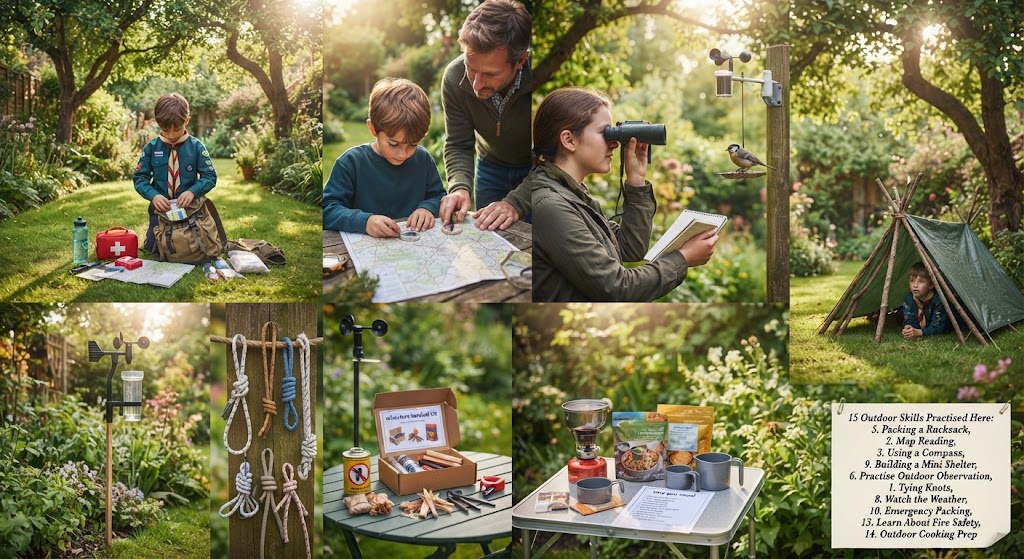
Here are 15 outdoor skills you can practise in your own garden.
1. Practise Tying Knots
Knots are one of the easiest outdoor skills to practise at home.
All you need is some rope or suitable cord.
Start with simple knots and gradually introduce more challenging ones.
You could practise:
- Reef knot
- Clove hitch
- Bowline
- Sheet bend
- Round turn and two half hitches
- Figure-eight knot
- Taut-line hitch
Don’t just learn how to tie each knot.
Learn what it is actually useful for.
A good challenge is to have someone name a knot and see how quickly you can tie it correctly.
2. Learn Basic Map Reading
You can practise map reading without going anywhere.
Take a suitable local map and find:
- Roads
- Footpaths
- Streams
- Buildings
- Woods
- Hills
- Bridges
- Other landmarks
Try to work out how the map represents the area around your home.
You can also practise identifying grid lines and finding simple grid references.
3. Practise Using a Compass
A garden gives you somewhere safe to practise basic compass skills.
Learn to:
- Identify north
- Take a bearing
- Follow a bearing
- Turn through a set number of degrees
- Estimate directions
Start with very short distances.
For example, set a bearing and ask someone else to place a marker at the destination.
Then increase the difficulty.
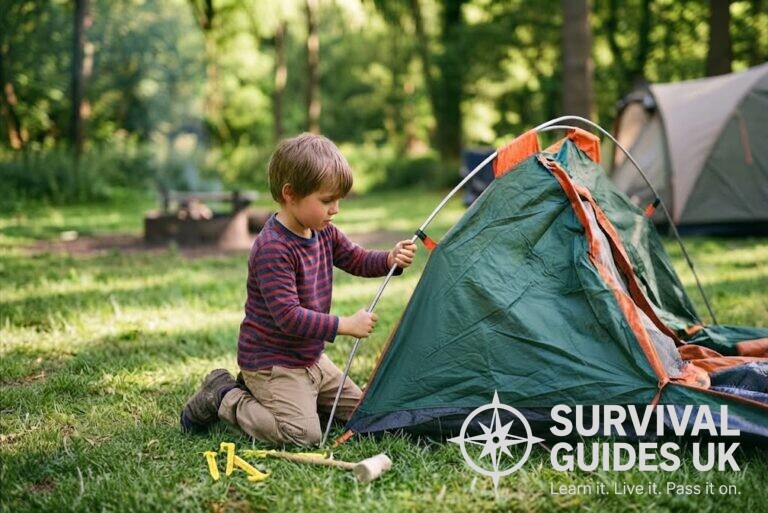
4. Pitch a Tent
You don’t need to be camping to practise putting up a tent.
Choose a suitable area and see how quickly you can pitch it correctly.
Then practise taking it down and packing it away.
Try doing it in different conditions if appropriate.
You may discover that packing a tent neatly is considerably harder than putting it up.
5. Pack a Rucksack
Lay out everything you might need for a day outdoors.
Then decide what belongs in the rucksack and where it should go.
Think about:
- Weight distribution
- Waterproofing
- Accessibility
- Emergency equipment
- Food
- Water
- Spare clothing
Once packed, put the rucksack on.
Does it feel comfortable?
Can you reach the things you might need quickly?
6. Practise Outdoor Observation
Choose a spot in the garden and spend five minutes simply observing.
Write down everything you notice.
Try again for ten minutes.
Then see whether you spotted more the second time.
You can look for:
- Birds
- Insects
- Plants
- Tracks
- Sounds
- Weather changes
- Animal activity
This is a surprisingly useful skill for wildlife walks.
7. Try a Mini Nature Survey
Choose a small section of the garden.
Count how many different types of plant, insect or bird activity you can find.
You don’t necessarily need to identify everything.
Instead, concentrate on observing differences.
For example:
“Three different leaf shapes.”
“Two different types of insect.”
“Four different bird calls.”
This can become a simple challenge for younger children.
8. Watch the Weather
Spend a few minutes each day observing the sky.
Record:
- Cloud types
- Wind direction
- Wind strength
- Temperature if you have a thermometer
- Rain
- Changes in cloud cover
Then compare your observations with the weather forecast.
Over time, you’ll begin to notice how conditions change.
9. Build a Mini Shelter
You can practise shelter design without creating a full-size survival shelter.
Use sticks, a tarp, cord or other suitable materials.
The challenge is to create something that provides protection from wind or rain.
For younger children, keep the activity simple.
For older Scouts or Explorers, introduce a time limit or design requirements.
For example:
“Build a shelter that could protect one person from wind using these materials.”
10. Practise Emergency Packing
Imagine that you’re going on a short walk and the weather suddenly becomes cold and wet.
What would you want in your rucksack?
Create a small emergency kit and explain the purpose of each item.
Possible items include:
- Torch
- Emergency whistle
- Waterproof clothing
- Emergency shelter
- First aid supplies
- Food
- Water
- Navigation equipment
- Spare power source
The aim is not to create the biggest possible kit.
It’s to understand why each item might be useful.
11. Try a Memory Challenge
Place ten outdoor objects on a table.
Give everyone 30 seconds to look at them.
Cover the objects.
How many can they remember?
Make it harder by increasing the number of objects or reducing the viewing time.
This can help develop observation skills that are useful outdoors.
12. Practise Following Directions
Give someone a series of instructions such as:
“Walk ten steps north.”
“Turn east.”
“Walk five steps.”
“Turn south.”
See whether they can follow the instructions accurately.
You can combine this with a compass to make a simple navigation exercise.
Always keep the activity in a safe area free from obstacles and hazards.
13. Learn About Fire Without Lighting One
Fire skills don’t always require an actual fire.
You can learn about:
- Fire safety
- Tinder
- Kindling
- Fuel
- Different fire lays
- Safe fire locations
- How fires are extinguished
- Wind direction
- Fire hazards
You can also practise identifying suitable tinder and kindling materials without actually lighting them.
This makes a useful introductory activity for younger children.
14. Practise Outdoor Cooking Preparation
Even if you aren’t allowed to use a fire or stove, there are plenty of cooking skills you can practise.
Try preparing food that could be suitable for a camping trip.
Practise:
- Measuring ingredients
- Safe food preparation
- Cleaning equipment
- Packing ingredients
- Planning portions
- Storing food safely
Older participants can design a simple one-pot camping meal using a limited list of ingredients.
15. Create Your Own Outdoor Challenge
Once you’ve practised several skills, combine them.
For example, create a garden expedition.
Participants must:
- Pack a small rucksack.
- Follow a compass bearing.
- Find a hidden object.
- Tie a specified knot.
- Identify three plants.
- Complete a weather observation.
- Build a small shelter.
- Explain what they would take on a real hike.
This turns individual skills into a mini adventure.
Making Garden Activities More Challenging
The same activity can be adapted for different ages.
For younger children, concentrate on simple observation, identification and basic practical skills.
For older children, add:
- Time limits
- Navigation
- Problem solving
- Teamwork
- Limited equipment
- Multiple stages
You can also allow participants to design their own challenges.
Outdoor Skills Don’t Need to Wait for Camp
One of the biggest advantages of practising at home is that you can repeat the activity.
You don’t have to wait for the next camp to practise tying knots.
You don’t have to wait for a hike to use a compass.
You don’t have to wait for a woodland visit to practise observation.
A few minutes in the garden can build skills that become much more useful when you’re eventually out on a real adventure.
Start with one skill.
Practise it.
Then add another.
Before long, your garden can become your own small outdoor training ground.
🔒Ready to test your survival skills?
Join Survival Guides UK for free, complete challenges, earn badges and increase your Survival Level.
JOIN FREE →
CRAIG BURR
FOUNDER · SURVIVAL GUIDES UK
I'm Craig, the person behind Survival Guides UK. I created SGUK because I wanted somewhere people could learn real outdoor skills in a practical, straightforward way — from lighting a fire and tying knots to navigation, campcraft and everything in between.
You can read more about the story behind SGUK here as well as our approach here.