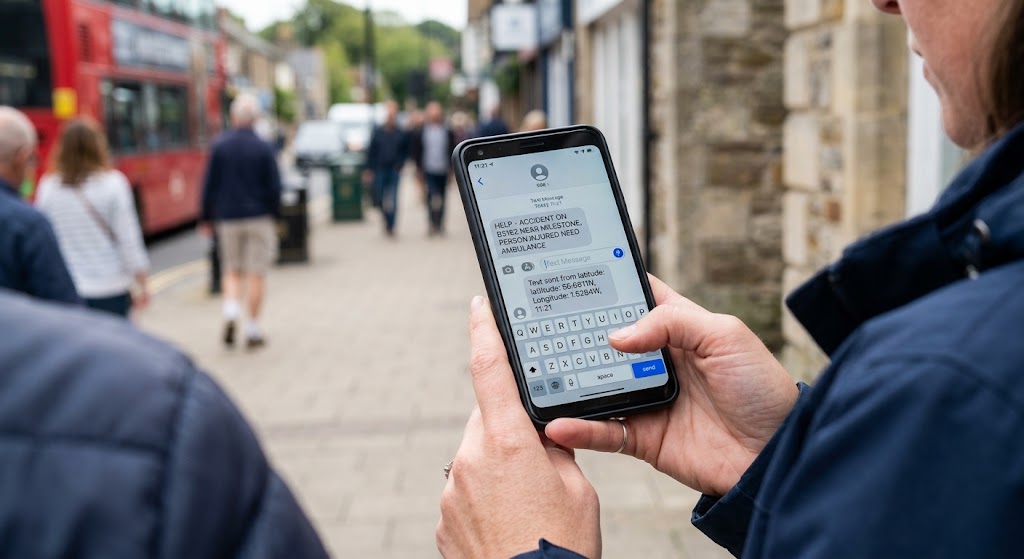
How to Register for Emergency SMS
If you are somewhere with a mobile signal but cannot make a voice call to the emergency services, the UK’s Emergency SMS service can provide another way to contact 999. It can be particularly useful for people who are deaf, hard of hearing or have a speech impairment, but it can also provide an alternative in some situations where making a voice call isn’t possible.
The important thing is to register before you need it. You cannot simply assume that sending a text to 999 will work if your phone number has not been registered.
What Is Emergency SMS?
Emergency SMS allows you to contact the emergency services by sending a text message to 999.
Your message can be passed to the appropriate emergency service, including police, fire, ambulance or coastguard, depending on what has happened.
Unlike a normal text conversation, this is an emergency service. You should only use it when you genuinely need emergency assistance.
Register Before You Need It
You need to register your mobile number for the service in advance.
To register, send a text message containing:
REGISTER
to:
999
You will receive a reply explaining what to do next. Follow the instructions in the reply to complete the registration.
Registration is free. (Relay)
Don’t wait until you are already dealing with an emergency to discover that your number isn’t registered.
Check That Your Registration Is Complete
The registration process involves replying to the messages you receive.
Follow the instructions carefully and wait for confirmation that your mobile number has been registered.
If you change your mobile number, don’t assume that your new number will automatically be registered. Check the current registration requirements before relying on the service.
How to Use Emergency SMS
If you need emergency assistance and cannot make a voice call, send a text message to 999.
Start by saying which emergency service you need, for example:
AMBULANCE
Then provide the information the emergency service needs.
Explain what has happened and give your location as accurately as possible.
For an outdoor emergency, your location might include a grid reference, named path, road, landmark, postcode, nearby building or other information that could help rescuers find you.
Give Your Location First
When you’re outdoors, your location can be more important than a detailed description of the incident.
If someone has suffered a serious injury on a walk, for example, tell the emergency service where you are and what has happened.
Include as much useful location information as you can without delaying the message.
If you have a grid reference from a map or GPS device, give it to the emergency service. If you are near a recognisable landmark, mention that as well.
Keep Your Messages Clear
Emergency SMS is text-based, so keep your messages short and clear.
You should provide:
- Which emergency service you need
- What has happened
- Your location
- Whether anyone is injured or in immediate danger
- Any other information that could affect the response
Don’t use unnecessary abbreviations or spend time writing a long explanation.
Wait for a Reply
Once you have contacted Emergency SMS, stay available to respond to questions.
The emergency service may need more information before sending help. Keep your phone switched on and monitor your messages.
Don’t assume that silence means help is already on its way.
Follow the instructions you receive.
Emergency SMS Needs Mobile Signal
Emergency SMS still depends on your phone being able to connect to a mobile network.
If there is no mobile signal, you may not be able to send the message.
This is one reason outdoor emergency planning should never depend on a single method of communication. Carry a charged phone, know how to read a map and understand how to give your location to rescuers.
A Voice Call Is Usually Better When You Can Make One
If you can safely make a voice call to 999, do so.
A voice call allows the emergency operator to communicate with you immediately and ask questions about the situation.
Emergency SMS is particularly useful when a voice call isn’t possible or isn’t suitable.
Don’t choose text simply because it seems easier if you can safely make an emergency voice call.
Teach Children How to Get Help
Older children and young people who spend time outdoors should know how to contact emergency services.
They don’t necessarily need to memorise every detail, but they should understand that 999 is the emergency number and know how to describe where they are.
It is also worth teaching them to stay calm, give their location first and follow instructions from the emergency operator.
For organised groups, knowing the group’s location before an activity begins makes a major difference if something goes wrong.
Practise Giving Your Location
Registering for Emergency SMS is only part of being prepared.
Practise finding your location using the navigation equipment you normally carry. If you use a map and compass, learn how to obtain and communicate a grid reference. If you use a GPS device or phone, understand how to find your coordinates.
You don’t want to be learning these skills for the first time while someone is injured.
Don’t Rely on Emergency SMS Alone
Emergency SMS is a useful additional option, but it shouldn’t replace basic emergency planning.
Before heading outdoors, think about where you are going, how you will communicate if something goes wrong and how you will get help if your phone stops working.
A charged phone, navigation skills, appropriate clothing, first-aid knowledge and a sensible route plan all work together.
Remember the Basic Rule
Register before you need it.
Send REGISTER to 999, follow the reply instructions and wait for confirmation.
If you later need emergency assistance and cannot make a voice call, you can use Emergency SMS to contact the emergency services. Give your location clearly, explain what has happened and keep your phone available so you can respond to further questions.
🔒Ready to test your survival skills?
Join Survival Guides UK for free, complete challenges, earn badges and increase your Survival Level.
JOIN FREE →
CRAIG BURR
FOUNDER · SURVIVAL GUIDES UK
I'm Craig, the person behind Survival Guides UK. I created SGUK because I wanted somewhere people could learn real outdoor skills in a practical, straightforward way — from lighting a fire and tying knots to navigation, campcraft and everything in between.
You can read more about the story behind SGUK here as well as our approach here.