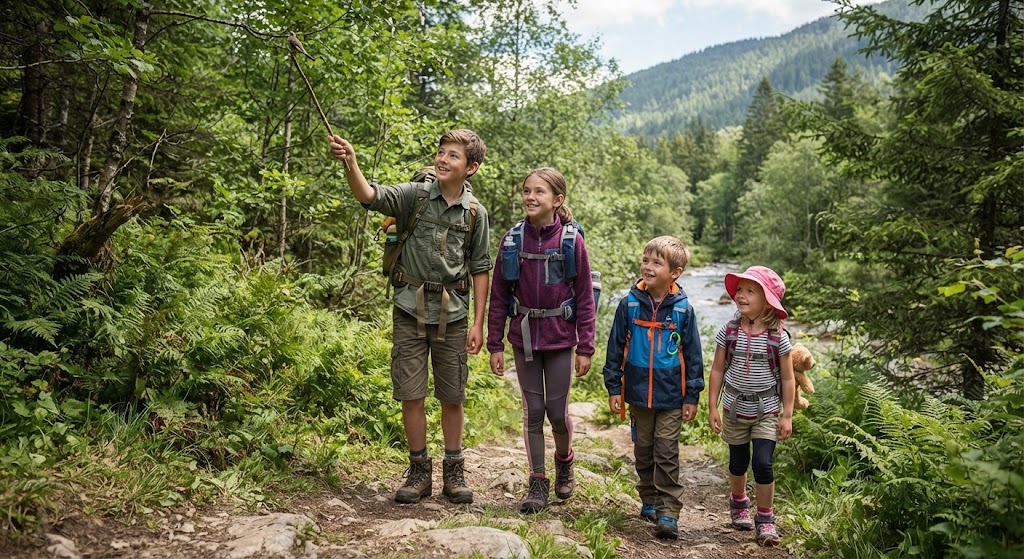
How Children Can Navigate a Short Route
Navigation doesn’t have to mean walking for miles with a map and compass. For children, learning to navigate can start with something much simpler: understanding where they are, knowing where they want to go and working out how to get there.
A short route is a great way to practise. It might be a walk around a campsite, a route through a woodland, a short trail in a park or simply a journey between a few recognisable landmarks. The aim isn’t to get everything right immediately. It’s to help children become comfortable looking around, making decisions and checking that they’re still going the right way.
What You’ll Learn
This guide will help children learn how to:
- Follow a short route using simple directions
- Use landmarks to recognise where they are
- Check their progress as they walk
- Understand the 3-3-3 rule
- Use the five Ds of navigation
- Become more confident when navigating outdoors
Start With a Short, Simple Route
The best first route is one that is short enough to complete without becoming tiring or confusing.
Choose somewhere familiar and reasonably safe, with obvious features such as paths, gates, bridges, benches, signs or distinctive trees. A route with three or four clear points to navigate between is plenty for a first attempt.
For example, a child might be asked to walk from a starting point to a gate, follow the path to a bridge, turn left and continue to a bench.
This is enough to introduce the basic idea of navigation without overwhelming them with too much information.
Before You Set Off
Give the child an opportunity to look at the route before they start.
Explain where they are starting and where they are going. Point out some of the features they should expect to see along the way and, if you’re using a map, show them where these features appear.
Don’t give them every answer. Ask questions instead.
“What do you think we’ll see first?”
“Which way do you think the path goes?”
“What will tell you that you’ve reached the right place?”
Questions like these encourage children to think about the route rather than simply following instructions without understanding them.
Follow One Instruction at a Time
Young navigators don’t need to remember an entire route in their heads.
Give them the next useful piece of information and let them work through the route one stage at a time. Once they’ve reached the first landmark, ask what they think they should do next.
This gradually develops the habit of looking ahead while still concentrating on where they are now.
As confidence grows, you can give them slightly longer sections to navigate independently.
Use Landmarks
Landmarks are one of the easiest ways for children to understand navigation.
A landmark is something recognisable that helps you identify where you are. It could be a bridge, gate, sign, large tree, stream, building or junction.
Instead of saying, “Walk 200 metres,” you could say, “Follow the path until you reach the wooden gate.”
The second instruction gives the child something they can actually look for.
Encourage them to notice landmarks themselves too. If they spot something distinctive, ask them whether it could help someone else describe the route.
The 3-3-3 Rule
The 3-3-3 rule can be used as a simple way of encouraging children to pay attention to their surroundings while navigating.
The idea is to look:
3 steps ahead — notice what’s immediately in front of you.
3 seconds around you — pause and take in your surroundings rather than staring only at the ground.
3 things that help identify where you are — for example, a path, a large tree and a gate.
The exact way you use the rule can be adapted to the child’s age and the activity. The important lesson is to develop the habit of regularly looking up, looking around and checking where you are.
Navigation becomes much harder when you’re only concentrating on your feet.
How to Help a Child Learn to Follow Directions?
The best way to teach directions is to let children do the thinking themselves.
Start with very simple instructions and gradually make them more complicated. Rather than constantly telling a child where to go, ask questions that encourage them to work it out.
For example:
“Which path do you think we need?”
“What landmark are we looking for?”
“Where did we last know exactly where we were?”
“What should we expect to see next?”
If they make a mistake, resist the temptation to immediately correct them. Stop and ask them to look again. Can they work out what happened?
This turns navigation into a problem-solving skill rather than simply teaching a child to obey a set of instructions.
The Five Ds of Navigation
The five Ds of navigation provide another useful way to think about finding your way outdoors:
Direction — Which way are you travelling?
Distance — How far have you travelled, or how far do you need to go?
Description — What does the route or surrounding landscape look like?
Destination — Where are you trying to get to?
Decision — What do you need to decide at the next point on the route?
These five ideas can be introduced gradually. A young child might simply be asked, “Which way are we going and what are we looking for?” An older or more experienced child can start thinking about distance, route descriptions and decisions at junctions.
The value of the five Ds is that they encourage children to think about navigation as a process rather than simply following a line on a map.
Check Your Position as You Go
A good navigator doesn’t wait until they’re completely lost before checking where they are.
Encourage children to stop occasionally and ask themselves:
Where am I?
Where have I just come from?
Where am I going next?
What tells me I’m in the right place?
These simple questions can prevent small mistakes from becoming big ones.
If something doesn’t look right, stop and check rather than continuing in the hope that the route will somehow correct itself.
What Are Some Fun Activities to Teach Following Directions?
Navigation can become much more enjoyable when children don’t realise they’re practising a skill.
Treasure Hunt
Create a short route using clues and landmarks. Each clue leads to the next location.
For younger children, the clues can be simple: “Find the big tree, then look for the path beside it.”
Leader Says
Play a navigation version of Simon Says. Give instructions such as “take three steps forwards”, “turn left” or “walk towards the gate”.
It helps children become comfortable listening carefully and turning instructions into movement.
Landmark Challenge
Give children a list of things to find along a route.
They might need to spot a bridge, gate, sign, bench and particular type of tree. This encourages them to look actively at their surroundings.
Follow My Route
One child leads another along a very short route using simple instructions. They then swap roles.
This is particularly useful because giving directions makes children think about the route from another person’s point of view.
Navigation Memory Game
Walk a short route together and then ask the child to describe it afterwards.
“How did we get from the gate to the bridge?”
“What did we pass?”
“Where did we turn?”
This helps develop route memory and observation.
What Should You Do If You Make a Wrong Turn?
Making a mistake is part of learning navigation.
The most important lesson is not to panic or keep walking simply because you don’t want to admit you’re unsure.
Stop. Think about where you last knew exactly where you were. Look around for the landmarks or features you expected to see. If you’re with a parent, leader or other responsible adult, tell them you’re unsure.
Children should never be encouraged to wander off alone to try to correct a navigation mistake.
Gradually Give Children More Responsibility
Once a child becomes comfortable following directions, start allowing them to make more decisions.
Instead of saying, “Turn left at the next junction,” you could ask, “Which way do you think we need to go?”
Later, you might give them a simple map and ask them to lead the group for part of the route.
The aim is to gradually move from following directions to understanding directions, and eventually to making sensible navigation decisions.
Build Towards Map and Compass Skills
Once children are confident navigating short routes using landmarks and simple instructions, they have a strong foundation for more advanced navigation.
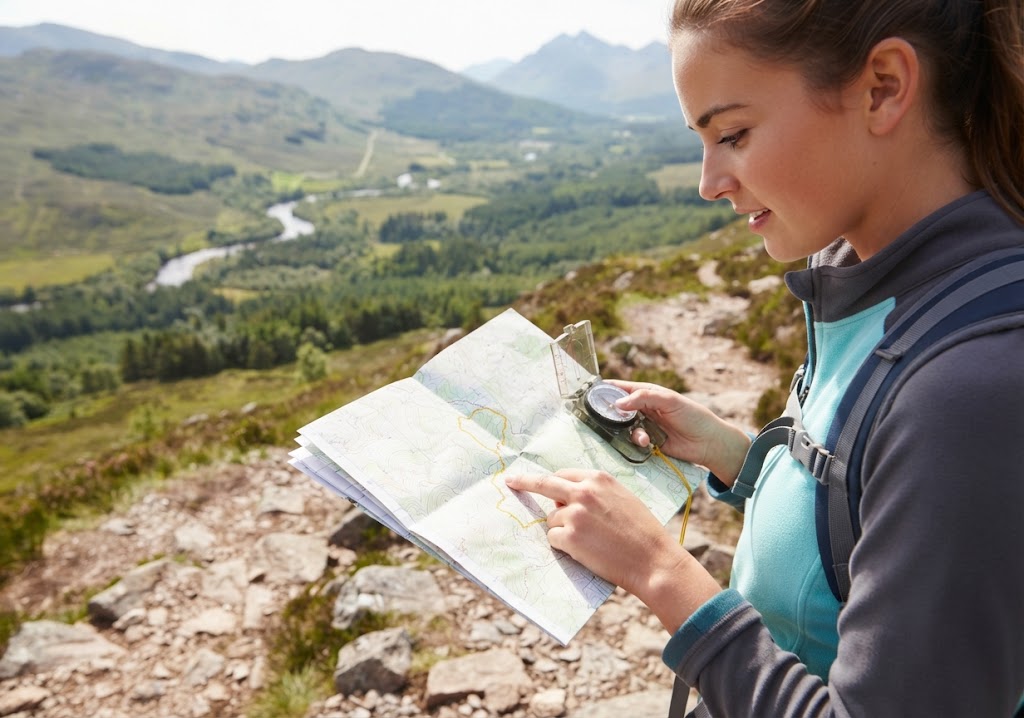
The next steps might include learning the four main directions, understanding map symbols, reading a simple map, measuring distance, using a compass and eventually following a planned route.
These skills are much easier to understand when a child already knows what it feels like to navigate somewhere in the real world.
Final Tip
Don’t make the first navigation challenge too difficult. A short route that a child successfully navigates themselves is far more valuable than a complicated route where an adult gives every instruction.
Let children look, think, make decisions and occasionally make mistakes in a safe environment. The goal isn’t simply to get them from A to B. It’s to help them become the kind of outdoor explorer who can look around, work out where they are and confidently decide what to do next.
🔒Ready to test your survival skills?
Join Survival Guides UK for free, complete challenges, earn badges and increase your Survival Level.
JOIN FREE →
CRAIG BURR
FOUNDER · SURVIVAL GUIDES UK
I'm Craig, the person behind Survival Guides UK. I created SGUK because I wanted somewhere people could learn real outdoor skills in a practical, straightforward way — from lighting a fire and tying knots to navigation, campcraft and everything in between.
You can read more about the story behind SGUK here as well as our approach here.