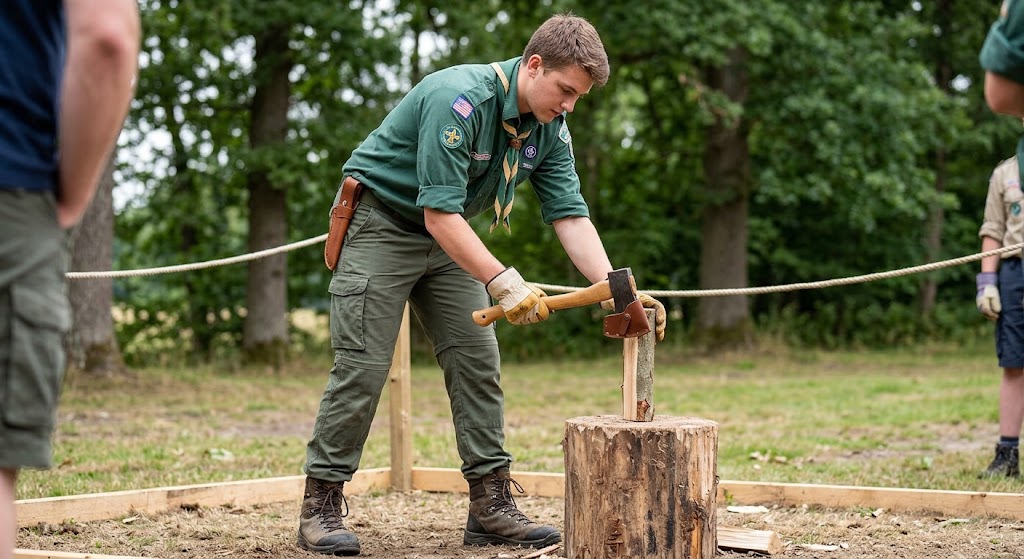
Safe Use of a Hatchet
Activity Overview
Difficulty: Advanced
Time: 30–60 minutes
Location: Designated axe area or suitable outdoor training area
Best for: Scouts and Explorers, with appropriate adult supervision
Skills: Tool safety, woodcraft, cutting techniques, risk management, concentration
A hatchet should only be used in a controlled area with suitable supervision, a stable chopping surface and a clear safety zone. Check the hatchet before use, wear appropriate footwear, maintain a secure grip, keep your body and other people outside the swing area, and make controlled cuts rather than trying to force the blade through wood.
For Scouts, a hatchet should be treated as a serious cutting tool rather than simply another piece of camping equipment.
What You’ll Learn
You will learn how to prepare a safe hatchet-working area, inspect and handle the tool correctly, make controlled cuts, work safely around other people, and put the hatchet away securely when you have finished.
These skills are useful for woodcraft, campcraft and pioneering activities where processing small pieces of suitable timber is permitted.
🔴 SAFETY – HIGH RISK
Hatchets can cause serious cuts or other injuries if they are used incorrectly. They should only be used where the activity has been properly risk assessed and where the supervising adult is satisfied that the young person is competent to use the tool safely.
Never use a hatchet when tired, distracted, rushing or messing around. Only cut wood that you have been instructed to cut, and never use a hatchet as a substitute for a saw when a saw is the more appropriate tool.
Keep a generous exclusion zone around the person using the hatchet. Nobody should stand within the potential swing or rebound area. Spectators should remain well clear.
Wear sturdy footwear that covers the feet. Gloves are not a substitute for good technique and should only be worn when they provide a secure grip without interfering with control of the tool.
Equipment
You will need a suitable hatchet in good condition, a stable chopping block and appropriate timber.
The hatchet should have a secure head, an undamaged handle and a sharp, properly maintained cutting edge. A blunt or damaged hatchet can be more dangerous because it may require excessive force or glance off the wood.
A sheath or blade guard should be available for transporting and storing the hatchet.
Prerequisites
Before using a hatchet, learn the correct technique from a competent adult. You should be able to identify the sharp edge, carry the tool safely, maintain control during a cut and understand the boundaries of the working area.
The supervising leader should establish the working area, explain the safety rules and decide whether each participant is ready to use the tool.
Instructions
1. Prepare the working area
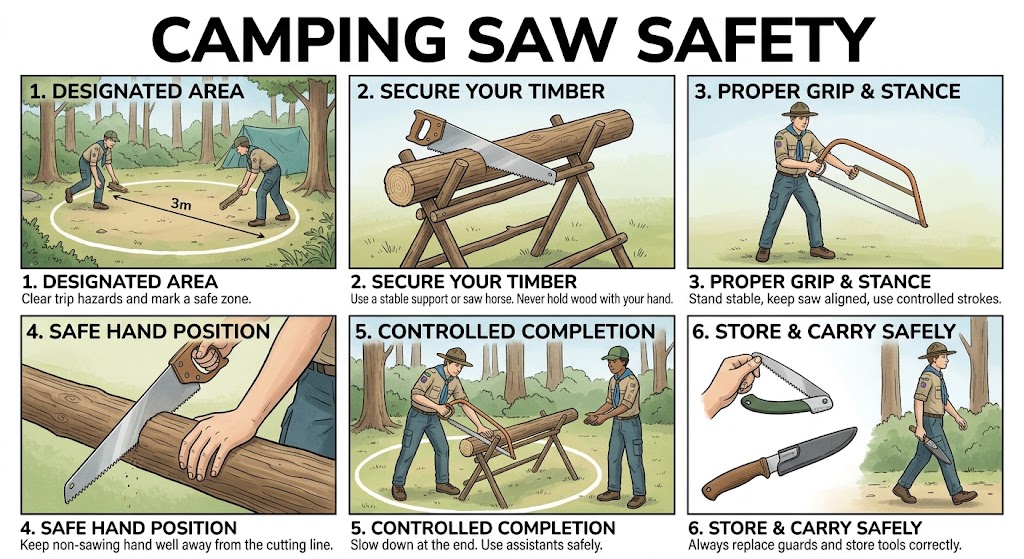
Choose firm, level ground with plenty of space around the chopping block.
Remove loose branches, bags, ropes and other objects that could cause you to trip. Establish a clear exclusion zone so that nobody accidentally walks into the working area.
Position the chopping block securely. It should not wobble, roll or move when struck.
2. Inspect the hatchet
Before picking up the hatchet, check that the head is secure and that the handle has no serious cracks, splits or other damage.
Check the blade for damage and make sure the protective cover is fitted whenever the hatchet is not actually being used.
If anything appears unsafe, stop and tell the supervising leader rather than attempting your own repair.
3. Position the timber
Place the timber securely on the chopping block.
Never hold a piece of wood in your hand while striking it with a hatchet. Keep your supporting hand away from the cutting area.
For small pieces, use a stable method approved by your leader rather than trying to hold the timber close to the blade.
4. Adopt a stable stance
Stand with your feet comfortably apart and maintain your balance.
Your body should remain outside the likely path of the hatchet. Avoid positioning your legs directly behind the piece of timber being cut.
The aim is to make controlled movements using the arms and shoulders rather than swinging wildly or relying on maximum force.
5. Make controlled cuts
Start with light, accurate cuts rather than powerful swings.
Allow the blade to do the cutting. Keep your eyes on the cutting point and maintain a firm but controlled grip.
If the hatchet becomes stuck, stop and assess the situation. Do not twist the tool violently or use excessive force to free it.
6. Keep checking your surroundings
Before every series of cuts, make sure the safety zone is still clear.
If somebody enters the area, stop cutting immediately and wait until the area is safe again.
Never assume that other people can see where the blade is moving.
7. Carry the hatchet correctly
When moving with a hatchet, fit the blade guard whenever practical.
Carry the tool with the cutting edge controlled and pointed away from yourself and others. Never run with it, throw it or carry it over your shoulder in a way that could endanger someone behind you.
If you need to move through a group, secure the hatchet rather than attempting to carry an exposed blade through the crowd.
8. Passing a hatchet
Avoid passing an exposed hatchet from one person to another.
The safest approach is normally to place the hatchet securely on the chopping block or another designated surface, with the blade protected, and allow the next person to pick it up when instructed.
9. Finish safely
When you have finished, check that the working area is clear of offcuts and loose timber.
Clean the hatchet as appropriate, fit its blade guard and return it to its designated storage location.
Never leave an uncovered hatchet lying on the ground or hidden in grass where somebody could accidentally step on it.
Final Tip
A good hatchet user is controlled, not powerful. Accurate cuts, a secure chopping block and plenty of space are far more important than trying to make the biggest swing. If the job requires excessive force, stop and reconsider the technique or use a more suitable tool.
🔒Ready to test your survival skills?
Join Survival Guides UK for free, complete challenges, earn badges and increase your Survival Level.
JOIN FREE →
CRAIG BURR
FOUNDER · SURVIVAL GUIDES UK
I'm Craig, the person behind Survival Guides UK. I created SGUK because I wanted somewhere people could learn real outdoor skills in a practical, straightforward way — from lighting a fire and tying knots to navigation, campcraft and everything in between.
You can read more about the story behind SGUK here as well as our approach here.