Team Pioneering
Activity Overview
Difficulty: Moderate–Advanced
Time: 60–120 minutes
Location: Campsites, activity fields and suitable outdoor training areas
Best for: Scouts, Explorers, Patrol Leaders and experienced Cubs with appropriate supervision
Skills: Pioneering, teamwork, communication, leadership, knots, lashings, planning and problem-solving
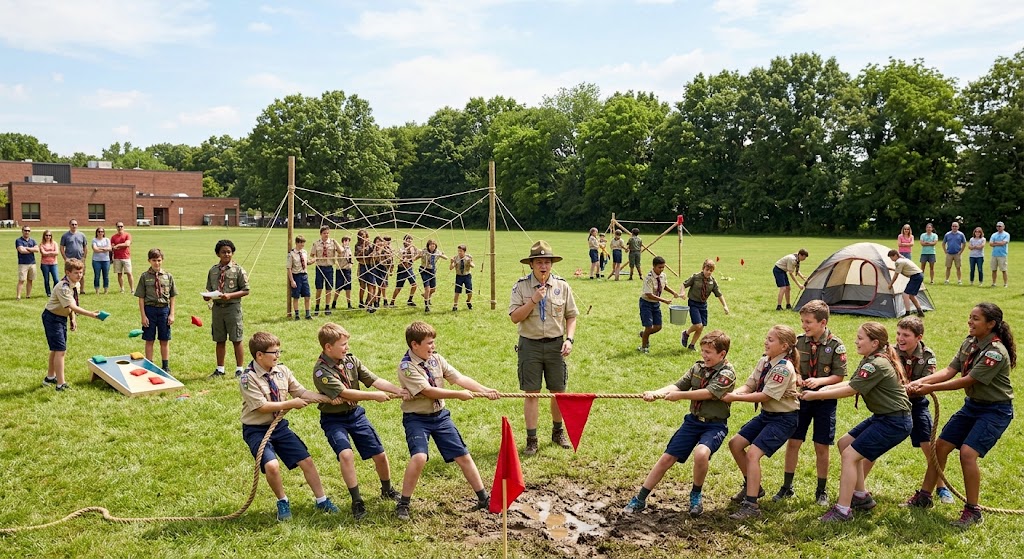
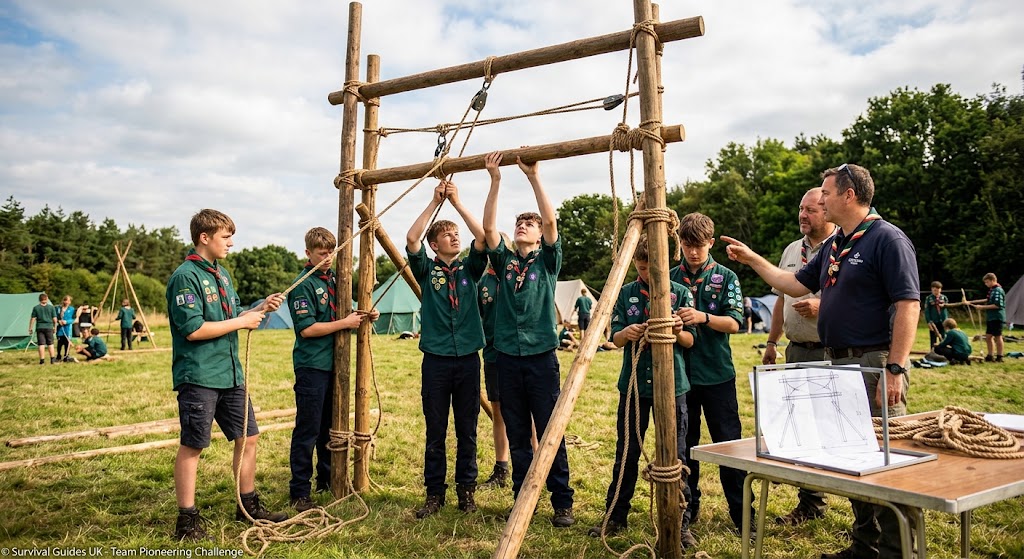
Team pioneering involves working together to design and construct a structure or solve a practical problem using poles, ropes, knots and lashings.
The emphasis is on how well the team communicates and organises itself, rather than on how quickly one person can build the structure.
What You’ll Learn
You’ll learn how to organise a pioneering project as a team.
Scouts will practise dividing jobs, communicating clearly, choosing appropriate knots and lashings, solving construction problems and checking each other’s work.
The activity also develops leadership and cooperation because everyone has a role in completing the project.
🔴 SAFETY – HIGH RISK
Pioneering structures can collapse if incorrectly designed or constructed.
Inspect poles, ropes and lashings before use.
Set clear limits on the size, height and loading of the structure.
A suitably competent adult should inspect significant structures before they are tested or used.
Keep Scouts and spectators clear of structures that could fall.
Don’t allow competitive pressure to encourage unsafe construction.
If a structure becomes unstable, stop work and move everyone to a safe distance.
Weather and ground conditions should be considered before and throughout the activity.
Equipment
You’ll need pioneering poles and suitable ropes.
Additional equipment depends on the challenge and could include flags, buckets, hoops, wooden blocks or other lightweight objects.
You’ll need a clear working area and, for more complex projects, a sketch or design plan.
A measuring tape and timer can be useful for certain challenges.
Prerequisites
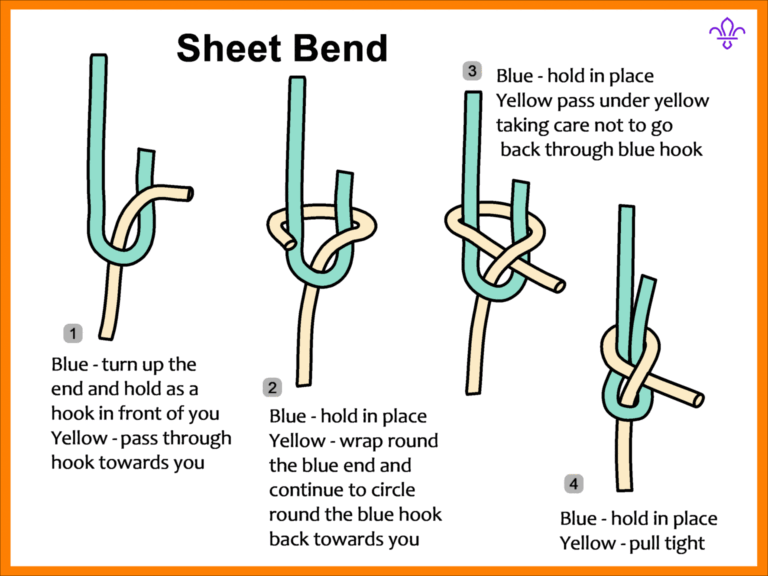
Scouts should know the basic knots and lashings needed for the project.
They should understand how to check a lashing and recognise obvious signs of an unstable structure.
Before starting, everyone should understand the safety rules and their individual responsibilities.
Instructions
1. Choose a Team Challenge
Select a project that genuinely requires several people to complete.
A simple structure can work well for younger Scouts, while older Scouts can tackle a larger design problem requiring several interconnected components.
The challenge should have a clear objective.
2. Explain the Objective
Tell the team exactly what they need to achieve.
For example, they might need to build a freestanding structure, move an object between two points or create a large camp feature.
Don’t give them unnecessary construction instructions—the aim is for the team to work out the solution.
3. Set the Limits
Give the team a defined quantity of poles and rope.
Set any restrictions on dimensions, construction methods or testing.
Clear limits encourage Scouts to think about how best to use their available materials.
4. Plan Before Building
Give the team time to discuss the problem.
Encourage them to sketch the proposed structure and identify its main components.
Ask them to decide which knots and lashings will be required before construction starts.
5. Allocate Roles
Divide the work between team members.
One Scout might coordinate the project, while others prepare ropes, construct frames, measure components or inspect lashings.
Roles can be rotated during the activity.
The aim is to involve everyone rather than allowing one confident Scout to take over.
6. Establish Communication
Agree how the team will communicate before construction begins.
Scouts should tell others before moving large poles or making changes to an important part of the structure.
Clear communication is particularly important when several people are working on different sections.
7. Prepare the Equipment
Lay out the poles and ropes so everyone can see what is available.
Prepare rope lengths where appropriate.
Check equipment for damage before construction starts.
8. Build the Main Sections
Where possible, construct major components on the ground.
This makes construction easier and allows Scouts to inspect their work before sections are assembled.
Encourage team members to check one another’s knots and lashings.
9. Bring the Sections Together
Once the individual components are ready, assemble them in a controlled sequence.
The team should communicate before lifting or moving large sections.
Use enough people to handle awkward components safely.
10. Check As You Go
Don’t wait until the end to inspect the structure.
Pause after each major stage and check that the design is developing as planned.
If something isn’t working, allow the Scouts to discuss and solve the problem.
11. Solve Construction Problems
Team pioneering is particularly valuable when something goes wrong.
A pole may be the wrong length, a lashing may not hold correctly or the structure may need additional support.
Encourage Scouts to identify the problem before suggesting a solution.
This develops genuine problem-solving skills.
12. Inspect the Finished Structure
Before any testing, carry out a thorough inspection.
Check the main lashings, joints, supports and overall stability.
Any problems should be corrected before the structure is used.
13. Test the Solution
Use only the test established at the beginning.
For example, the team might need to move a lightweight object, support a predetermined load or demonstrate that the structure remains stable for a set period.
Don’t improvise dangerous tests.
14. Review the Teamwork
Once the challenge is complete, discuss how the team worked together.
Ask which roles worked well, where communication broke down and whether everyone had an opportunity to contribute.
This reflection is an important part of the activity.
15. Dismantle the Structure
Remove any test objects first.
Dismantle the structure in a controlled order.
Keep everyone clear of sections that could fall or move unexpectedly.
16. Check and Store Equipment
Inspect poles and ropes after the activity.
Set aside damaged equipment.
Coil ropes properly and return everything to its designated storage area.
Team Pioneering Challenge Ideas
Build a Camp Gateway
Give the team a collection of poles and ropes and ask them to design a large entrance feature.
The challenge can focus on stability, appearance and efficient use of materials.
Transport Challenge
Ask the team to construct a device that moves a lightweight object from one point to another without simply carrying it.
This encourages Scouts to combine different pioneering techniques.
Ball Delivery
The team must design a structure or system that moves a ball along a specified route.
It is simple to explain but leaves plenty of room for creative solutions.
Flag Structure
Challenge the team to construct a freestanding structure that raises a flag to a specified height.
The design must remain stable without people holding it.
Rescue Equipment Challenge
Ask the team to design a simple pioneering device for moving an inanimate object across a defined area.
Keep the challenge focused on equipment rather than having Scouts act as casualties or be carried by the structure.
Developing Leadership
Team pioneering provides a natural opportunity for Patrol Leaders to practise leadership.
A good leader doesn’t need to tie every knot themselves.
They should understand the objective, organise the team, delegate tasks, monitor progress and make sure everyone knows what is happening.
For older Scouts, allow the team to organise itself with minimal adult intervention while maintaining appropriate safety supervision.
Improving Team Communication
Encourage Scouts to use clear instructions rather than shouting general commands.
For example, instead of everyone grabbing a pole at once, one person can explain what needs to happen and make sure the team is ready before the pole is moved.
This becomes increasingly important as structures become larger.
Final Tip
Team pioneering isn’t really about building the biggest structure.
The best teams plan together, communicate clearly, divide the work and help each other solve problems.
A simple structure built safely by an organised patrol can teach more than an impressive project where one Scout does all the work.
🔒Ready to test your survival skills?
Join Survival Guides UK for free, complete challenges, earn badges and increase your Survival Level.
JOIN FREE →
CRAIG BURR
FOUNDER · SURVIVAL GUIDES UK
I'm Craig, the person behind Survival Guides UK. I created SGUK because I wanted somewhere people could learn real outdoor skills in a practical, straightforward way — from lighting a fire and tying knots to navigation, campcraft and everything in between.
You can read more about the story behind SGUK here as well as our approach here.