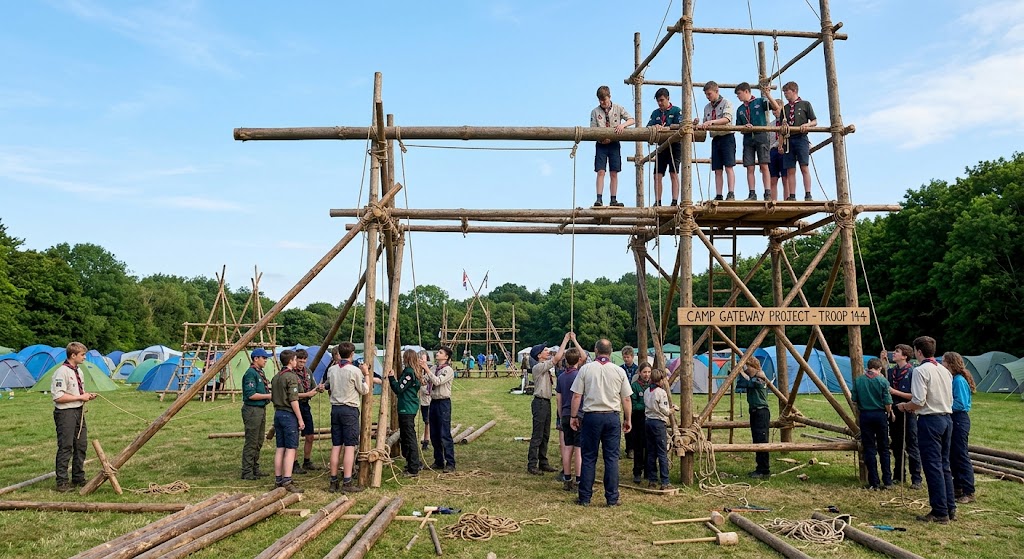
Large-Scale Pioneering: Scout Campcraft Guide
Activity Overview
Difficulty: Advanced
Time: 2–6 hours or a full activity session
Location: Large, level campsites and suitable outdoor activity areas
Best for: Older Scouts, Explorers, Patrol Leaders and experienced teams with close adult supervision
Skills: Advanced pioneering, project planning, knots, lashings, structural design, teamwork, leadership and risk management
Large-scale pioneering involves building a substantial structure or project from poles, ropes and lashings.
Unlike a small pioneering activity, the main challenge is managing the whole project. Scouts need to plan the design, organise materials, divide responsibilities, construct safely and inspect the finished structure.
The bigger the project, the more important planning and supervision become.
What You’ll Learn
You’ll learn how to turn a pioneering idea into a manageable construction project.
You’ll practise producing a plan, estimating materials, organising a team and building in stages.
You’ll also learn why structural checks, communication and controlled dismantling are essential when working on larger projects.
🔴 SAFETY – HIGH RISK
Large pioneering structures can involve significant height, weight and stored forces. A failure can cause serious injury.
Large structures should only be built where the design, construction methods and supervision are appropriate to the experience of the group.
A suitably competent adult should assess the project and inspect critical stages of construction.
Set clear limits for height, loading and access.
Don’t allow Scouts to improvise structural changes to a major structure without checking the consequences.
Keep non-participants away from construction areas.
Inspect poles, ropes, lashings and ground conditions before construction.
Weather conditions, particularly strong winds, can make large structures unsafe.
Never test a structure by placing people on it simply to see whether it holds.
Equipment
Large-scale pioneering normally requires a substantial collection of suitable poles and ropes.
Depending on the project, you may also need measuring equipment, mallets, stakes and other appropriate construction aids.
You’ll need design sketches or plans.
A materials checklist helps prevent equipment shortages during construction.
Barriers or clearly marked boundaries can help keep spectators away from the construction area.
Prerequisites
Scouts should already be confident with the knots and lashings required for the project.
The team should understand how to inspect lashings and identify obvious structural problems.
Large-scale projects should have clear adult supervision and an agreed emergency procedure.
The project should be planned around the group’s actual experience rather than simply attempting the biggest structure possible.
Instructions
1. Choose a Suitable Project
Start with a structure that is achievable with the equipment, space and experience available.
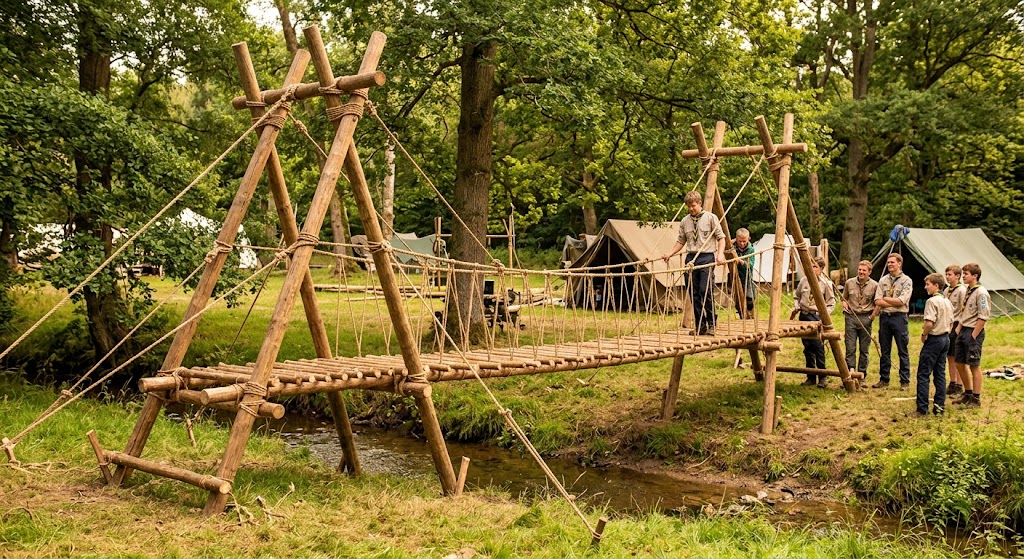
Possible projects include a large gateway, observation structure, camp entrance, bridge-style construction or other substantial pioneering installation.
Avoid selecting a project simply because it looks impressive.
2. Establish the Objective
Decide exactly what the structure needs to achieve.
For example, it might need to create a camp entrance or demonstrate a particular set of pioneering techniques.
Knowing the purpose makes it easier to decide what is actually necessary.
3. Produce a Design
Create a sketch showing the major components.
Identify the main poles, supporting sections, lashings and connection points.
The design doesn’t need to be a professional engineering drawing, but everyone involved should understand what is being built.
4. Check the Site
Walk the proposed construction area before bringing materials into position.
Check the ground, available space, overhead hazards, nearby activities and access routes.
Make sure the completed structure won’t interfere with paths, vehicles or other campsite activities.
5. Calculate Materials
Work out approximately how many poles and how much rope will be required.
Separate the materials into construction stages where possible.
It is much easier to discover a shortage before construction starts than halfway through the project.
6. Divide the Project Into Sections
Large structures become much easier to manage when divided into smaller assemblies.
A team might construct several frames separately before joining them together.
This also allows different Scouts to work on different parts of the project.
7. Assign Responsibilities
Give Scouts clear roles.
Some can prepare ropes, others can construct frames, while others can measure and check components.
A Patrol Leader or project leader can coordinate the teams.
Make sure responsibility for safety checks is clear.
8. Prepare the Materials
Lay out the poles and ropes so that the team can identify what is needed.
Inspect poles for damage.
Check ropes for serious wear.
Prepare the lengths of rope required for major lashings.
Good organisation saves considerable time on a large project.
9. Build the Base Sections
Construct the main components on the ground where practical.
Ground-level construction is generally easier to inspect and can reduce the need for working at height.
Check each component before moving on.
10. Inspect Before Assembly
Don’t wait until the entire structure is complete to discover a weak joint.
Check important lashings and connections as each section is completed.
Correct problems while access is easy.
11. Assemble the Structure
Bring the prepared sections together in a controlled sequence.
Use enough people to handle poles safely.
Never rely on Scouts improvising how a heavy or awkward section should be lifted.
12. Check Stability
Once the main structure is assembled, inspect its stability.
Look at the major joints, supporting poles, lashings and contact points with the ground.
Check that the structure matches the intended design.
13. Complete Secondary Components
Add remaining braces, supports and decorative elements only after the main structure is sound.
Don’t allow decoration to obscure important structural components.
14. Carry Out a Final Inspection
Before the structure is used or approached by other people, carry out a thorough inspection.
Check every major lashing.
Look for loose connections, damaged poles, movement and unexpected loads.
Only allow the structure to be used if it has been judged suitable for its intended purpose.
15. Control Access
Mark out the area around the completed structure.
Make sure everyone knows whether it is purely decorative or whether any specific use has been authorised.
Don’t allow Scouts or visitors to climb or load the structure unless that activity has been specifically planned, assessed and approved.
16. Maintain the Structure
If a large project remains standing for several days, inspect it regularly.
Weather, movement and repeated contact can loosen components.
A structure that was safe immediately after construction can require attention later.
17. Dismantle in Reverse
When the project is finished, plan the dismantling just as carefully as the construction.
Remove non-structural components first.
Then dismantle the major sections in a controlled sequence.
Keep people clear of anything that could fall or move unexpectedly.
18. Inspect the Equipment
Sort poles and ropes after dismantling.
Remove damaged equipment from service.
Coil ropes correctly and return equipment to storage.
Planning a Large Pioneering Project
A useful approach is:
Idea → design → site check → materials → roles → construction → inspection → use → dismantling
Don’t skip directly from the idea to construction.
The planning stage is where many problems can be identified before they become difficult or dangerous to correct.
Large-Scale Project Ideas
Camp Gateway
Build a substantial entrance feature using frames, lashings and decorative elements.
This is a good introduction to large-scale work because the finished structure can be impressive without needing to support people.
Pioneering Tower
A tower can provide an advanced design and construction challenge, but height significantly increases the consequences of structural failure.
Any tower project requires particularly careful design, supervision and controls around access and loading.
Large Flag Structure
Construct a substantial freestanding framework to display a camp flag.
The emphasis can be on stability, symmetry and efficient use of materials rather than height alone.
Giant Camp Sign
Create a large freestanding sign or notice structure.
This allows Scouts to work on large frames and lashings while keeping the primary objective relatively straightforward.
Managing a Large Team
Large projects can quickly become chaotic if everyone tries to work on the same part.
Create small construction teams with defined responsibilities.
Have one person coordinate the overall project and ensure that teams communicate before joining components together.
Regular pauses for progress and safety checks can prevent mistakes from becoming built into the structure.
Keeping Scouts Involved
Large projects shouldn’t become an activity where one experienced Scout does all the important work.
Rotate responsibilities where appropriate.
Let less-experienced Scouts prepare ropes, practise lashings and assist with construction under supervision.
Older or more experienced Scouts can take greater responsibility for planning and coordination.
Final Tip
Large-scale pioneering is as much about project management as pioneering technique.
The most impressive structure isn’t necessarily the tallest or most complicated. A well-planned project that is constructed carefully, inspected properly and dismantled safely demonstrates far more useful skills than a rushed structure that simply looks impressive.
🔒Ready to test your survival skills?
Join Survival Guides UK for free, complete challenges, earn badges and increase your Survival Level.
JOIN FREE →
CRAIG BURR
FOUNDER · SURVIVAL GUIDES UK
I'm Craig, the person behind Survival Guides UK. I created SGUK because I wanted somewhere people could learn real outdoor skills in a practical, straightforward way — from lighting a fire and tying knots to navigation, campcraft and everything in between.
You can read more about the story behind SGUK here as well as our approach here.