Pioneering Design Challenges
Activity Overview
Difficulty: Moderate–Advanced
Time: 60–120 minutes
Location: Campsites, activity fields and suitable outdoor training areas
Best for: Scouts, Explorers, Patrol Leaders and experienced Cubs with appropriate supervision
Skills: Pioneering, design, knots, lashings, problem-solving, teamwork, planning and leadership
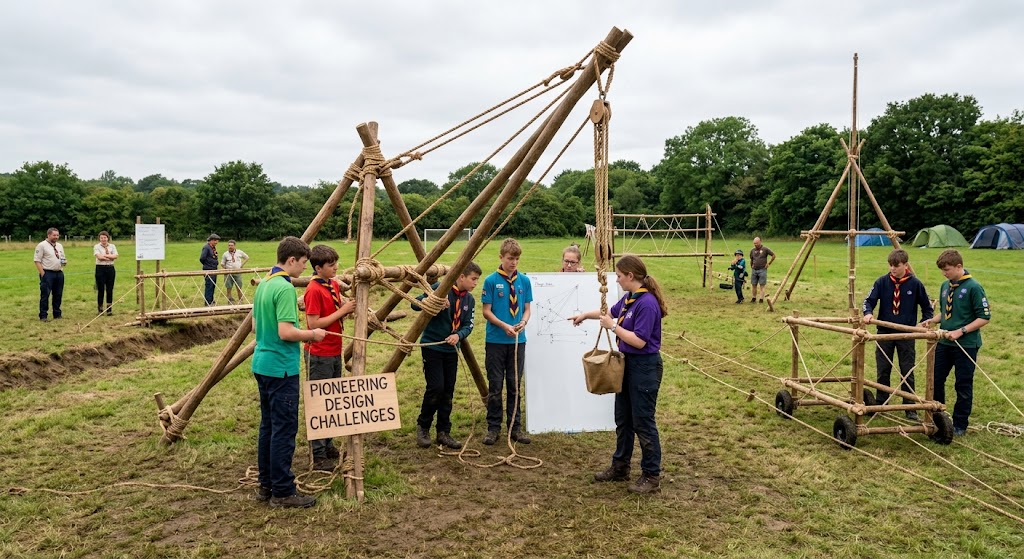
Pioneering design challenges give Scouts a problem to solve rather than a structure to copy.
Instead of providing step-by-step instructions, give each patrol a set of materials, limitations and an objective. They must then design, build and test their own solution using pioneering techniques.
The emphasis should be on planning, creativity, sound construction and teamwork, rather than simply finishing first.
What You’ll Learn
You’ll learn how to turn basic pioneering skills into practical design problems.
Scouts will practise deciding which poles, knots and lashings are appropriate, working within material limitations and adapting their design when something doesn’t work.
They’ll also develop communication, leadership and problem-solving skills.
🔴 SAFETY – HIGH RISK
Pioneering structures can become unstable or collapse if poorly designed or constructed.
Challenges should be designed so that Scouts are not required to climb, sit on or place significant loads on structures unless the activity has been specifically assessed and designed for that purpose.
A suitably competent adult should inspect structures before testing them.
Set clear limits on height, loading and construction methods.
Keep spectators away from structures being built or tested.
Inspect poles and ropes before use and remove damaged equipment.
Stop a challenge immediately if weather, ground conditions or construction problems make it unsafe.
Equipment
You’ll need pioneering poles and ropes appropriate to the challenge.
Additional equipment can include buckets, hoops, tennis balls, flags, wooden blocks or other lightweight objects.
You’ll need measuring equipment if dimensions form part of the challenge.
A timer and score sheet can be useful when running several patrols.
Paper and pencils can be provided for planning and design sketches.
Prerequisites
Scouts should already know the basic knots and lashings required for the challenge.
They should understand how to inspect ropes, poles and lashings before using a structure.
Explain the safety limits before the design process begins.
Instructions
1. Set the Problem
Start with a practical problem rather than a construction method.
For example:
“Design a way to move this object from here to there without carrying it by hand.”
Or:
“Build a structure that allows this flag to be raised to a specified height.”
The Scouts should have to work out the construction method themselves.
2. Set the Constraints
Give every patrol the same basic resources.
You might specify the number of poles, length of rope, maximum dimensions or available construction time.
Constraints make the design process more interesting because Scouts have to make decisions about how their materials will be used.
3. Explain What Cannot Be Done
Make safety restrictions clear before the challenge starts.
For example, specify that structures must not be climbed or that no person may be supported by the construction.
This prevents Scouts from developing a design around something that was never intended to be permitted.
4. Give Planning Time
Don’t let patrols immediately grab the nearest poles and start building.
Give them time to discuss the problem.
Encourage them to sketch their proposed solution and decide which knots and lashings they expect to use.
5. Identify the Key Problem
Ask each patrol to consider what will make its design succeed.
It might be stability, strength, reach, weight, balance or efficient use of materials.
This encourages Scouts to think about why a particular construction method is appropriate.
6. Assign Roles
Patrol members can divide responsibilities between design, measuring, rope preparation, construction and safety checking.
The Patrol Leader can coordinate the work rather than doing all the construction personally.
This makes the challenge a genuine team exercise.
7. Build a Prototype
Where materials allow, encourage patrols to test a small section of their design before committing all their resources.
A prototype can reveal problems with dimensions, lashings or stability before the main construction begins.
8. Build the Final Design
Once the patrol is satisfied with its plan, begin construction.
Leaders should allow Scouts to solve problems themselves where possible.
Intervene when there is a safety issue rather than simply correcting every design mistake.
9. Test the Design
Use the predetermined test.
For example, a patrol might have to move a lightweight object through a course, reach a specified height or transport an item without touching it directly.
Don’t introduce unexpected loads or tests that weren’t part of the original challenge.
10. Evaluate the Result
After testing, ask the patrol what worked and what didn’t.
Which part of the design was strongest?
Where did they have to change their original plan?
Was there a simpler way of achieving the objective?
This turns the activity into a learning exercise rather than simply a construction task.
11. Allow Redesign
For longer sessions, give patrols an opportunity to modify their structure.
They might have to improve it while using the same amount of equipment.
This is particularly effective because Scouts learn that engineering involves testing and improving, not expecting the first design to be perfect.
12. Present the Design
Ask each patrol to explain its solution.
They should be able to describe the problem, their design decisions and the construction techniques they used.
This develops communication skills as well as pioneering ability.
13. Dismantle Safely
Remove any test objects first.
Then dismantle the structure in a controlled manner.
Don’t allow Scouts to pull structures apart randomly or climb onto them to dismantle them.
14. Check the Equipment
Inspect ropes and poles after the activity.
Set aside damaged equipment.
Coil ropes properly and return all equipment to storage.
Challenge Ideas
Bridge Without Crossing
Give patrols a gap and ask them to design a bridge that can transport a lightweight object from one side to the other.
The challenge can focus on span, stability and efficient use of materials without requiring Scouts to cross the bridge.
Pioneering Crane
Challenge Scouts to design a mechanism capable of lifting a lightweight object from the ground to a specified height.
The object should be lifted under controlled conditions and without anyone standing underneath it.
Flag-Raising Structure
Give each patrol a limited number of poles and ropes and ask them to design a stable structure capable of raising a flag to a specified height.
Award points for height, stability and efficient material use.
Transport System
Ask patrols to design a device that moves a lightweight object between two points without someone simply carrying it.
This encourages creative thinking about wheels, runners, frames, ropes and mechanical advantage.
Ball Delivery
Give each patrol a ball and a defined route.
Their design must move the ball from the start to the finish without someone carrying it directly.
This can produce very different solutions from different patrols.
Tallest Freestanding Structure
Give every patrol identical materials and set a maximum construction area.
The structure must stand independently for a specified period.
Because height introduces additional stability issues, this should be carefully controlled and inspected.
Limited-Material Challenge
Give patrols fewer poles or less rope than they would normally expect.
They must design a solution while making every piece of equipment count.
This is particularly good for advanced Scouts because it encourages resource management.
Scoring Design Challenges
A useful scoring system can include:
Design: Does the solution address the problem effectively?
Construction: Are the knots and lashings correctly used?
Efficiency: How effectively were the available materials used?
Innovation: Does the design show creative problem-solving?
Teamwork: Did the patrol communicate and share responsibilities?
Safety: Was the structure constructed and tested responsibly?
Performance: Did the finished design actually complete the challenge?
Avoid making speed the dominant category. A slower patrol with an excellent design should be able to compete with a patrol that simply builds quickly.
Making Challenges More Difficult
For experienced Scouts, introduce additional constraints rather than simply making structures bigger.
Limit the amount of rope available.
Give patrols a fixed number of poles.
Require the structure to be assembled without certain types of equipment.
Introduce a weight or size restriction.
Give patrols a mid-challenge design change that they have to accommodate.
These changes encourage genuine problem-solving.
Final Tip
The best pioneering design challenges don’t tell Scouts what to build.
Give them a problem, some materials and sensible boundaries, then let them work out the solution.
The most valuable part is often not the finished structure but the process of planning, testing, discovering problems and redesigning the idea until it works.
🔒Ready to test your survival skills?
Join Survival Guides UK for free, complete challenges, earn badges and increase your Survival Level.
JOIN FREE →
CRAIG BURR
FOUNDER · SURVIVAL GUIDES UK
I'm Craig, the person behind Survival Guides UK. I created SGUK because I wanted somewhere people could learn real outdoor skills in a practical, straightforward way — from lighting a fire and tying knots to navigation, campcraft and everything in between.
You can read more about the story behind SGUK here as well as our approach here.