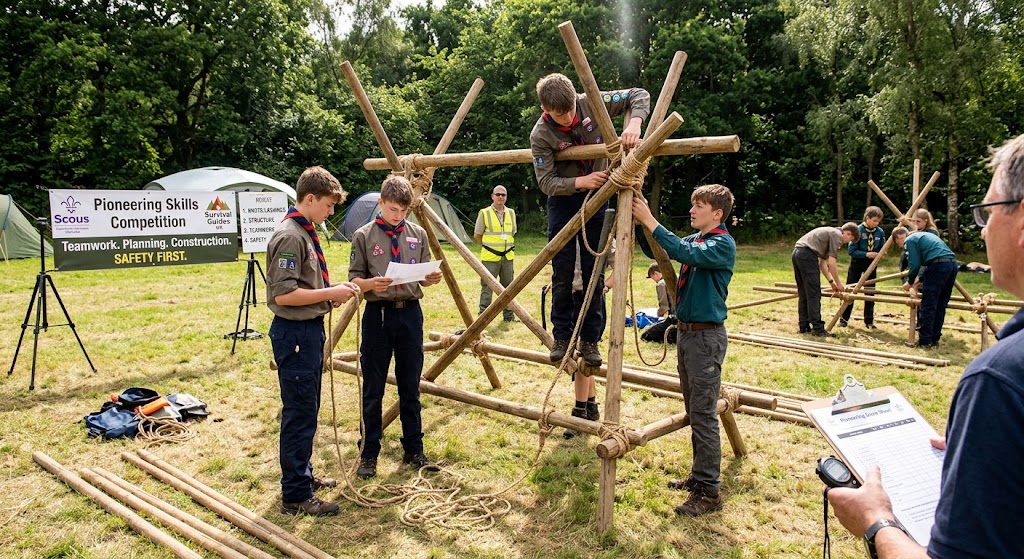
Pioneering Competitions
Activity Overview
Difficulty: Moderate–Advanced
Time: 60–180 minutes
Location: Campsites, activity fields and suitable outdoor training areas
Best for: Scouts, Explorers, Patrol Leaders and experienced Cubs with appropriate supervision
Skills: Pioneering, knots, lashings, teamwork, planning, problem-solving, communication and leadership
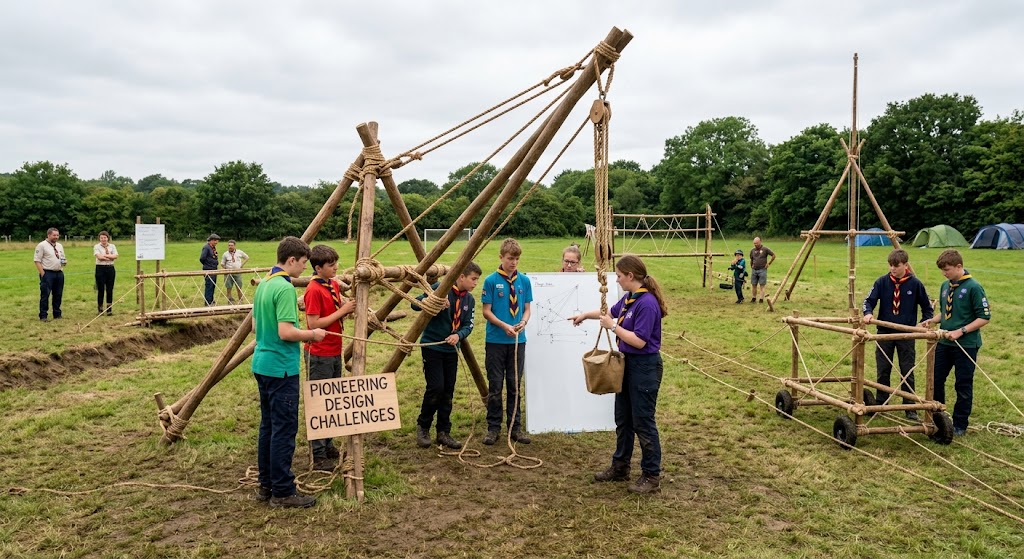
Pioneering competitions challenge patrols to use knots, lashings, poles and teamwork to complete a practical task against a time limit or set of judging criteria.
Good competitions reward more than speed. A patrol that builds a strong, well-planned structure safely should be able to beat a team that simply rushes.
What You’ll Learn
You’ll learn how to design and run pioneering challenges that test practical skills while encouraging teamwork and problem-solving.
You’ll also learn how to set fair rules, score patrols and keep competition from compromising safety.
🔴 SAFETY – HIGH RISK
Pioneering structures can fail if poles, ropes, lashings or joints are incorrectly assembled.
Every structure must be checked by a suitably competent person before it is used.
Set clear limits on height, loading and permitted construction methods.
Don’t allow Scouts to climb or stand on structures unless the activity has specifically been designed and assessed for this purpose.
Keep spectators away from structures under construction.
Inspect poles and ropes before use and remove damaged equipment.
Stop the competition immediately if weather or site conditions make the activity unsafe.
Equipment
You’ll need suitable pioneering poles and ropes for each patrol.
Depending on the challenges, additional equipment might include buckets, wooden blocks, hoops, beanbags, flags or lightweight objects to be transported.
You’ll need measuring equipment and timing devices for some competitions.
A score sheet and pens will make judging easier.
Prerequisites
Scouts should already understand the knots and lashings required for the particular challenges.
Before competing, patrols should know how to inspect their equipment and recognise an unsafe structure.
Everyone should understand that safety rules take priority over the competition.
Instructions
1. Choose the Challenge
Pick a task that genuinely requires pioneering skills.
Possible challenges include constructing a simple bridge, building a raised platform, making a transport device or creating a structure capable of supporting a specified lightweight load.
The task should have a clear objective and a defined finish point.
2. Set the Rules
Explain exactly what Scouts are allowed to use.
Specify the number and type of poles, amount of rope and any additional equipment available to each patrol.
Set limits on dimensions, height and loading where appropriate.
Keep the rules simple enough that patrols can understand them before starting.
3. Decide How It Will Be Scored
A useful scoring system can award points for:
Don’t make speed the only scoring category.
4. Prepare Equal Equipment
Give each patrol comparable equipment.
If one patrol has significantly longer poles or more rope, the competition becomes a test of equipment rather than pioneering ability.
Lay out the equipment before the competition begins.
5. Explain the Safety Rules
Before starting, explain where Scouts may work and where spectators must remain.
Make it clear that unsafe construction will not receive a score simply because it was completed quickly.
Any structure that fails a safety check should be corrected before it can be used.
6. Give Patrols Planning Time
Allow a short period for patrols to discuss their approach.
This rewards leadership and planning rather than encouraging Scouts to immediately start tying ropes.
For more advanced competitions, require patrols to sketch or describe their proposed structure before construction begins.
7. Start the Competition
Give all patrols the same starting signal.
Begin timing at the agreed point.
Leaders should observe rather than constantly intervene, unless safety requires them to do so.
8. Encourage Teamwork
A good pioneering competition should require several Scouts to contribute.
Patrol members might divide responsibilities between measuring, preparing rope, tying lashings, holding poles and checking the structure.
This gives Patrol Leaders an opportunity to practise delegation.
9. Monitor Safety
Watch for unsafe behaviour throughout the competition.
Stop a team if necessary rather than allowing an unsafe structure to develop.
Don’t allow competitive pressure to encourage Scouts to skip equipment checks or use poorly tied lashings.
10. Inspect Completed Structures
Before any structure is climbed, loaded or otherwise tested, inspect it.
Check the main lashings, joints, stability and overall construction.
If the challenge involves a load, use only the predetermined test method.
11. Carry Out the Test
Once the structure has passed its safety check, carry out the agreed test.
For example, a patrol might need to transport a lightweight object across a designated area or demonstrate that a structure can support a specified load.
Don’t improvise additional tests simply to make the competition harder.
12. Record the Scores
Record each patrol’s score immediately.
Keep judging consistent between teams.
If time is being measured, use the same starting and finishing criteria for everyone.
13. Allow a Tie-Breaker
If two patrols finish with the same score, use a short additional challenge rather than changing the original scoring retrospectively.
A quick knot-tying or lashing challenge can work well.
14. Dismantle Safely
Once the competition is finished, dismantle structures carefully.
Don’t allow Scouts to pull structures apart randomly.
Remove loads first and then dismantle the structure in a controlled sequence.
15. Inspect and Store Equipment
Check poles and ropes after use.
Set aside damaged equipment rather than returning it to general storage.
Coil ropes properly and return equipment to its designated storage area.
Competition Ideas
Build the Strongest Structure
Give each patrol the same materials and a specified construction objective.
Award points for structural quality and safe construction rather than simply allowing teams to add unlimited materials.
Timed Bridge Build
Patrols construct a designated bridge or crossing structure within a fixed period.
The finished structure is inspected before any test is carried out.
Pioneering Transport Challenge
Teams construct a device for moving a lightweight object from one point to another.
This can test both design and teamwork without requiring Scouts to ride on the structure.
Knot and Lashing Relay
Patrol members complete a series of knots or lashings before the next member takes over.
This works particularly well when there isn’t enough space or equipment for large structures.
Design Challenge
Give patrols a collection of poles and rope and ask them to design a solution to a practical problem.
Award points for creativity, stability, efficient use of materials and explanation of the design.
Making Competitions Fair
The best pioneering competitions have clear objectives and measurable criteria.
If the challenge is supposed to test lashing technique, don’t allow one patrol to gain an advantage simply because it has more equipment.
If speed is important, give every patrol the same time limit and starting conditions.
Most importantly, don’t reward unsafe shortcuts.
Judging Pioneering Skills
Judges can look at the quality of the finished work as well as the process used to create it.
A neatly constructed structure with correctly dressed lashings demonstrates better pioneering technique than a quickly completed structure held together by poorly tied knots.
Team communication and sensible planning are also valuable skills worth recognising.
Final Tip
A good pioneering competition should make Scouts think “How can we build this well?”, not simply “How can we build this fastest?”
Reward sound construction, teamwork, planning and safe working alongside speed. That turns the competition into a genuine pioneering skills challenge rather than a race to finish first.
🔒Ready to test your survival skills?
Join Survival Guides UK for free, complete challenges, earn badges and increase your Survival Level.
JOIN FREE →
CRAIG BURR
FOUNDER · SURVIVAL GUIDES UK
I'm Craig, the person behind Survival Guides UK. I created SGUK because I wanted somewhere people could learn real outdoor skills in a practical, straightforward way — from lighting a fire and tying knots to navigation, campcraft and everything in between.
You can read more about the story behind SGUK here as well as our approach here.