Mirror Signalling: Scout Emergency Skills Guide
Activity Overview
Difficulty: Moderate
Time: 30–45 minutes
Location: Open countryside, campsites and suitable outdoor training areas
Best for: Scouts, Explorers, Patrol Leaders and adult leaders
Skills: Emergency signalling, observation, communication, navigation and situational awareness
A signalling mirror uses reflected sunlight to attract attention over long distances.
The most important skill is controlling the reflected flash and directing it towards the intended target without looking directly at the concentrated reflection.
A mirror can be particularly useful in bright daylight and open country, but it should be treated as an emergency signalling device rather than a toy.
What You’ll Learn
You’ll learn how a signalling mirror works and how to create a visible flash of reflected sunlight.
You’ll also learn how to aim the reflection safely, how to signal to aircraft or people at a distance and how to practise the technique without accidentally dazzling anyone.
🟡 SAFETY – MODERATE TO HIGH RISK
Never deliberately direct a concentrated reflection into someone’s eyes.
Don’t use a signalling mirror to distract or interfere with drivers, cyclists, aircraft or other people.
Be particularly careful around roads, paths and populated areas.
Don’t climb dangerous ground or structures to improve the mirror’s visibility.
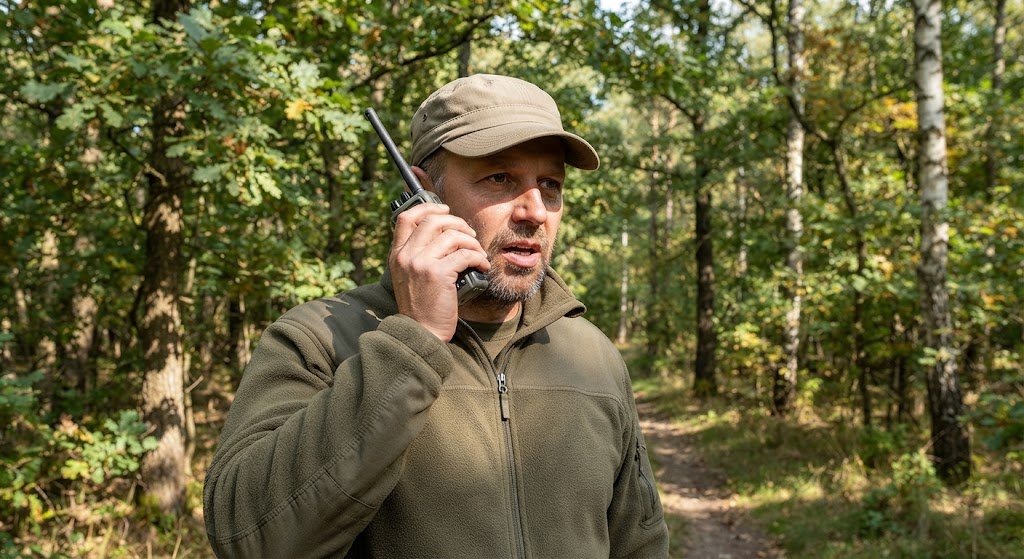
If there is a genuine emergency, use a mobile phone to contact emergency services where possible. Mirror signalling should supplement, not replace, emergency communication.
Equipment
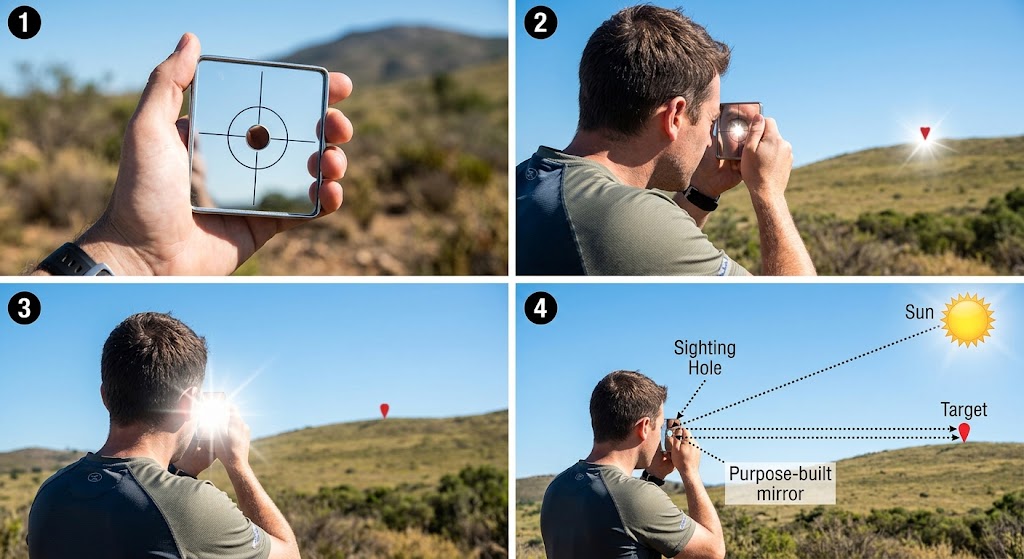
You’ll need a signalling mirror with a sighting hole or aiming aid where available.
A small ordinary mirror can demonstrate the principle, although a purpose-designed signalling mirror is generally easier to aim.
A map and compass can help establish your position and identify suitable directions for signalling.
Prerequisites
Scouts should understand basic emergency procedures before learning mirror signalling.
They should know that the reflected light can be extremely bright and must never deliberately be aimed at someone’s face.
Practise in an open, controlled area with a clear target.
Instructions
1. Choose a Safe Location
Find an open area with good visibility.
Make sure there are no roads, buildings or people in the intended reflection path.
Avoid practising towards aircraft or other moving vehicles unless the activity has been specifically planned and controlled.
2. Face the Sun
A mirror needs sunlight to produce a strong signal.
Position yourself so that sunlight can reach the mirror.
Don’t stare at the sun while trying to find the correct position.
3. Hold the Mirror Securely
Hold the mirror so that the reflective surface faces towards the sun.
Keep your fingers away from any sighting hole or aiming feature.
Maintain control of the mirror throughout the exercise.
4. Find the Reflection
Many signalling mirrors have a small sighting hole.
Look through or around the aiming feature as instructed by the manufacturer and adjust the mirror until the reflected sunlight reaches the intended target.
Don’t look directly at the concentrated reflection.
5. Aim at a Safe Target
For training, use a clearly defined stationary target such as a distant marker.
Start at a relatively short distance where the reflection can be controlled easily.
Never use another person as the target.
6. Create Short Flashes
Once the reflection is correctly aligned, make deliberate movements to create noticeable flashes.
A series of brief flashes can attract attention.
Avoid sweeping the mirror unpredictably across the surrounding area.
7. Practise Tracking
As a Scout skill, practise moving the reflection from one safe target to another.
This helps develop control and demonstrates how small changes in the mirror’s angle can move the reflected light considerably.
8. Signal Towards a Distant Person
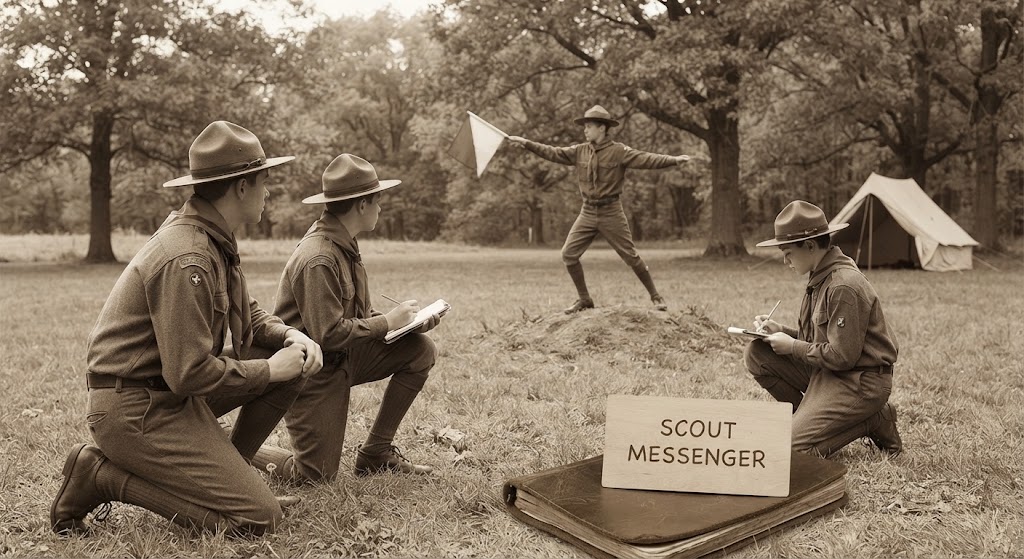
For a controlled exercise, a second group can stand at a safe distance and act as observers.
They can record when they see the flashes.
Keep the reflection away from their faces and use a designated target area instead.
9. Signal in an Emergency
If genuinely stranded and daylight conditions are suitable, use the mirror to attract attention from people, vehicles or aircraft that may be able to assist.
If you have a phone, contact emergency services and provide your location first.
The mirror can then help rescuers identify your position.
10. Use Your Location Information
A mirror tells someone where to look, but it doesn’t necessarily tell them where you are.
Use your map and other information to establish your location.
If communicating with rescuers by phone, provide a grid reference or other useful location details.
11. Keep Signalling
If someone appears to be searching for you, continue making deliberate flashes when safe and appropriate.
Don’t waste energy making continuous movements.
Watch for a response.
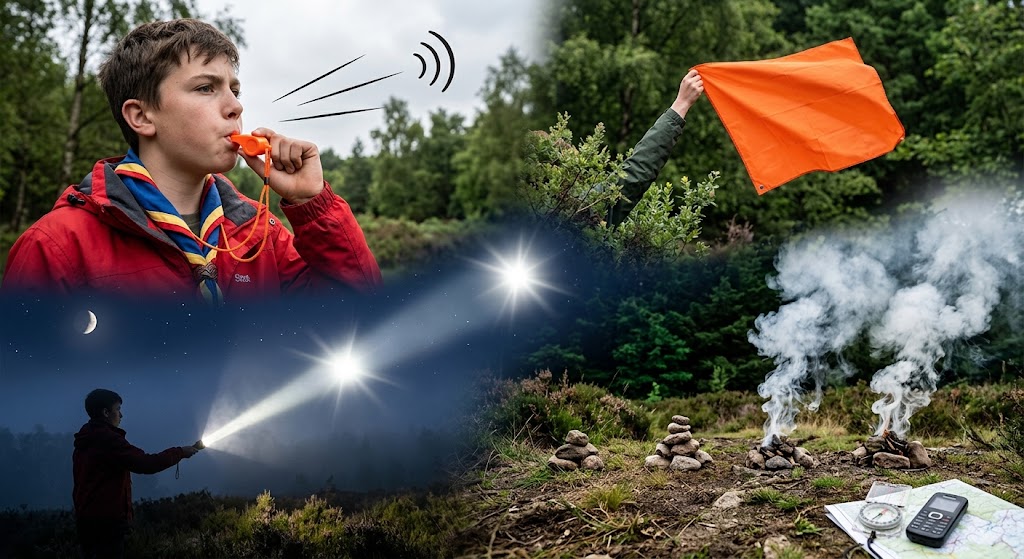
12. Combine With Other Signals
Mirror signalling works particularly well alongside other methods.
A phone can provide detailed communication.
A whistle can attract attention when people are closer or visibility is poor.
Bright clothing or other visual markers can help rescuers identify your position.
13. Stop When You’ve Been Located
Once rescuers or another responsible person has clearly identified your location, stop unnecessary signalling and follow their instructions.
Why Does Mirror Signalling Work?
The mirror doesn’t create light—it redirects sunlight.
Because sunlight is extremely bright, a small area of reflected light can be visible from a considerable distance under suitable conditions.
The effectiveness depends on sunlight, visibility, the size and quality of the mirror, and how accurately it is aimed.
Using a Signalling Mirror With Aircraft
Aircraft can potentially see a strong reflection from considerable distances, making a signalling mirror useful in some emergency situations.
However, never deliberately aim a mirror at an aircraft as a casual experiment.
Reflected sunlight can be distracting or hazardous to pilots.
Any practical training exercise should use a safe ground target rather than a real aircraft.
Mirror Signalling at Sea or on Open Water
A mirror can be particularly useful where there is a long, unobstructed view.
If an emergency occurs near water, remain in a safe location and use the mirror to attract attention from appropriate rescuers or vessels.
Don’t enter the water simply to improve visibility.
Mirror Signalling Practice for Scouts
A good training activity is to place several clearly marked targets around an open field.
Scouts can practise directing the reflection towards each target while another person observes from a safe position.
The exercise demonstrates how precise mirror control needs to be and reinforces the importance of never directing the reflection towards people.
Final Tip
Mirror signalling is simple in principle but takes practice to control.
Use sunlight, aim carefully, create deliberate flashes and never direct the reflection into someone’s eyes.
For Scouts, the skill is best taught as part of wider emergency planning, where the mirror supplements reliable communication and a clear understanding of the group’s location.
🔒Ready to test your survival skills?
Join Survival Guides UK for free, complete challenges, earn badges and increase your Survival Level.
JOIN FREE →
CRAIG BURR
FOUNDER · SURVIVAL GUIDES UK
I'm Craig, the person behind Survival Guides UK. I created SGUK because I wanted somewhere people could learn real outdoor skills in a practical, straightforward way — from lighting a fire and tying knots to navigation, campcraft and everything in between.
You can read more about the story behind SGUK here as well as our approach here.