Phonetic Alphabet: NATO Alphabet for Scouts and Outdoor Communication
Activity Overview
Difficulty: Beginner
Time: 30–45 minutes
Location: Suitable indoor or outdoor training area
Best for: Scouts, Explorers and outdoor enthusiasts
Skills: Communication, radio skills, spelling, emergency communication, accuracy, teamwork
The phonetic alphabet is a standard way of spelling letters aloud so that they are less likely to be misunderstood.
The most widely used version is the NATO phonetic alphabet, which uses a word for each letter:
A — Alfa
B — Bravo
C — Charlie
D — Delta
E — Echo
F — Foxtrot
G — Golf
H — Hotel
I — India
J — Juliett
K — Kilo
L — Lima
M — Mike
N — November
O — Oscar
P — Papa
Q — Quebec
R — Romeo
S — Sierra
T — Tango
U — Uniform
V — Victor
W — Whiskey
X — X-ray
Y — Yankee
Z — Zulu
It is particularly useful when communicating over radios, telephones or in noisy environments where individual letters can easily be confused.
For example, instead of saying a call sign contains the letters B-N, you could spell them using their phonetic words. This makes the message much clearer.
What You’ll Learn
By the end of this guide, you’ll know:
🟢 SAFETY – LOW RISK
Learning and practising the phonetic alphabet is a low-risk activity.
The main concern is not physical injury but communication errors. An incorrectly communicated letter, grid reference, name or call sign could cause confusion.
When practising:
- Use sensible radio procedures.
- Don’t transmit unnecessary personal information.
- Follow any rules for the radio equipment being used.
- During a genuine emergency, prioritise getting accurate information to the appropriate person rather than worrying about perfect radio terminology.
The phonetic alphabet is a communication aid, not a replacement for clear emergency procedures.
Equipment
You don’t need specialist equipment to learn the alphabet.
A useful practice session can use:
A pair of radios makes the exercise particularly useful because Scouts can practise communicating information while dealing with background noise and normal radio discipline.
Prerequisites
No previous experience is required.
Before practising, it helps to understand the difference between:
The important skill is learning to recognise the phonetic word immediately rather than having to think about which letter it represents.
Instructions
1. Learn the Alphabet
Start by becoming familiar with all 26 words.
| Letter | Phonetic word |
|---|---|
| A | Alfa |
| B | Bravo |
| C | Charlie |
| D | Delta |
| E | Echo |
| F | Foxtrot |
| G | Golf |
| H | Hotel |
| I | India |
| J | Juliett |
| K | Kilo |
| L | Lima |
| M | Mike |
| N | November |
| O | Oscar |
| P | Papa |
| Q | Quebec |
| R | Romeo |
| S | Sierra |
| T | Tango |
| U | Uniform |
| V | Victor |
| W | Whiskey |
| X | X-ray |
| Y | Yankee |
| Z | Zulu |
Don’t worry about memorising the entire list immediately.
Start with groups of five or six letters and gradually build up your recall.
2. Understand Why It Is Used
Some letters sound very similar when spoken.
For example, B, D, E, P and T can be difficult to distinguish when there is background noise, poor radio reception or someone speaking quickly.
Using a standard word removes much of this ambiguity.
Instead of relying on the sound of a single letter, the listener hears a distinctive word.
This is especially useful when communicating:
3. Practise Recognising Letters
Have someone say phonetic words at random.
For example, they might call out:
Sierra — Kilo — Mike — Echo
Your task is to identify the corresponding letters.
Start slowly, then increase the speed.
The aim is eventually to recognise the letter almost automatically.
4. Practise Spelling Simple Words
Choose ordinary words and spell them using the alphabet.
For example, a word such as CAMP would be communicated using the phonetic words for its four letters.
Don’t rush.
Say each phonetic word clearly and give the listener enough time to record it.
Once you’re comfortable, try longer words and names.
5. Practise Receiving Information
Communication is a two-way skill.
One person should spell a word using the phonetic alphabet while another writes down the letters.
The second person can then read the result back.
This teaches an important habit:
Send → Receive → Check.
It is not enough to assume that the other person heard the message correctly.
6. Use It With Radios
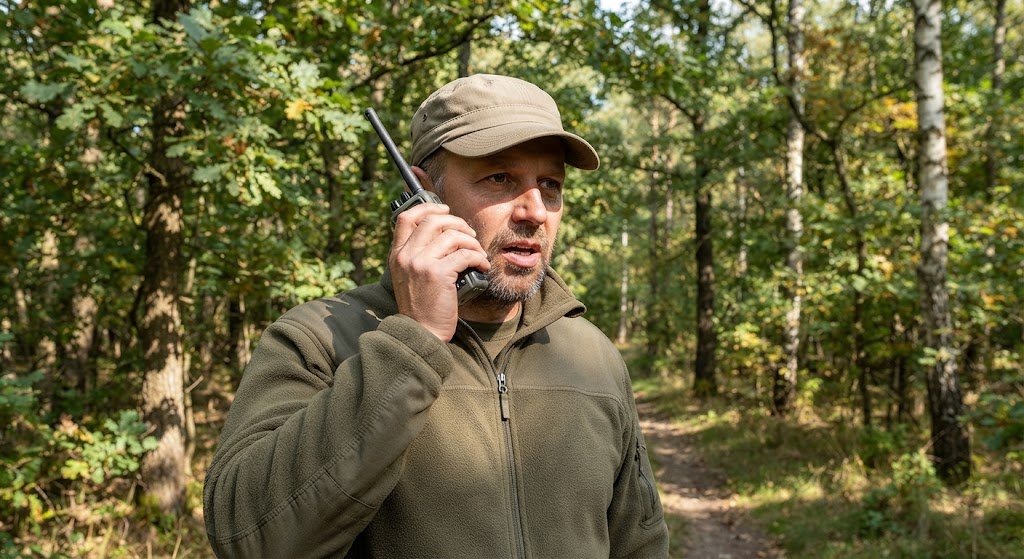
The phonetic alphabet is particularly useful with two-way radios.
When spelling something important, speak clearly and avoid rushing.
For example, if giving a call sign or name, introduce the spelling before starting so the listener knows what to expect.
Keep the rest of the radio message concise.
The phonetic alphabet should make communication clearer, not turn a simple message into an unnecessarily complicated one.
7. Practise With Maps
Maps provide an excellent outdoor exercise.
Choose a place name, feature or other piece of information from a map and have one person communicate it using the phonetic alphabet.
The other person writes it down and identifies the location.
This can be made more challenging by introducing background noise or increasing the distance between the people using radios.
The exercise develops both communication and navigation skills.
8. Use It for Difficult Names and Places
Names can be particularly difficult to communicate accurately.
If someone needs to record an unfamiliar name, spelling it using the phonetic alphabet can prevent mistakes.
The same applies to unfamiliar place names or technical terms.
Don’t assume the listener knows how something is spelled simply because they can hear how it sounds.
If accuracy matters, spell it.
9. Practise Under Distraction
Once the basic skill is reliable, introduce realistic distractions.
For example:
The objective isn’t to make the exercise chaotic.
It is to demonstrate why standardised communication is useful when conditions aren’t perfect.
If mistakes start occurring, slow down and return to clearer communication.
10. Learn to Confirm Important Information
For particularly important information, use a read-back.
The person receiving the message repeats the information to the sender.
If there is an error, correct it immediately.
This is particularly important when communicating information where one incorrect letter could change the meaning.
A good communicator doesn’t simply ask, “Did you get that?”
They make sure the important information has actually been understood.
11. Practise Emergency Communication
The phonetic alphabet can form part of a wider emergency communication exercise.
For example, a scenario could involve communicating:
The exercise should concentrate on accuracy and clarity, rather than pretending that the phonetic alphabet itself is an emergency procedure.
In a real emergency, give the information required by the emergency service or responsible person as clearly as possible.
12. Make It Automatic
The best time to learn the phonetic alphabet is before you need it.
Practise occasionally until the words become automatic.
Short exercises work well:
Regular practice is much more effective than trying to memorise the entire alphabet immediately before a camp or expedition.
Final Tip
When a letter matters, don’t leave it to chance.
Use the phonetic alphabet, speak clearly and confirm important information.
The goal isn’t simply to know that A is Alfa and B is Bravo — it’s to be able to communicate accurately when the conditions aren’t perfect.
🔒Ready to test your survival skills?
Join Survival Guides UK for free, complete challenges, earn badges and increase your Survival Level.
JOIN FREE →
CRAIG BURR
FOUNDER · SURVIVAL GUIDES UK
I'm Craig, the person behind Survival Guides UK. I created SGUK because I wanted somewhere people could learn real outdoor skills in a practical, straightforward way — from lighting a fire and tying knots to navigation, campcraft and everything in between.
You can read more about the story behind SGUK here as well as our approach here.