
Calling for Help: Emergency Skills Guide
Calling for Help: What to Do in an Emergency
Knowing what to do when something goes wrong is one of the most important survival skills you can learn.
You might become lost, someone might become injured, weather conditions could deteriorate, or your group could find itself in a situation that it can’t safely manage.
In an emergency, people can panic and forget information they already know.
That’s why it’s worth learning a simple process before you need it.
Safety First
If someone is seriously injured, seriously ill or in immediate danger, get emergency help as quickly as possible.
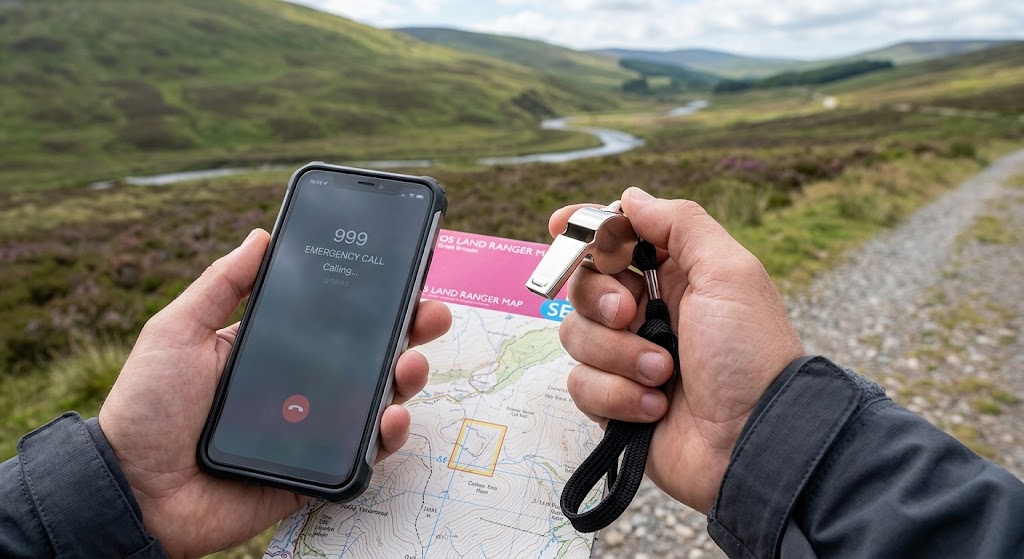
In the UK, 999 and 112 can be used to contact emergency services.
If you’re with a Scout group, follow your leader’s emergency procedures and instructions.
Don’t put yourself in danger while trying to help someone else.
The Most Important Rule
When something goes wrong:
STOP → THINK → ACT
STOP
Don’t immediately rush into the situation.
THINK
What has happened?
Who is in danger?
Where are you?
What help is needed?
ACT
Get appropriate help and follow the instructions you’re given.
This simple process can prevent panic from making a situation worse.
1. Recognise an Emergency
Not every problem requires emergency services.
But some situations require immediate help.
Examples include:
- Serious injury
- Serious illness
- Someone unconscious
- Difficulty breathing
- Severe bleeding
- Someone missing
- Immediate danger
- Fire that cannot be safely controlled
- A serious accident
If you’re unsure whether a situation is an emergency, tell a responsible adult or leader immediately.
Don’t try to deal with a serious situation beyond your training.
2. Tell Someone
If you’re part of a Scout group, you shouldn’t be dealing with an emergency alone.
Tell:
- Your scout leader
- Another responsible adult
- A member of your group who can get help
If you’re alone, you may need to contact emergency services yourself.
Remember:
Getting help is not admitting you’ve failed.
Recognising that you need assistance is a valuable survival skill.
3. Calling Emergency Services
In the UK, you can call:
999
or
112
for emergency services.
You may be asked which service you require, such as:
- Police
- Fire and Rescue
- Ambulance
Stay calm and listen carefully to the operator.
Don’t hang up until you’re told to do so.
4. What Should You Say?
When you make an emergency call, the operator needs useful information.
Try to answer:
WHERE?
Where are you?
WHAT?
What has happened?
WHO?
Who needs help?
HOW SERIOUS?
What injuries or dangers are involved?
WHO ARE YOU?
Give your name and contact information when requested.
5. Your Location is Critical
One of the most useful things you can learn is how to describe where you are.
A street address is easy.
But what if you’re:
- On a moor?
- In woodland?
- On a footpath?
- On a hill?
- In a large campsite?
- Somewhere without a postcode?
This is where your navigation skills become extremely useful.
You might be able to provide:
- Grid reference
- Named location
- Road name
- Nearby landmark
- Path or trail name
- What3words location if appropriate
- GPS coordinates
- Description of your surroundings
Don’t guess your location.
If you’re unsure, say so.
You can then provide other information that may help rescuers locate you.
6. Learn Your Grid Reference
If you regularly spend time outdoors, learning how to use a map and give a grid reference is extremely valuable.
A grid reference can provide emergency services with a much more precise location than:
“We’re somewhere on the hill.”
Practise finding your location before you need to use it.
Your goal:
Be able to look at a map and answer:
“Where exactly are we?”
This connects directly with the navigation skills you’re learning elsewhere on SurvivalGuidesUK.
7. Your Phone Can Help — But Don’t Rely on It Completely
A mobile phone can be extremely useful during an emergency.
You may be able to use it to:
- Call emergency services
- Share your location
- Check a map
- Read GPS coordinates
- Communicate with your group
- Receive instructions
But phones have limitations.
You may have:
- No signal
- Low battery
- Poor reception
- Water damage
- A damaged phone
That’s why:
Your phone should support your survival skills, not replace them.
Know how to navigate using a map and compass as well.
8. Look After Your Phone
If you’re heading outdoors, think about your phone before you leave.
Check:
Keep your phone somewhere accessible but protected from the weather.
9. Know Where You Are Before You Need Help
This is one of the easiest ways to make an emergency easier.
When walking outdoors, regularly ask:
Where are we now?
Don’t wait until you’re lost.
Look at your map periodically.
Notice:
- Path junctions
- Bridges
- Roads
- Buildings
- Rivers
- Hills
- Other landmarks
If something goes wrong later, you’ll have a much better idea of where you are.
10. Attracting Attention
Sometimes you may need to attract the attention of people nearby.
Depending on the situation, you might use:
VOICE
Call for help.
LIGHT
Use a torch or other appropriate light to attract attention.
PHONE
Call or message for assistance where possible.
HIGH-VIS EQUIPMENT
Bright or reflective clothing can make people easier to locate.
EMERGENCY EQUIPMENT
Some activities may involve specialist emergency signalling equipment.
Only use equipment you understand and have been trained to use.
11. Calling for Help Without a Phone
What if you don’t have a phone?
- Call out
- Use a whistle
- Use a light
- Make yourself visible
A whistle can carry considerably further than a human voice and requires less energy.
If your lost:
Don’t wander around randomly shouting.
Find a safe location where possible and make yourself visible while continuing to assess your situation.
12. If You’re Lost
Getting lost doesn’t automatically mean you’re in an emergency.
But continuing to walk without a plan can make the situation much worse.
If you realise you’re lost:
STOP
- Stop moving – don’t continue travelling simply because you hope you’ll recognise something.
- Think – think about the last place you definitely knew where you were.
- Observe – look around for useful landmarks.
- Check – use your map and compass if you have them.
- Plan – decide on the safest next action.
If you’re unable to safely establish your location, get help rather than continuing deeper into unfamiliar terrain.
13. If Someone Is Injured
If someone becomes injured:
First:
Make sure you are safe.
Then:
Get help.
Tell a responsible adult or contact emergency services when appropriate.
Give useful information.
Explain:
- What happened
- Where you are
- What injuries you can see
- How many people are involved
- Any immediate hazards
Stay with the injured person where it is safe to do so.
Don’t attempt treatment beyond your training.
If you’ve completed appropriate first-aid training, use those skills within your level of competence.
14. Stay Calm and Listen
When contacting emergency services, you may be asked questions you’ve already answered.
Don’t become frustrated.
The operator is gathering information and assessing what help is needed.
Your job is simple:
The Emergency Call Process
Here’s the system I want SurvivalGuidesUK readers to remember:
STOP → THINK → CALL → EXPLAIN → FOLLOW
STOP
Make sure you’re not making the situation worse.
THINK
Work out what has happened and what help is needed.
CALL
Contact the appropriate person or emergency service.
EXPLAIN
Give your location and explain what has happened.
FOLLOW
Listen carefully and follow instructions.
Your First Calling-for-Help Challenge
The Emergency Information Challenge
This challenge should be completed as a role-play.
You don’t need to make a real emergency call.
Ask a leader, parent or another adult to give you a scenario.
For example:
“Someone in your group has fallen and appears to have suffered a serious injury. You need to get emergency help.”
You have to explain what you would do.
Can you answer:
- What happened?
- Where are you?
- How many people need help?
- What injuries or dangers are present?
- Who is with you?
- What would you do while waiting for help?
Bonus Challenge: The Location Challenge
This is a fantastic activity to combine with your navigation skills.
Go somewhere outdoors with a map.
Choose a location.
Without giving the name of the location, ask someone:
“Tell me where you are”
They should provide enough information for someone else to find them.
Try using:
- Grid reference
- Nearby path
- Nearby landmark
- Direction of travel
- GPS coordinates if available
The test:
Could someone who doesn’t know exactly where you are use your information to find you?
Explorer Challenge: The Emergency Scenario
Work in a small team.
Your leader gives you a scenario.
For example:
You’re walking in unfamiliar countryside when one member of your group becomes seriously unwell. Mobile phone signal is available.
Your team needs to decide:
- What do you do first?
- Where exactly are you?
- Who calls for help?
- What information will you provide?
- Who stays with the casualty?
- How will rescuers find you?
- What can you do to keep everyone safe while waiting?
Then explain your plan to your leader.
There isn’t necessarily one perfect answer.
The aim is to demonstrate:
Calm thinking → good communication → accurate information → appropriate action.
What Have You Learned?
You should now understand that calling for help involves much more than knowing an emergency number.
You’ve learned how to:
The most important lesson is:
You don’t need to solve every emergency yourself. You need to recognise when you need help and communicate that clearly.
Scout Connection
Calling for help connects several important Scout skills.
NAVIGATION
Knowing where you are makes it much easier for help to find you.
COMMUNICATION
Giving clear and accurate information.
FIRST AID
Knowing when someone needs professional assistance.
DECISION-MAKING
Recognising when a situation is beyond your ability.
LEADERSHIP
Staying calm and helping others remain calm.
OUTDOOR SAFETY
Understanding how to respond when something goes wrong away from home.
This is also a great skill to practise through scenario-based games rather than simply memorising information.
SurvivalGuidesUK is an independent educational resource and isn’t an official Scouts website. Always follow the current Scouts programme requirements and your leader’s instructions.
SurvivalGuidesUK Safety Notice
This article provides general educational information and does not replace first-aid training, emergency-service training or appropriate Scout training.
In a genuine emergency, contact the appropriate emergency service and follow the instructions you are given.
Do not put yourself at risk while attempting to rescue another person.
For organised Scout activities, always follow your leader’s emergency procedures and the current official Scouts guidance.
🔒Ready to test your survival skills?
Join Survival Guides UK for free, complete challenges, earn badges and increase your Survival Level.
JOIN FREE →
CRAIG BURR
FOUNDER · SURVIVAL GUIDES UK
I'm Craig, the person behind Survival Guides UK. I created SGUK because I wanted somewhere people could learn real outdoor skills in a practical, straightforward way — from lighting a fire and tying knots to navigation, campcraft and everything in between.
You can read more about the story behind SGUK here as well as our approach here.