
What to Do If You Get Lost in a Forest
⚠️ SAFETY FIRST
If you realise you’re lost, stop and tell someone if you can.
Continuing to walk without knowing where you are can make the situation much worse.
If you’re in immediate danger, injured, lost after dark or unable to find your way to safety, call 999 or 112 and ask for the appropriate emergency service. If you have a mobile phone, conserve its battery and share your location if possible.
What Should You Do If You Get Lost in a Forest?
Getting lost in a forest can happen surprisingly easily.
Trees can make familiar landmarks disappear. Paths can split into smaller tracks, and it is very easy to convince yourself that you know which direction you’re travelling when you don’t.
You might walk around a bend expecting to see the path you remember, only to realise that nothing looks familiar.
The most important thing you can do is stop.
It might feel strange to stand still when you’re lost. Your instinct may be to keep moving and try to find your way out.
But if you don’t know where you are going, walking further can increase the distance between you and the place where someone is looking for you.
🧭 THE FIRST RULE OF GETTING LOST
Stop moving until you have worked out your situation.
Don’t turn a small navigation mistake into a much bigger one.
Stay Calm
Being lost can trigger panic.
You may start thinking about everything that could go wrong, which can make it harder to think clearly.
Take a few slow breaths and concentrate on what you actually know.
Ask yourself:
Where was the last place I knew exactly where I was?
When did I last see my group or leader?
Which direction was I travelling?
Do I have a map and compass?
Do I have a phone?
How much daylight is left?
You don’t need to solve everything immediately.
Your first job is simply to stop making the situation worse.
Try to Retrace Your Steps
If you have only just realised that you’ve taken a wrong turn, think carefully about returning to the last place you definitely knew where you were.
This is different from wandering around looking for the right path.
If you know that you were standing at a particular junction a few minutes ago, returning carefully to that point may make sense.
But if you’re no longer sure where you came from, don’t start guessing.
You could easily travel further away from your original route.
🧠 ASK YOURSELF
“Do I know where I am, or do I just think I know where I am?”
If the answer is the second one, stop and reassess.
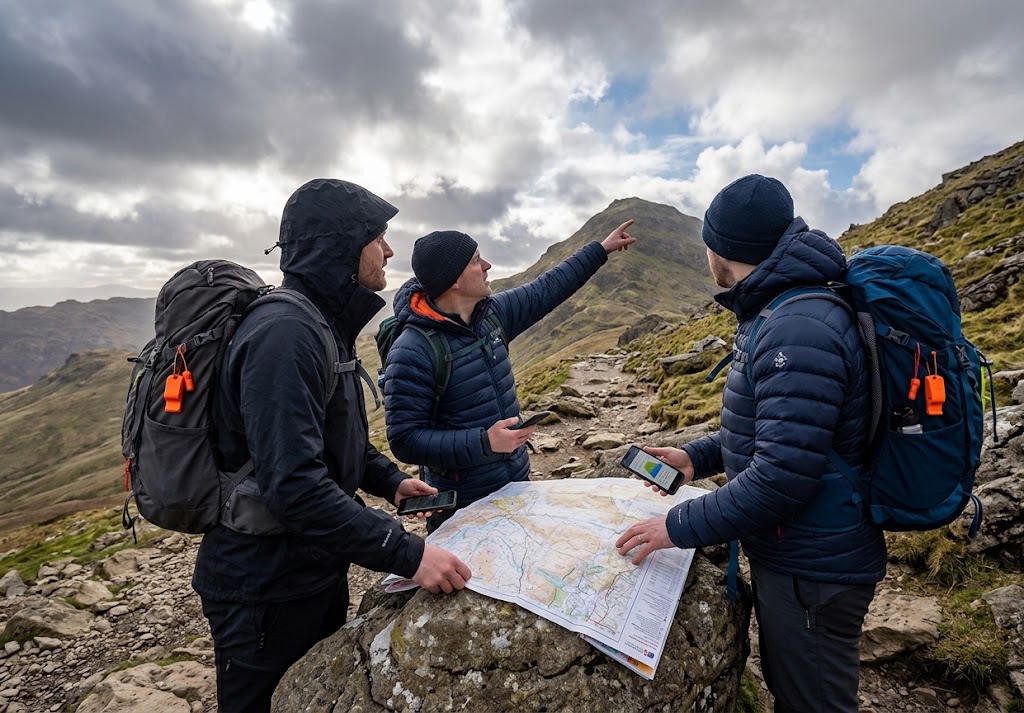
Use Your Map
If you have a map, get it out.
Don’t rely on memory when you have a navigation tool available.
Look for features you can identify around you.
These might include:
Forests can make navigation difficult because many features look similar.
Take your time and compare what you can actually see with what’s shown on the map.
Use Your Compass
If you have a compass and know how to use it, this is where it becomes extremely useful.
A compass doesn’t tell you where you are.
It tells you direction.
Your map tells you what is around you.
Together, they can help you establish where you are and which way you need to travel.
If you know the direction you were supposed to be travelling, you may be able to establish whether you’ve accidentally turned around or followed the wrong track.
If you don’t know your location, however, don’t simply pick a direction and start walking.
🧭 REMEMBER
A compass can tell you north. It cannot tell you where you are.
Don’t confuse knowing a direction with knowing your location.
Look for Clues — Carefully
Forests contain plenty of natural and man-made features that can help with navigation.
You might notice:
A road in the distance.
Power lines.
A fence.
A stream.
A distinctive building.
A trail of footprints.
A marked walking route.
These can provide useful information.
But don’t assume that every path leads to civilisation.
A narrow track might simply be an animal trail or forestry track.
If you use a feature to navigate, make sure it makes sense alongside your map and your known location.
Don’t Follow Every Path
One of the biggest mistakes people make when lost is choosing a path simply because it looks promising.
You might think:
“That trail must lead somewhere.”
It might.
But it could also lead deeper into the forest.
If you don’t know where a path goes, following it can make your situation harder to solve.
If you have a map, use it to determine whether the track actually exists and where it leads.
What If You Have No Map?
If you’ve lost your map as well as your way, things become more difficult.
Your first priority is still to stop and assess.
Think about the route you were following and any landmarks you remember.
If you have a phone, check whether you have access to an offline map.
Don’t assume you will have mobile signal.
Many forests have areas with poor or no reception.
If you can contact your group or someone at home, tell them where you last knew your location.
That information can be extremely useful.
What If You Have a Phone?
A mobile phone can be extremely useful if you’re lost, but don’t waste its battery.
If you have signal, contact someone who knows where you are.
If appropriate, share your location.
If you have no signal, don’t repeatedly attempt calls until your battery is almost empty.
Your phone may still be needed later.
Turn down the screen brightness and avoid unnecessary apps.
If you have an emergency and cannot safely get yourself out, call 999 or 112.
📱 PHONE TIP
Battery is a survival resource.
If you’re lost, don’t spend it scrolling, playing games or repeatedly checking for a signal.
Use it for navigation, communication and emergencies.
Should You Keep Walking?
This is one of the most important decisions.
If you know where you are and know where you’re going, continuing may be reasonable.
If you don’t know where you are, continuing to walk can make you harder to find.
This is particularly true in a large forest.
The safest choice is often to stay put, particularly if:
Make Yourself Easier to Find
If you need to stay where you are, make yourself visible.
A forest can hide a person surprisingly well.
If you have bright clothing, wear it where it can be seen.
A whistle can be useful because its sound carries further than your voice and requires less energy.
If you’re with Scouts, a whistle should be treated as useful emergency equipment rather than simply another piece of kit.
📢 THREE WHISTLE BLASTS
Three repeated whistle blasts are widely recognised as a distress signal.
If you use a whistle to attract attention, listen afterwards.
Someone may respond.
Stay Near a Safe Location
If you have a safe place to remain, stay there.
Don’t climb dangerous trees to get a better view.
Don’t enter caves or unstable structures.
Don’t walk along dangerous cliff edges or near fast-flowing water simply because you think they might lead somewhere.
Your goal isn’t to explore.
Your goal is to remain safe until you can work out your next step or help reaches you.
What If It Starts Getting Dark?
Getting lost becomes considerably more challenging after dark.
Navigation becomes harder, temperatures can fall and hazards such as roots, holes and steep ground become much more difficult to see.
If you’re lost near sunset and don’t know where you are, don’t start rushing through the forest in an attempt to get out before it becomes completely dark.
You may be safer staying in a known, relatively sheltered location.
Use your torch if you have one, but conserve its battery.
Keep yourself warm and dry.
If you’re camping, use your normal shelter equipment.
If you’re not camping, look for a safe place protected from wind and rain without putting yourself in danger.
🌙 DON’T MAKE IT WORSE
Darkness can turn a simple navigation mistake into a serious accident.
It’s usually better to stop safely than stumble blindly through unfamiliar woodland at night.
What About Following a Stream?
You may have heard the survival advice:
“Follow the water.”
This isn’t always a good idea.
A stream may lead somewhere, but it can also take you through increasingly difficult terrain.
You could encounter:
If you have a map, use it to understand where the watercourse goes.
Don’t follow a stream simply because you’re desperate to find a route out.
What About Climbing a Tree?
Another common idea is to climb a tree to see where you are.
This can be dangerous.
A fall from even a relatively low height can leave you injured and make your situation considerably worse.
You don’t need a spectacular view if the price is a broken ankle.
If you have a safe viewpoint available at ground level, use that instead.
Don’t Waste Energy
When you’re lost, energy becomes important.
Walking aimlessly uses energy without necessarily improving your situation.
So does repeatedly trying to climb obstacles, forcing your way through thick vegetation or taking unnecessary risks.
Think before you move.
Ask:
“Will this actually improve my situation?”
If the answer is no, don’t do it.
Think About Water
If you’re going to be waiting for help, think about hydration.
If you still have water, conserve it sensibly.
Don’t drink excessively simply because you’re anxious.
But don’t deliberately dehydrate yourself either.
If you have no water, your priorities change.
Finding a known safe source may become important, but don’t wander off randomly looking for streams.
Natural water may also need treatment before drinking.
Think About Shelter
If the weather is cold or wet, staying warm and dry becomes increasingly important.
Use your waterproof clothing.
Get out of the wind.
Use a suitable shelter if you have one.
If you’re carrying an emergency shelter or tarp, this may be the time to use it.
Remember that staying warm is more important than being comfortable.
If You’re With a Scout Group
If you’re separated from your group, stop and stay where you are unless your group procedure specifically tells you otherwise.
Your leaders may already have an agreed plan for separation.
A Scout should know:
This is why practising separation scenarios before an activity can be so valuable.
🏕️ SCOUT TIP
Before a hike or expedition, make sure everyone knows:
“What should I do if I can’t see the group anymore?”
Knowing the answer before you become separated is much better than trying to work it out while frightened and alone.
When Should You Call for Help?
Don’t be embarrassed about asking for help.
You should seriously consider contacting emergency services if you’re:
If you’re genuinely lost and can’t safely resolve the situation yourself, calling for help early is better than waiting until the situation becomes critical.
In the UK, call 999 or 112 for an emergency.
Tell the operator what has happened and provide your location or the last place you know you were.
What Information Should You Give?
If you need help, try to provide as much useful information as possible.
For example:
“I’m in a forest and I’ve become separated from my group.”
Then explain:
Don’t worry if you don’t know everything.
Tell the emergency operator what you do know.
A Simple LOST Plan
A useful way to remember the basics is:
L — Leave your panic behind
Stop, breathe and think.
O — Observe
Look around and identify what you know.
S — Stay put
Don’t wander without a plan.
T — Tell someone
Contact your group, a responsible person or emergency services when appropriate.
It’s simple, but that’s the point.
When you’re frightened, complicated instructions are harder to remember.
How to Avoid Getting Lost in the First Place
Good navigation begins before you enter the forest.
Study your route.
Know where the major paths and junctions are.
Carry a map and compass.
Don’t rely entirely on your phone.
Pay attention as you walk.
If you’re following a trail, look behind you occasionally and notice what the route looks like from the opposite direction.
And tell someone where you’re going.
🧭 NAVIGATION TIP
Don’t wait until you’re lost to start paying attention to your surroundings.
Regularly ask yourself:
“If I had to turn around right now, would I recognise the route back?”
A Useful Scout Activity
Getting lost makes a great scenario-based Scout activity.
Take Scouts into a safe, supervised woodland area and give them a simple navigation challenge.
At a predetermined point, stop and ask:
“Imagine you’ve just realised you’re lost. What do you do?”
Let them explain their decisions.
Then introduce different situations:
It’s starting to rain.
Your phone has 20% battery.
It’s getting dark.
One member of the group is injured.
Ask how their priorities change.
This teaches something more valuable than simply memorising survival rules:
Good survival decisions depend on the situation.
Final Thoughts
Getting lost in a forest can be frightening, but panic is rarely helpful.
The most important thing is to stop.
Work out what you know.
Use your map and compass if you have them.
Try to return only if you know exactly where you came from.
If you don’t know where you are, avoid wandering.
Stay somewhere safe, conserve your resources and make yourself easier to find.
And if the situation becomes dangerous, ask for help.
Getting lost isn’t a failure.
Continuing to walk deeper into the forest when you know you’re lost is the mistake you want to avoid.
🧭 THE BIG IDEA
STOP. THINK. STAY SAFE.
Stop moving.
Think about what you know.
Use your navigation equipment.
Stay put if you’re unsure.
Make yourself visible.
Call for help when necessary.
🔒Ready to test your survival skills?
Join Survival Guides UK for free, complete challenges, earn badges and increase your Survival Level.
JOIN FREE →
CRAIG BURR
FOUNDER · SURVIVAL GUIDES UK
I'm Craig, the person behind Survival Guides UK. I created SGUK because I wanted somewhere people could learn real outdoor skills in a practical, straightforward way — from lighting a fire and tying knots to navigation, campcraft and everything in between.
You can read more about the story behind SGUK here as well as our approach here.