Memory and Observation Games for Groups
Activity Overview
Difficulty: Easy
Time: 10–30 minutes
Location: Indoors or outdoors
Best for: Small groups, patrols and activity sessions
Skills: Memory, observation, concentration, communication and teamwork
Memory and observation games challenge participants to notice information and then recall it accurately. They can involve objects, people, sounds, pictures, surroundings or changes to an environment.
For groups, the best games are simple to explain and allow everyone to participate. You can make them easier by giving participants more time or fewer things to remember, or harder by reducing the viewing time and asking for increasingly specific details.
What You’ll Learn
These games help young people practise:
The activities can also be useful introductions to practical outdoor skills where careful observation and accurate communication matter.
🟢 SAFETY – LOW RISK
These games are generally low risk, but the playing environment still needs to be suitable.
Keep equipment arranged safely and avoid creating trip hazards. If playing outdoors, establish boundaries and check the area for obvious hazards beforehand.
Avoid games that require participants to move quickly while concentrating on something other than where they are walking.
Equipment
Most activities can be run with everyday equipment.
Useful items include:
You can also use features of the room or outdoor environment instead of bringing equipment.
Prerequisites
No previous experience is required.
Explain that participants are being tested on their ability to observe and remember, rather than their general knowledge.
For mixed-age groups, adjust the difficulty rather than expecting everyone to achieve the same score.
Instructions
1. Start with a simple object memory game
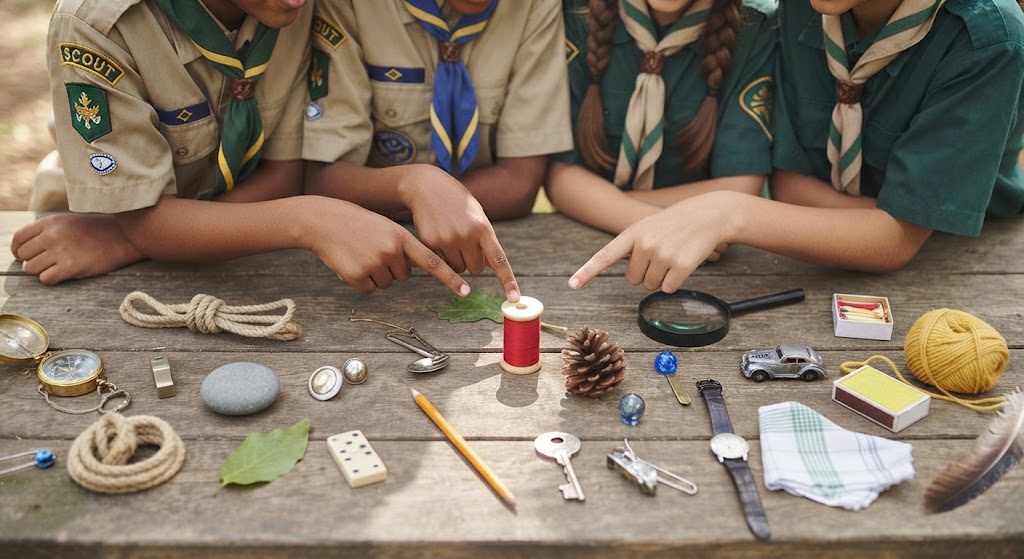
Place a selection of objects where everyone can see them.
Give the group around one minute to study them before covering the objects.
Ask participants to name or write down everything they remember.
Start with approximately 8–10 objects and increase the number if the group finds the activity easy.
2. Play “What Has Changed?”
Arrange several objects or features in a particular way.
Give everyone time to study the arrangement.
Ask participants to turn away while you make one change.
This could be moving an object, removing something or swapping two objects.
Let the group look again and identify the change.
Once they become confident, make two or three changes.
3. Try a visual sequence
Arrange several objects in a particular order.
Give participants a short time to memorise the sequence.
Cover the objects and mix them up.
The group must then recreate the original order.
For a harder version, allow only one participant at a time to view the original arrangement before returning to tell their team how to recreate it.
4. Use a memory relay
Divide the group into teams.
Place an arrangement, picture or short piece of information at a location where participants can view it.
Only one team member can look at it at a time.
They return to their team and describe what they saw.
The next person can then go and check the information.
The team must eventually recreate the arrangement or write down the information correctly.
Keep the distance short and use a safe, unobstructed route.
5. Try the listening memory game
Ask everyone to sit quietly and listen to a series of sounds.
You can make simple sounds yourself or use naturally occurring sounds in the environment.
Afterwards, ask participants to remember the sounds and their order.
For example, you might make a clap, tap a table, shake some keys and knock on a container.
The group then identifies the sounds or recreates the sequence.
This provides a useful reminder that observation isn’t only visual.
6. Play “Who Moved?”
Ask participants to study the appearance and position of people in the group.
Everyone closes their eyes while one or more participants quietly change position.
The group looks again and tries to identify who has moved.
For younger groups, move one person at a time.
For older groups, several people can change position.
Keep the activity stationary so participants aren’t moving around with their eyes closed.
7. Try the descriptive memory challenge
Show participants an object for a short period.
Remove it and ask them to describe it as accurately as possible.
Instead of simply asking what the object was, ask for details such as its size, shape, colour, markings and material.
Compare the descriptions with the actual object.
This demonstrates how easily people can remember the general appearance of something while forgetting smaller details.
8. Use the surrounding environment
Choose an area containing several noticeable features.
Give the group a minute or two to observe it.
Move them somewhere else and ask questions about what they saw.
For example:
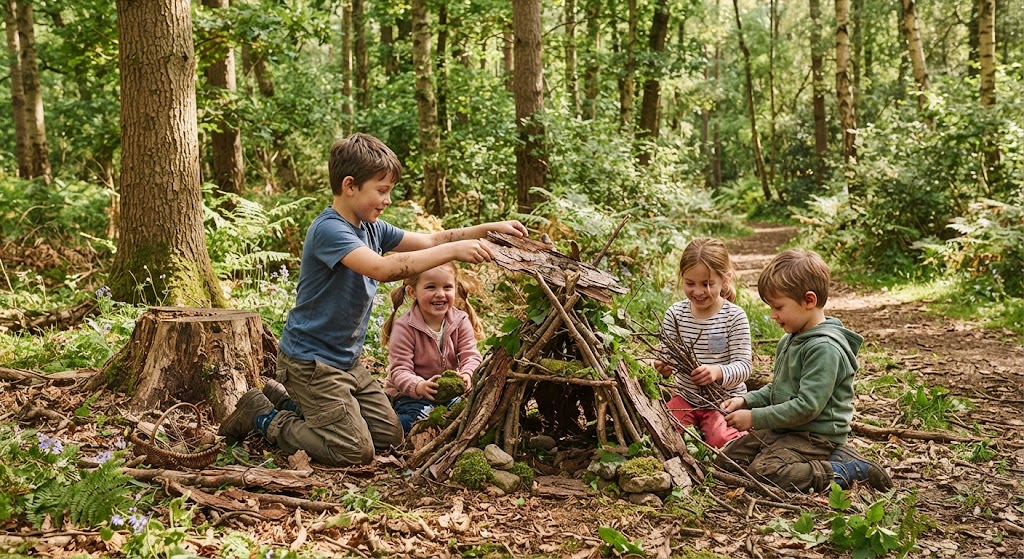
This works particularly well outdoors because there are many natural details to observe.
9. Introduce a team memory challenge
Give each team a collection of objects to remember.
After the observation period, remove the objects and ask the team to agree on everything they can recall.
Compare the team’s combined answer with what each participant remembered individually.
This can demonstrate how people notice different things.
One person might remember colours, another positions and another small objects that everyone else missed.
10. Increase the challenge
There are several ways to make these games progressively harder.
Reduce the observation time.
Increase the number of objects.
Introduce similar-looking objects.
Ask participants to remember positions.
Add a sequence or order.
Ask for specific details rather than simple identification.
Introduce distractions such as background conversation, provided they remain appropriate for the age and group.
Increase difficulty gradually so participants can see their skills improving.
11. Give the group a practical observation task
Use camping or outdoor equipment to create a realistic challenge.
Place several pieces of equipment in an arrangement and give participants time to observe them.
Cover the equipment and ask them to recreate the arrangement.
Alternatively, show them a small campsite setup and ask them to remember what equipment was present.
This gives the activity a practical context without turning it into a formal skills test.
12. Finish with a discussion
Ask participants what techniques helped them remember.
Some may have grouped objects together, remembered a sequence or created a mental picture.
Discuss whether they found it easier to remember objects, positions, colours or sounds.
The aim is to help participants recognise that observation can be improved by using deliberate techniques.
Final Tip
Avoid making memory games purely about getting the highest score. The real skill is learning how to observe deliberately.
Encourage participants to develop their own memory techniques, then repeat the same type of game later. Seeing their scores improve can be a simple and effective way of demonstrating that careful observation is a skill that can be practised.
🔒Ready to test your survival skills?
Join Survival Guides UK for free, complete challenges, earn badges and increase your Survival Level.
JOIN FREE →
CRAIG BURR
FOUNDER · SURVIVAL GUIDES UK
I'm Craig, the person behind Survival Guides UK. I created SGUK because I wanted somewhere people could learn real outdoor skills in a practical, straightforward way — from lighting a fire and tying knots to navigation, campcraft and everything in between.
You can read more about the story behind SGUK here as well as our approach here.