Historical Signalling
Activity Overview
Difficulty: Beginner
Time: 45–60 minutes
Location: Suitable indoor or outdoor training area
Best for: Scouts, Explorers and outdoor enthusiasts
Skills: Communication, signalling, observation, Morse code, semaphore, teamwork, concentration
Before mobile phones, digital radios and satellite communications, people had to find other ways of sending information over distance.
Historical signalling methods included semaphore, Morse code, flags, whistles, mirrors, lamps and other visual signals.
These methods are particularly well suited to Scout activities because they combine communication with concentration, teamwork and practical outdoor skills.
The aim isn’t simply to memorise an old signalling system. Historical signalling demonstrates an important principle:
A useful communication system needs to be understood by both the sender and the receiver.
What You’ll Learn
By the end of this guide, you’ll know how to:
- Understand why historical signalling was important.
- Use basic semaphore.
- Understand Morse code.
- Communicate with flags and whistles.
- Explore mirror and light signalling.
- Set up a simple signalling exercise.
- Improve accuracy when sending and receiving messages.
🟢 SAFETY – LOW RISK
Historical signalling is generally a low-risk activity.
The main hazards are environmental rather than related to the signalling techniques themselves.
Take care to:
- Choose a safe area with good visibility.
- Avoid signalling from roads or other hazardous locations.
- Don’t shine lights at aircraft, vehicles or other people.
- Don’t use mirrors in a way that could distract drivers or create a hazard.
- Keep participants clear of water, cliffs and other hazards when concentrating on signals.
- Make sure everyone understands that training signals should not be mistaken for genuine emergency signals.
Historical signalling should be practised as a controlled communication exercise.
Equipment
A simple session can require very little equipment.
Useful items include:
- Semaphore flags.
- Two small flags or improvised signalling flags.
- Morse code reference sheet.
- Whistle.
- Torch or signalling lamp.
- Signal mirror.
- Notebook and pencil.
- Two-way radios for comparison with modern communication.
You don’t need historically accurate equipment for every activity. Modern replicas can be used to demonstrate the principles.
Prerequisites
No previous signalling experience is required.
It helps to have:
- A clear understanding of left and right.
- Good concentration.
- A willingness to practise repeatedly.
- A partner or group to send and receive messages.
For outdoor exercises, establish clear boundaries and make sure everyone knows where they are allowed to go.
Instructions
1. Understand Why Historical Signalling Was Needed
Communication over distance has always been difficult.
A person shouting may only be heard a short distance away, while written messages require someone to physically carry them.
Signalling provided another option.
A system of agreed signals allowed information to travel between people who could not easily speak to one another.
This was particularly valuable for:
- Ships.
- Military units.
- Scouts.
- Explorers.
- Emergency situations.
- Outdoor expeditions.
The effectiveness came from standardisation.
Everyone involved needed to understand the same signals.
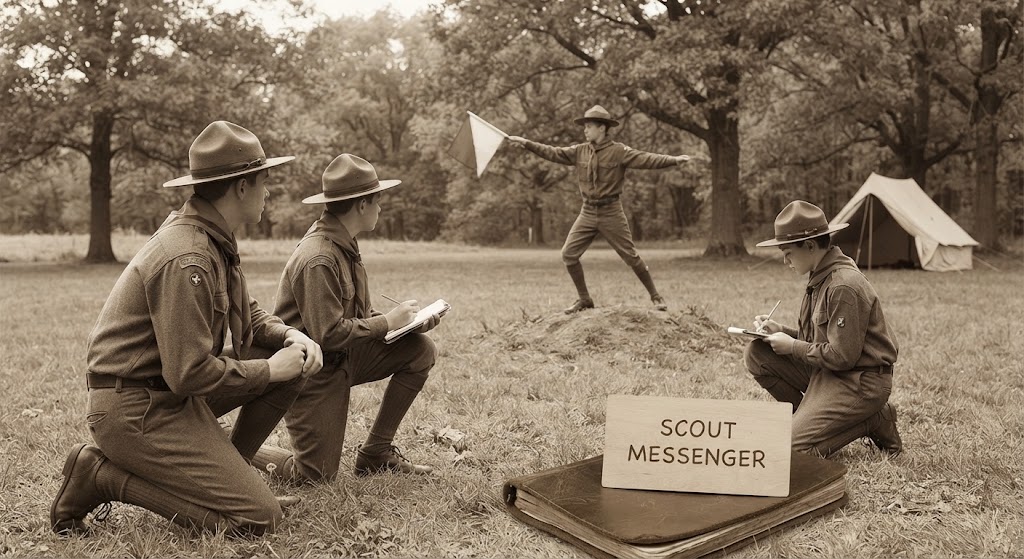
2. Learn Semaphore
Semaphore is one of the best-known traditional visual signalling systems.
It uses the positions of two flags to represent letters.
The sender holds a flag in each hand and moves them into specific positions. The receiver watches the positions and identifies the corresponding letter.
Start by learning a small number of letters rather than trying to memorise the complete alphabet immediately.
Practise recognising the positions before attempting to send complete words.
3. Practise Sending Semaphore
Once the basic positions are familiar, work in pairs.
One person sends a short word while the other writes down the letters.
Start with simple words.
The sender should:
- Hold the flags clearly.
- Pause between letters.
- Maintain consistent positions.
- Make sure the receiver can see the signals.
The receiver should concentrate on the position of the flags, rather than trying to guess the word.
This distinction is important.
Good signalling depends on accurately receiving the information rather than assuming what the sender intended.
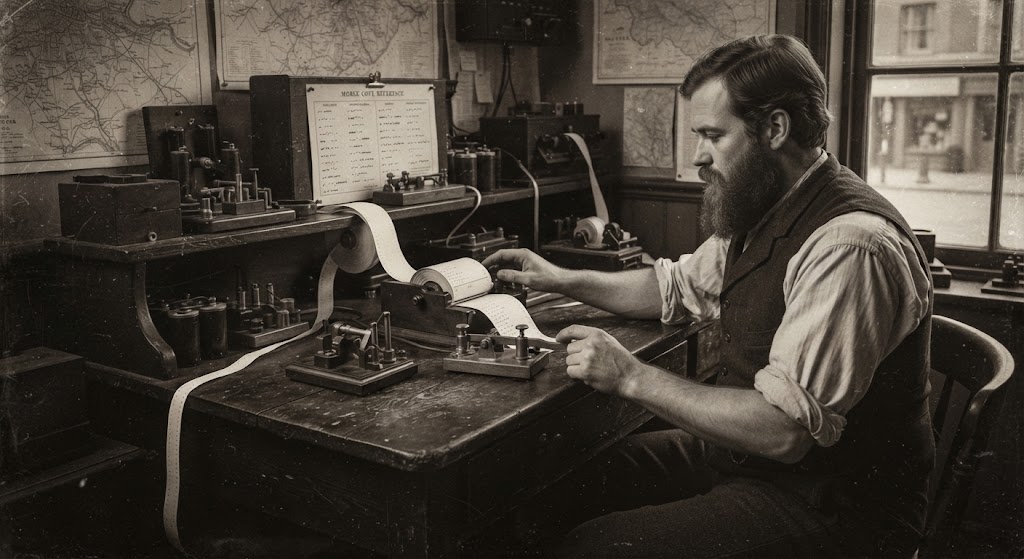
4. Learn Morse Code
Morse code represents letters and numbers using combinations of short and long signals.
These are commonly represented as:
Dot → short signal
Dash → long signal
Morse can be transmitted using sound, light or other suitable signals.
For Scouts, this makes it particularly versatile.
You can practise Morse using:
- A torch.
- A whistle.
- A buzzer.
- Tapping.
- A signalling lamp.
Start with a few simple letters and gradually increase the number you know.
5. Try Whistle Signalling
Whistles can carry much further than the human voice and can be useful when people are spread out outdoors.
A simple whistle-signalling exercise can use a small number of agreed signals rather than full Morse code.
For example, a group could establish signals for:
- Attention.
- Come back.
- Stop.
- Message ready.
The exact meanings should be agreed before the exercise begins.
This demonstrates an important historical signalling principle: the signal only has meaning because everyone has agreed what it means.
6. Experiment With Flags
Flags can be used for both semaphore and simpler visual signals.
Try sending a series of predetermined signals between two stations.
Increase the distance gradually while maintaining clear visibility.
You can also introduce an observation challenge where Scouts have to identify a signal from a distance and record what they see.
This develops attention to detail as well as communication skills.
7. Explore Light Signalling
Before modern electronic communications, lamps could be used to send messages over considerable distances when conditions allowed.
A torch can provide a simple modern demonstration.
Use short and long flashes to represent Morse code.
Practise at dusk or in another controlled environment where the signals can be seen clearly.
Never use powerful lights in a way that could distract road users, aircraft or other people.
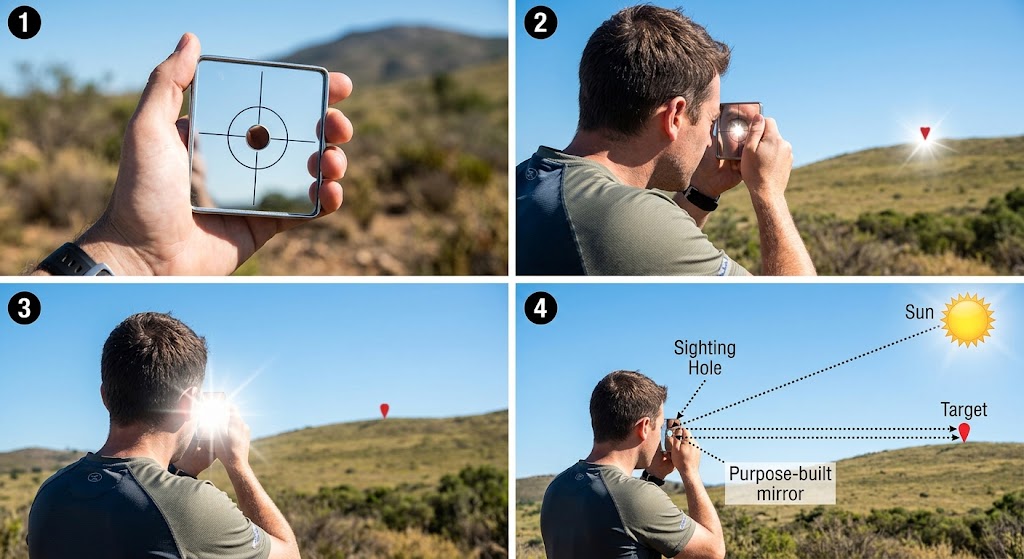
8. Try Mirror Signalling
A mirror can reflect sunlight towards a distant observer.
With suitable technique, the reflected flash can be used as a visual signal.
A training exercise can demonstrate how difficult it is to direct the reflection accurately.
Participants can work in pairs, with one attempting to signal and the other watching for flashes.
The exercise is particularly useful for demonstrating the importance of line of sight and positioning.
9. Build a Signalling Station
For a larger Scout activity, establish two signalling stations some distance apart.
Each station should have:
- A sender.
- A receiver.
- Signalling equipment.
- A message sheet.
- A pencil.
Give Station A a short message.
The sender transmits it to Station B.
The receiver writes down what they believe was sent and then reads the message back.
Compare the original and received messages.
Any differences demonstrate why signalling requires concentration and confirmation.
10. Introduce Longer Messages
Once Scouts are comfortable with individual letters and short words, introduce longer messages.
For example, messages could contain:
- A person’s name.
- A place name.
- A simple instruction.
- A number.
- A short sentence.
Don’t increase the difficulty too quickly.
If messages become inaccurate, return to shorter transmissions and improve technique before progressing.
11. Compare Historical and Modern Communication
Once several methods have been tried, compare them with modern communications.
| Historical method | Main limitation | Modern equivalent |
|---|---|---|
| Semaphore | Requires visibility | Digital messaging |
| Morse | Requires agreed code | Radio/data communication |
| Whistle signals | Limited information | Radio |
| Mirror signalling | Requires sunlight and visibility | Electronic signalling |
| Lamp signalling | Requires line of sight | Radio or satellite communication |
The comparison shows why newer technologies became so valuable.
However, many of the underlying skills remain useful.
A person who understands signalling also understands the importance of clarity, standardisation, confirmation and redundancy.
12. Create a Signalling Challenge
Finish with a team competition.
Set up several stations using different methods:
Station 1: Semaphore
Station 2: Morse code
Station 3: Whistle signals
Station 4: Flag signals
Station 5: Light signalling
Give each team a message to transmit.
Score them on:
- Accuracy.
- Speed.
- Clear signalling.
- Correct decoding.
- Teamwork.
Accuracy should matter more than simply being fast.
A fast message that contains errors isn’t a successful message.
13. Use Historical Scenarios
Give Scouts a historical-style scenario to make the exercise more meaningful.
For example:
A patrol is separated from its main camp and needs to communicate a simple message between two observation points.
The group must decide which signalling method is most appropriate.
They should consider:
- Distance.
- Daylight.
- Visibility.
- Noise.
- Equipment.
- Whether the receiver knows the signalling system.
This turns signalling from a memorisation exercise into a practical decision-making challenge.
14. Finish With a Review
Ask Scouts what they found most difficult.
Useful questions include:
- Which method was easiest to learn?
- Which was easiest to use at a distance?
- How did weather affect signalling?
- What happened when the receiver missed one signal?
- Why was standardisation important?
- Which historical method would still be useful if modern communications failed?
The answers help demonstrate that historical signalling was not simply about old equipment.
It was about finding reliable ways to communicate with limited resources.
Final Tip
A signal is only useful if the other person understands it.
Historical signalling teaches Scouts to communicate clearly, pay attention, use agreed systems and check that information has been received correctly.
Those principles are just as useful with a modern radio or phone as they were with a pair of semaphore flags.
🔒Ready to test your survival skills?
Join Survival Guides UK for free, complete challenges, earn badges and increase your Survival Level.
JOIN FREE →
CRAIG BURR
FOUNDER · SURVIVAL GUIDES UK
I'm Craig, the person behind Survival Guides UK. I created SGUK because I wanted somewhere people could learn real outdoor skills in a practical, straightforward way — from lighting a fire and tying knots to navigation, campcraft and everything in between.
You can read more about the story behind SGUK here as well as our approach here.