What Would You Take? Survival Kit Challenge
Activity Overview
Difficulty: Beginner
Time: 30 minutes
Group Size: 6-10
Best for: Cubs, Scouts
Skills: Survival awareness, teamwork, decision-making, prioritisation, problem-solving
Give each team a list of survival equipment and ask them to choose the items they would take if they had to spend a night outdoors with limited equipment.
The challenge is not simply about choosing the “right” equipment. Teams must explain their choices, decide what is most important and work together when they disagree.
What You’ll Learn
By the end of the activity, young people should understand that survival is about priorities rather than having lots of equipment.
They will practise:
- Identifying useful survival equipment
- Prioritising limited resources
- Explaining and defending decisions
- Working as a team
- Thinking about shelter, warmth, water and signalling
- Considering how one item can have several uses
🟢 SAFETY – LOW RISK
This is primarily a discussion and decision-making activity and can be run indoors or outdoors.
The main considerations are:
- Keep the activity area clear of trip hazards.
- If real equipment is used, check that it is safe to handle.
- Do not provide dangerous tools simply for demonstration.
- Make it clear that the scenario is fictional and that real survival situations require appropriate adult help and emergency services where necessary.
The leader should adapt the activity to the age, ability and circumstances of the group.
Equipment
You can run this activity with just paper and pens.
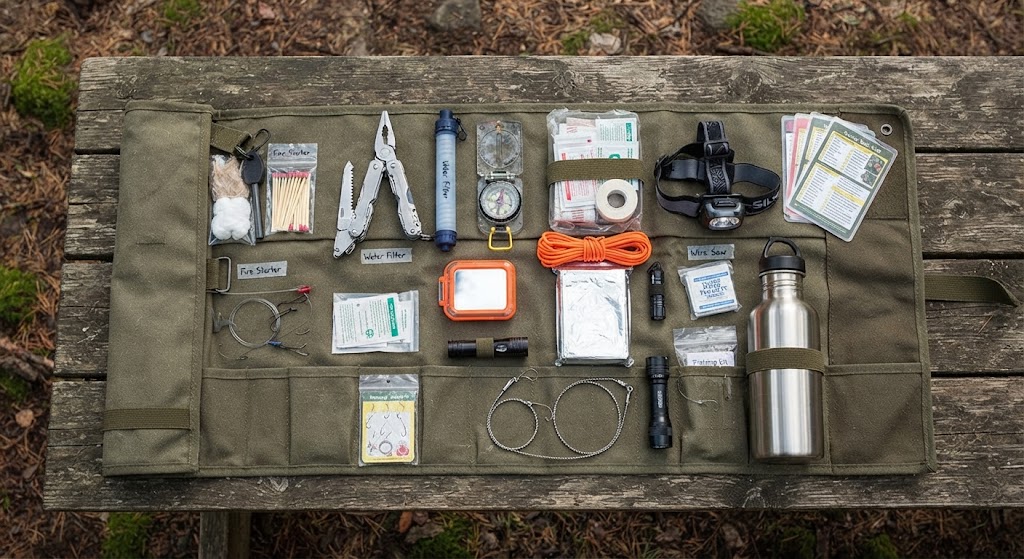
For a more practical version, provide a selection of real or representative items such as:
- Water bottle
- Torch
- Whistle
- Waterproof jacket
- First aid kit
- Emergency blanket
- Rope or cord
- Tarp
- Map
- Compass
- Food
- Fire-lighting equipment
- Knife
- Plastic bag
- Bin bag
- Hat
- Gloves
You will also need a list of additional items that are less useful, such as a book, football, toy, frying pan or large bottle of shampoo.
Prerequisites
No previous survival knowledge is required.
For younger Cubs, it can help to briefly introduce the basic survival priorities of shelter, warmth, water, signalling and staying safe before starting.
Instructions
- Split the group into teams of around 3–5.
- Tell the teams they are going on a short outdoor trip when something goes wrong. They need to stay safe until help arrives.
- Give each team a list of around 15–20 possible items.
- Explain that they can only choose 10 items to take with them.
- Give the teams around 10 minutes to discuss their choices.
- Ask each team to put their chosen items into order from most important to least important.
- Bring everyone together and ask each team to explain its top three choices.
- Encourage teams to challenge each other’s decisions. For example, why take a torch if you already have a phone? Why take rope? Could the tarp be more useful than a tent?
- Introduce a change to the scenario. For example:
- It is going to rain.
- Someone has become cold.
- It will be dark in two hours.
- You have no mobile phone signal.
- The group is further from help than expected.
- Give teams five minutes to reconsider their equipment choices.
- Finish by discussing which items became more important after the situation changed.
Make It Harder
Give each team only five items instead of ten.
Alternatively, give every team the same five items and ask them to explain how they would use each item in more than one way.
Make It Easier
Use pictures instead of written equipment names.
For younger Cubs, reduce the choice to around 10 items and ask them to select five.
Final Tip
Don’t focus too heavily on finding a single “correct” answer. The most useful part of this activity is getting young people to explain their thinking and reconsider their decisions when the situation changes.
🔒Ready to test your survival skills?
Join Survival Guides UK for free, complete challenges, earn badges and increase your Survival Level.
JOIN FREE →
CRAIG BURR
FOUNDER · SURVIVAL GUIDES UK
I'm Craig, the person behind Survival Guides UK. I created SGUK because I wanted somewhere people could learn real outdoor skills in a practical, straightforward way — from lighting a fire and tying knots to navigation, campcraft and everything in between.
You can read more about the story behind SGUK here as well as our approach here.