Nature Scavenger Hunt
Activity Overview
Difficulty: Beginner
Time: 30 minutes
Group Size: 11-20
Best for: Squirrels
Skills: Observation, teamwork, nature awareness, communication, listening
Take the Squirrels outside and challenge them to find a series of natural objects or signs without damaging the environment.
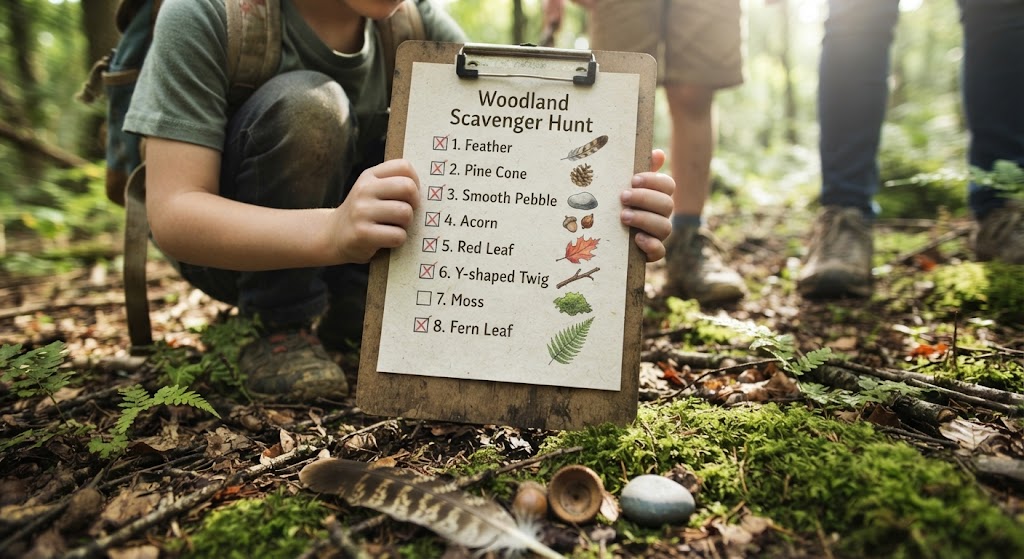
They can work in small teams or as one large group, looking for things such as a feather, a different-shaped leaf, moss, a smooth stone or evidence of an animal.
What You’ll Learn
This activity helps Squirrels develop their ability to:
- Observe their surroundings
- Notice small details
- Work together
- Identify simple natural features
- Listen to instructions
- Explore the outdoors responsibly
🟢 SAFETY – LOW RISK
Before starting, establish clear boundaries and explain that participants must stay within the agreed area.
Consider:
- Uneven or slippery ground
- Low branches and obstacles
- Brambles, nettles and thorny plants
- Ponds, streams or other water
- Ticks and biting insects
- Weather conditions
- Any plants, fungi or berries that could be harmful
Tell the group not to eat anything they find and not to pick, break or damage plants.
Young people should remain within the agreed boundaries and be appropriately supervised.
Equipment
- Scavenger hunt checklist
- Pencils or crayons
- Clipboards, if available
- Small bags for carrying approved items, if desired
- Optional: magnifying glasses
You can also run the activity without collecting anything by asking the Squirrels to find and point to each item.
Prerequisites
No previous knowledge is required.
Before starting, explain the boundaries and the basic rule:
Look, don’t damage.
Instructions
- Take the group to a suitable outdoor area and establish clear boundaries.
- Divide the Squirrels into small teams of 2–4.
- Give each team a scavenger hunt sheet.
- Explain that they need to find as many things on the list as possible within the time limit.
- Suitable challenges could include:
- Find a feather
- Find three different types of leaf
- Find something rough
- Find something smooth
- Find moss
- Find a stick shaped like a letter
- Find evidence that an animal has been nearby
- Find something smaller than your thumb
- Find something that makes a sound
- Find a natural object with an unusual pattern
- Give the teams around 15 minutes to explore.
- Call everyone back together and check what they found.
- Ask each team to show one interesting discovery and explain where they found it.
- Finish by asking the group what they noticed outside that they had never spotted before.
Make It Harder
Add observation challenges rather than simply asking participants to find objects.
For example:
Find a tree with three different types of texture.
Or ask teams to remember five things they saw and describe them when they return.
Make It Easier
Use pictures instead of written descriptions.
For very young Squirrels, run the hunt as one group and find each item together.
Final Tip
Don’t worry about who finds the most items. Encourage the Squirrels to slow down and look carefully — the best discoveries are often the things they would normally walk straight past.
🔒Ready to test your survival skills?
Join Survival Guides UK for free, complete challenges, earn badges and increase your Survival Level.
JOIN FREE →
CRAIG BURR
FOUNDER · SURVIVAL GUIDES UK
I'm Craig, the person behind Survival Guides UK. I created SGUK because I wanted somewhere people could learn real outdoor skills in a practical, straightforward way — from lighting a fire and tying knots to navigation, campcraft and everything in between.
You can read more about the story behind SGUK here as well as our approach here.