
30-Minute Activity Plan: Campcraft Challenge
A well-organised campsite can make outdoor activities much easier.
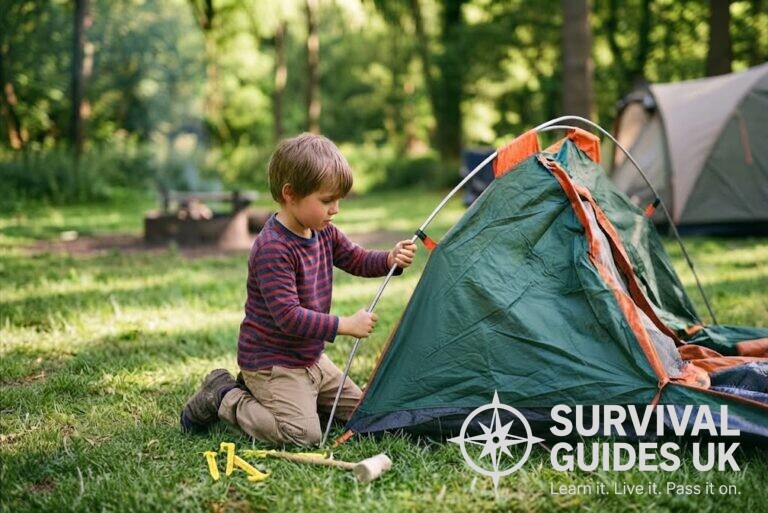
Campcraft is the collection of practical skills that help Scouts set up, organise and look after a campsite. It includes simple things such as deciding where equipment should go, keeping a working area tidy and making sure useful items are easy to find.
The Campcraft Challenge turns these everyday skills into a short team activity. Scouts are given a fictional campsite to organise and must decide how to make it practical, safe and easy to manage.
Activity Overview
Time: 30 minutes
Group size: 6–30 Scouts
Age: Adaptable for Cubs and Scouts
Location: Indoors or outdoors
Equipment: Cones, rope, camping equipment, paper, pencils and optional campsite layout cards
The aim is to develop organisation, planning, teamwork and awareness of how a campsite can be arranged effectively.
Before You Start
Choose a safe area where you can create a simple campsite layout.
If working indoors, use cones, chairs or pieces of paper to represent tents, cooking areas, equipment stores and other campsite features.
You can also draw a campsite layout on paper and ask teams to plan where everything should go.
Don’t use actual fires, cooking equipment or other hazards during this activity.
0–5 Minutes: What Makes a Good Campsite?
Ask the Scouts:
“What makes a campsite work well?”
Let them suggest ideas.
They might mention keeping equipment tidy, having enough space, knowing where things are and keeping different activities organised.
Then ask:
“What could make a campsite difficult or unsafe to use?”
Introduce the idea that a campsite isn’t just somewhere to put a tent. It needs to be planned so people can move around, work and relax without creating unnecessary problems.
5–15 Minutes: Build the Campsite
Divide the Scouts into small teams.
Give each team a selection of campsite features to place on a blank layout.
These could include:
Ask teams to decide where they would place each feature.
They should be prepared to explain their decisions.
Encourage them to think about how people will move around the campsite and which activities might need to be kept separate.
There isn’t necessarily one perfect layout.
The important part is the reasoning behind their decisions.
15–25 Minutes: Campcraft Problems
Now introduce problems that might occur at the campsite.
Scenario 1: Wet Equipment
Some equipment has become wet after rain.
Where could it be placed so that it can dry without creating a mess or obstruction?
Scenario 2: Missing Kit
Something important can’t be found.
What could the team change about its equipment storage to make this less likely?
Scenario 3: Busy Campsite
Several groups are trying to use the same area at once.
How could the campsite layout be changed to improve movement?
Scenario 4: End of Camp
It’s time to leave.
What should the team check before packing everything away?
Ask the teams to suggest solutions and explain why they would work.
25–30 Minutes: The Campsite Check
Finish with a quick campsite inspection challenge.
Ask Scouts to imagine that their team is about to leave the campsite.
Give them two minutes to identify everything they should check.
Encourage answers such as:
Equipment accounted for
Rubbish removed
Area left tidy
Personal belongings collected
Equipment checked and packed appropriately
No unnecessary damage to the site
Then ask:
“If another group arrived after us, what would we want them to find?”
Use the question to reinforce the importance of leaving a campsite clean, organised and ready for others.
Safety
This activity should not involve lighting fires, operating stoves or using hazardous tools.
If using actual camping equipment, check it beforehand and remove damaged or unsuitable items.
Keep the activity area clear and avoid creating trip hazards with ropes, bags or other equipment.
Any real campsite layout must follow the site’s rules and the activity’s risk assessment.
The adult leader remains responsible for deciding where equipment and activities can safely be located.
Leader Notes
This activity works particularly well when Scouts are allowed to disagree.
Different teams may produce very different campsite layouts, and that’s a useful opportunity to discuss why they made their choices.
For Cubs, keep the layout simple and concentrate on tidiness, organisation and knowing where equipment belongs.
For Scouts, introduce additional considerations such as weather, movement around the site and keeping different activities appropriately separated.
You can also run the activity using a simple drawn campsite plan, making it possible to use even when weather prevents an outdoor session.
If you have a real camp coming up, use this activity to get Scouts thinking about how they could organise their own equipment and patrol area.
Learning Outcomes
By the end of the activity, Scouts should have had the opportunity to develop:
Final Thought for Leaders
Campcraft is often made up of small skills that don’t seem particularly exciting on their own.
Knowing where equipment belongs, keeping an area organised and thinking about how people move around a campsite can make a huge difference to how smoothly a camp runs.
Teaching Scouts these habits early helps them become more independent and responsible campers.
A good campsite isn’t necessarily the biggest or most impressive one. It’s one where everyone knows what they’re doing, equipment can be found easily and the site is left better organised than it was found.
🔒Ready to test your survival skills?
Join Survival Guides UK for free, complete challenges, earn badges and increase your Survival Level.
JOIN FREE →
CRAIG BURR
FOUNDER · SURVIVAL GUIDES UK
I'm Craig, the person behind Survival Guides UK. I created SGUK because I wanted somewhere people could learn real outdoor skills in a practical, straightforward way — from lighting a fire and tying knots to navigation, campcraft and everything in between.
You can read more about the story behind SGUK here as well as our approach here.