The Survival Challenge – 90-Minute Scout Activity Plan
A practical survival skills activity for Scouts built around a changing outdoor scenario.
Instead of teaching a series of unrelated survival skills, this session puts young people into a fictional situation where they have to make decisions, prioritise resources and adapt as the situation changes.
The challenge is designed to test thinking as much as practical skills. Teams won’t always have enough time, equipment or information to do everything they want, so they’ll need to decide what’s most important.
Activity Overview
Time: 90 minutes
Group size: 8–24 young people
Suitable for: Cubs and Scouts, with a simplified version for Beavers
Location: Indoors or outdoors
Main skills: Survival priorities, shelter, water awareness, communication, teamwork, planning and problem-solving
Teams are given a fictional survival scenario.
They begin with limited equipment and information and must decide what to do first.
As the activity progresses, new problems are introduced. The weather changes, equipment becomes unavailable and the team discovers additional information.
The aim isn’t to recreate a genuine survival situation. It is a controlled decision-making exercise that introduces sensible outdoor priorities.
Before You Start
Choose a scenario appropriate to the age and experience of your group.
A simple example is:
“Your team is on a day expedition when your planned route becomes unusable. You have several hours before you can return to your normal route. You need to stay together, stay safe and make a plan.”
Prepare equipment cards representing items the team might have available.
These could include:
You don’t need to use real survival equipment for everything. Cards or pictures often work better because they allow you to introduce and remove resources as the scenario develops.
If you include practical shelter or knot work, prepare the necessary equipment separately.
0–10 Minutes: The Scenario
Bring everyone together and introduce the story.
Tell them:
“You’re halfway through an outdoor expedition. The route ahead is no longer usable. You have your equipment, but you don’t know exactly how long the delay will last.”
Give each team its equipment cards.
Don’t tell them exactly what will happen.
Ask them to decide what their first three priorities should be.
You’ll probably hear suggestions such as finding shelter, finding water, contacting someone or working out where they are.
Don’t immediately tell them whether they’re right or wrong.
Instead ask:
“Why?”
The objective is to get them thinking about priorities rather than memorising a list of survival rules.
10–20 Minutes: Survival Priorities
Give teams a list of possible actions.
For example:
Find shelter
Keep warm
Find water
Eat food
Work out your location
Contact a responsible adult
Keep moving
Wait where you are
Explore the area
Teams have to rank them from highest to lowest priority for their particular scenario.
Then compare the answers.
Explain that there isn’t always one universal order.
The priorities depend on the environment, weather, injuries, available resources and how quickly help can be obtained.
However, some decisions are consistently important: staying calm, assessing the situation, avoiding unnecessary risk and communicating appropriately.
20–35 Minutes: Build a Safe Base
Now introduce the first practical challenge.
Tell teams:
“The weather is getting worse. You need somewhere suitable to shelter while you work out your next move.”
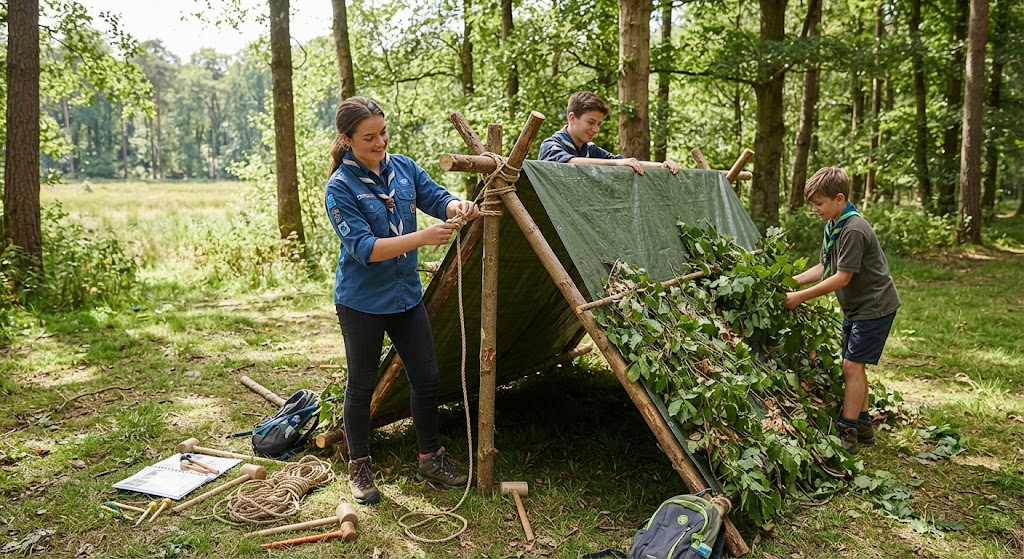
Give each team a tarp and rope, if appropriate.
They have to create a simple shelter or protected base area.
The emphasis should be on planning before construction.
Ask:
“Where would you put it?”
“Which direction should it face?”
“How will you keep it stable?”
“How will everyone use it?”
For Cubs, provide a basic shelter design.
Scouts can choose their own approach.
Don’t test shelters with young people inside unstable structures.
The leader should inspect each completed shelter before anyone uses it.
35–45 Minutes: The Situation Changes
Stop the activity and introduce a new piece of information.
For example:
“The weather forecast has changed. Heavy rain is expected for the next few hours.”
Give teams five minutes to reconsider their plan.
They might change their shelter, reorganise equipment or decide that their original plan isn’t appropriate.
Then introduce another complication:
“One member of the group has become tired and needs to rest.”
Ask:
“Does your plan still work?”
This demonstrates a key survival principle:
A good plan needs to be adaptable.
45–55 Minutes: Water Wise
Now introduce the group’s water supply.
Give each team several cards representing possible water sources.
For example:
Known safe drinking water
Clear stream
Pond
Rainwater
Unknown container
Ask teams to decide what they would do.
The important lesson is that finding water does not automatically mean finding safe drinking water.
Don’t have young people drink untreated water as part of the activity.
For Scouts, ask them to explain what information they would want before considering an unfamiliar water source.
For younger groups, keep the message straightforward:
“Take enough safe drinking water with you whenever possible.”
55–65 Minutes: Communication Challenge
Now tell the teams:
“Someone outside your group needs to understand your situation.”
Give them two minutes to prepare a clear message.
They need to explain:
Who they are
Where they believe they are
What has happened
Whether anyone needs help
What they plan to do
For younger sections, this can simply be a verbal message to a leader.
For Scouts, make it more challenging by giving them incomplete information and asking what they should confirm before communicating.
Explain that saying:
“We’re lost.”
doesn’t provide much useful information.
A good message gives the listener enough information to understand the situation and make sensible decisions.
65–75 Minutes: The Equipment Failure
Now remove one important item from each team’s equipment cards.
For example:
“Your main torch isn’t working.”
Or:
“Your map has become damaged.”
Ask:
“What changes?”
Teams must adapt their plan without simply receiving replacement equipment.
This is a useful opportunity to discuss redundancy and backup planning.
A sensible outdoor plan shouldn’t depend entirely on one piece of equipment working perfectly.
For older Scouts, ask them to identify another item they would ideally have brought as a backup.
75–83 Minutes: Final Survival Decision
Give each team one final scenario.
For example:
“You now have a clear idea of where you are. The weather is poor, one person is tired and you know the safest route back isn’t straightforward. You have a way to communicate with your leader.”
Ask:
“What is your plan?”
Teams have five minutes to prepare their response.
They should explain what they would do, why they would do it and what information they would communicate.
Don’t reward teams simply for choosing the most adventurous option.
A sensible plan that reduces unnecessary risk should score highly.
83–90 Minutes: Survival Debrief
Bring everyone together.
Ask each team to identify:
One decision they got right
One thing they would change
One piece of equipment they valued most
Then ask the most important question:
“What was the biggest survival skill today?”
The strongest answer isn’t necessarily shelter, fire or food.
It’s making sensible decisions.
Finish by reminding the group that real emergencies are unpredictable, which is why preparation and communication are so important.
Adapting for Different Ages
Beavers
Keep the scenario short and reassuring.
Instead of a survival situation, use a “camp problem-solving adventure”.
Give Beavers three or four equipment cards and ask them to decide what they would need first.
Focus on:
Stay together
Stay warm and dry
Tell an adult
Don’t take unnecessary risks
A simple tarp-building or equipment-identification challenge can replace the more complex survival sections.
Cubs
Cubs can handle the full scenario with simpler decision-making.
Give them a selection of equipment and several changes in circumstances.
Let them build a basic shelter and practise communicating their situation.
The focus should be on priorities, teamwork and adapting to problems.
Scouts
Give Scouts greater freedom.
Don’t tell them which survival priorities they should choose.
Introduce weather information, limited equipment, navigation problems and communication constraints.
Ask them to justify every major decision.
For experienced Scouts, give each team a different scenario so that they discover that survival priorities aren’t identical in every situation.
Safety
This activity should simulate survival rather than actually placing young people in a survival situation.
Never deliberately leave a young person lost, cold, wet or without access to appropriate food, water, shelter or adult supervision.
All practical outdoor work must take place in a known and controlled area.
If constructing shelters, check the structures carefully and don’t allow young people inside anything unstable.
Don’t use real untreated water for drinking.
If fire-lighting is introduced as an extension activity, use appropriate supervision, equipment and procedures.
Keep ropes, tarps and other equipment organised to reduce trip hazards.
Don’t introduce cold exposure, deliberate soaking, isolation or other “realistic” survival tests.
The challenge should test decision-making, not physical endurance or discomfort.
Leader Notes
The most important part of this activity is the debrief.
A team may make a decision that you wouldn’t have made yourself. Instead of immediately saying it’s wrong, ask them what information they based it on.
Then introduce another piece of information and ask whether that changes their decision.
This teaches something much more valuable than memorising a survival checklist.
It teaches young people to assess, decide and reassess.
Avoid presenting survival as a collection of dramatic tricks.
For a Scout group, the most useful survival skills are often very ordinary:
knowing where you are, dressing appropriately, carrying enough water, staying together, communicating clearly, recognising changing conditions and avoiding unnecessary risks.
You can also run this activity again later with a completely different scenario.
For example, one session could involve a winter hiking problem while another involves a summer campsite problem.
The structure stays familiar while the decisions change.
Learning Outcomes
By the end of the activity, young people should have had opportunities to:
Final Thought for Leaders
Survival skills are often presented as impressive tricks: lighting fires, building shelters or finding food.
Those skills can certainly be useful, but good judgement is arguably the most important survival skill of all.
The Survival Challenge gives young people a safe way to practise that judgement.
They learn that the best decision isn’t always the most exciting one. Sometimes it’s stopping, checking the situation, staying with the group and asking for appropriate help.
That’s a lesson worth carrying into every outdoor adventure.
🔒Ready to test your survival skills?
Join Survival Guides UK for free, complete challenges, earn badges and increase your Survival Level.
JOIN FREE →
CRAIG BURR
FOUNDER · SURVIVAL GUIDES UK
I'm Craig, the person behind Survival Guides UK. I created SGUK because I wanted somewhere people could learn real outdoor skills in a practical, straightforward way — from lighting a fire and tying knots to navigation, campcraft and everything in between.
You can read more about the story behind SGUK here as well as our approach here.