
60-Minute Activity Plan: Campcraft Olympics
A fast-moving Scout campcraft activity made up of short practical challenges rather than one long task.
Teams move through a series of campcraft stations, earning points for completing challenges safely, accurately and as a team.
The format keeps everyone active and gives young people the chance to practise several different outdoor skills in one session without turning the evening into a traditional skills lesson.
Activity Overview
Time: 60 minutes
Group size: 8–24 young people
Suitable for: Beavers, Cubs and Scouts
Location: Outdoors or a large indoor space
Main skills: Campcraft, knots, teamwork, practical problem-solving and organisation
Set up several stations around the activity area.
Teams spend a fixed amount of time at each station before moving to the next.
Possible challenges include tying a useful knot, packing a rucksack, putting up a simple tarp, transporting equipment, identifying camping equipment and solving a practical camp problem.
The winning team doesn’t have to be the fastest. Award points for safe working, teamwork and good technique as well as completion.
Before You Start
Choose four or five challenges that suit the equipment and experience of your group.
A good combination is:
Knot Station – tie specified knots and explain what they could be used for.
Pack Station – pack a rucksack for a fictional day hike.
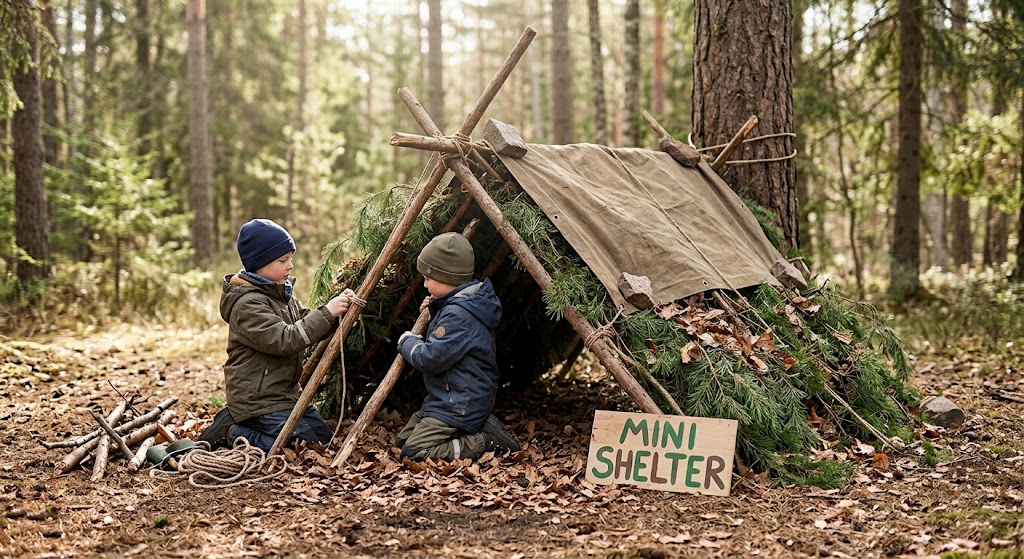
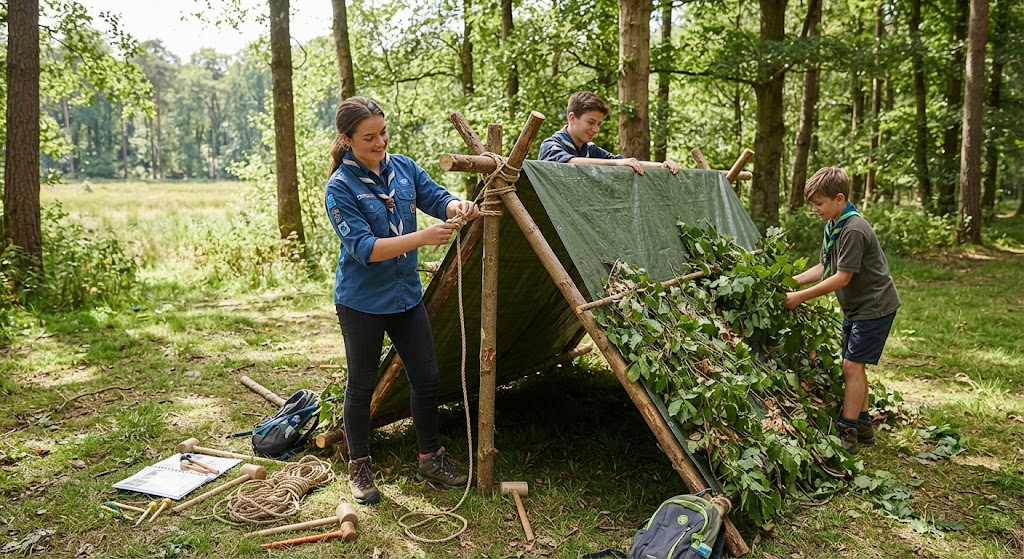
Tarp Station – create a simple shelter or shelter arrangement.
Camp Equipment Station – identify equipment and decide what it is useful for.
Team Transport Station – move equipment across a marked area using a specified method.
Set up each station before the meeting starts.
Give each team a scorecard.
You don’t need elaborate prizes. The challenge itself should provide most of the motivation.
Safety
Complete a risk assessment appropriate to your equipment, location and activities.
Make sure all equipment is suitable and in good condition.
Keep ropes, poles and other equipment organised so that they don’t create unnecessary trip hazards.
Don’t allow young people to climb structures or use unstable shelters.
Any stove, fire or other heat source should only be included if it can be properly supervised and is appropriate for the group.
For a simpler version, leave heat sources completely out of the competition.
Make sure there is enough space between stations so teams don’t interfere with each other.
0–8 Minutes: Welcome to the Olympics
Gather everyone together and explain the format.
Tell them:
“Today you’re not competing to be the fastest team. You’re competing to be the best campcraft team.”
Explain that points will be awarded for:
Skill
Teamwork
Safety
Problem-solving
Give each team its scorecard.
Make it clear that deliberately rushing or ignoring safety rules can lose points.
This immediately establishes that outdoor skills are about doing things properly rather than simply doing them quickly.
8–13 Minutes: Demonstration Round
Before teams split up, demonstrate each challenge briefly.
Don’t teach the complete skill again if the young people already know it.
Instead, explain exactly what each station requires.
For example:
“At the knot station you’ll have three minutes to tie two knots and explain when you might use them.”
This prevents teams from wasting time trying to understand the rules once the competition starts.
13–43 Minutes: The Campcraft Circuit
Teams rotate around the stations.
Allow approximately six minutes per station, with short transitions between them.
Station 1: Knot Relay
Give each team a short length of rope.
Call out practical challenges such as:
“Tie a knot that can join two ropes.”
or:
“Tie a knot that you could use to make a loop.”
Older Scouts can be asked to explain why they chose a particular knot.
Award points for correct technique rather than speed alone.
Station 2: Pack the Rucksack
Place a collection of objects on the ground.
Some are useful for the fictional journey, while others are unnecessary.
Give teams a scenario such as:
“You’re going on a half-day countryside walk in changeable weather.”
They need to decide what belongs in the rucksack and how it should be organised.
This tests judgement rather than simply recognising equipment.
Station 3: Tarp Challenge
Give teams a tarp and rope.
Their task is to create a simple useful shelter or covered area.
For younger groups, provide a basic design.
For Scouts, simply give them the objective and let them decide how to achieve it.
Award points for stability, practicality and teamwork.
Station 4: Camp Equipment Detective
Place camping equipment around the station.
Include familiar objects alongside less obvious ones.
Teams must identify each item and explain what it could be used for.
For older Scouts, include a few deliberately unsuitable items and ask them to explain why they wouldn’t take them on a particular trip.
Station 5: Team Transport
Mark out a start and finish line.
Give the team several objects that need to be moved from one side to the other.
Add a restriction such as:
“Nobody may carry more than one object.”
or:
“The team must stay connected while moving.”
The objective is communication and planning rather than physical strength.
43–50 Minutes: The Final Challenge
Bring all teams together for one final challenge.
Give every team the same fictional camp problem:
“Your group has arrived at camp. It’s getting dark, rain is approaching and you have ten minutes to organise yourselves. What needs doing first?”
Give them a selection of equipment cards.
They must agree on their priorities.
There isn’t necessarily one perfect answer.
Look for sensible thinking around shelter, weather, equipment, communication and keeping the group organised.
For younger sections, reduce the number of choices and make the scenario simpler.
50–55 Minutes: Scoring
Bring the teams together.
Add up the scores while keeping the atmosphere positive.
If possible, award different achievements rather than only announcing first place.
For example:
Best Teamwork
Best Problem Solving
Best Campcraft
Best Safety Awareness
This allows different strengths to be recognised.
55–60 Minutes: What Did You Actually Learn?
Finish with a short reflection.
Ask:
“Which challenge would be most useful on a real camping trip?”
Then ask:
“Which challenge looked easy until you tried it?”
Use the answers to reinforce the idea that campcraft is a collection of small practical skills.
The ability to choose equipment, organise a workspace, tie a useful knot or solve an unexpected problem can make a significant difference to a camping experience.
Adapting for Different Ages
Beavers
Use three stations rather than five.
Keep the tasks simple and visual.
Good choices include equipment identification, a basic knot challenge and a teamwork transport game.
Focus on having a go rather than scoring heavily.
Cubs
Use four or five stations.
Introduce simple time limits and allow Cubs to complete familiar skills with less adult direction.
The rucksack and equipment challenges work particularly well for this age group.
Scouts
Increase the problem-solving element.
Give Scouts fewer instructions and more responsibility for deciding how to complete each task.
Introduce constraints such as limited equipment, changing weather or a time pressure.
Ask them to explain their choices, not simply demonstrate the skill.
Leader Notes
The great advantage of this format is flexibility.
If one station isn’t working, you can shorten it or replace it without affecting the rest of the session.
Try to avoid making every challenge about speed.
A young person who ties a knot correctly and explains its use has demonstrated more useful campcraft than someone who finishes first by rushing.
You can also reuse the overall Olympics concept with completely different stations later in the year.
That means the format stays familiar while the actual activities remain fresh.
For an advanced version, give each team a small number of campcraft points to spend on equipment before the challenges begin.
Teams then have to decide which equipment is worth taking.
Learning Outcomes
By the end of the activity, young people should have had opportunities to:
Final Thought for Leaders
Campcraft is rarely about one spectacular skill.
It’s the collection of small decisions and practical abilities that make an outdoor trip work.
The Campcraft Olympics lets young people experience that in a lively format. They get to practise familiar skills, discover gaps in their knowledge and learn from one another without spending an entire meeting sitting through demonstrations.
And because the challenges can be changed each time, you can run your own Campcraft Olympics more than once without simply repeating the same activity.
🔒Ready to test your survival skills?
Join Survival Guides UK for free, complete challenges, earn badges and increase your Survival Level.
JOIN FREE →
CRAIG BURR
FOUNDER · SURVIVAL GUIDES UK
I'm Craig, the person behind Survival Guides UK. I created SGUK because I wanted somewhere people could learn real outdoor skills in a practical, straightforward way — from lighting a fire and tying knots to navigation, campcraft and everything in between.
You can read more about the story behind SGUK here as well as our approach here.