Recreating Historical Scout Activities
Activity Overview
Difficulty: Intermediate
Time: 1–3 hours depending on the activity
Location: Suitable indoor or outdoor training area
Best for: Scouts, Explorers, leaders and history enthusiasts
Skills: Research, traditional camping skills, pioneering, navigation, signalling, teamwork, historical awareness
Recreating historical Scout activities can be a great way to understand how Scouting developed while practising practical outdoor skills.
Historical activities might include traditional pioneering, campcraft, signalling, navigation, cooking, patrol competitions, games and early camping techniques.
The aim isn’t to pretend that historical methods are automatically better. Instead, recreating an activity allows Scouts to experience the equipment, techniques and challenges that earlier generations of Scouts would have encountered.
The safest approach is to research the original activity, identify what has changed, remove unnecessary hazards and then recreate the experience using modern safety standards.
What You’ll Learn
By the end of this guide, you’ll know how to:
- Research historical Scout activities.
- Select suitable activities to recreate.
- Distinguish historical authenticity from modern safety.
- Adapt old equipment and techniques responsibly.
- Create period-inspired activities without unnecessarily increasing risk.
- Make historical activities engaging for a modern Scout group.
🟡 SAFETY – MODERATE RISK
The risk depends heavily on the historical activity being recreated.
A historical signalling game may be low risk, while recreating activities involving open fires, knives, axes, pioneering structures or cooking equipment can introduce considerably greater hazards.
The historical nature of an activity does not justify ignoring modern safety standards.
Before starting:
- Carry out a suitable risk assessment.
- Use modern safety equipment where appropriate.
- Supervise activities according to their actual hazards.
- Don’t recreate dangerous practices simply because they were historically used.
- Inspect ropes, poles, cooking equipment and other equipment before use.
- Make sure participants understand which parts of the activity are historical and which have been adapted for safety.
A useful rule is:
Recreate the experience, not the unnecessary danger.
Equipment
Equipment depends on the activity being recreated.
Useful items might include:
- Rope and pioneering poles.
- Compass and map.
- Whistle.
- Canvas-style shelter or modern equivalent.
- Cooking equipment.
- Simple campcraft tools.
- Notebook and pencil.
- Copies of historical photographs or instructions.
- Modern safety equipment where required.
You don’t necessarily need genuine antique equipment. Reproduction equipment or modern equipment used in a historically appropriate way can often provide a better and safer experience.
Prerequisites
No specialist historical knowledge is required.
Before beginning, decide:
- What period are you recreating?
- What activity are you recreating?
- What equipment would historically have been used?
- What would Scouts have been expected to learn?
- What needs to be changed for modern safety?
It can also be useful to research the activity using original Scout manuals, photographs, books and other reliable historical sources.
Instructions
1. Choose a Historical Period
Scouting has changed considerably over its history.
An activity from the early twentieth century may look very different from one from the 1950s, 1970s or 1990s.
Choose a specific period rather than trying to recreate “old Scouting” in general.
For example, you might choose:
- Early Scouting.
- Wartime Scouting.
- Post-war Scouting.
- A particular decade.
- The period associated with a particular Scout camp or event.
Having a defined period makes researching equipment, clothing, terminology and activities much easier.
2. Research the Original Activity
Find out what Scouts actually did rather than relying on modern assumptions about historical Scouting.
Look for:
- Original instructions.
- Photographs.
- Camp reports.
- Old Scout handbooks.
- Historical equipment.
- Games and competitions.
- Accounts written by participants.
Pay attention to the purpose of the activity.
Understanding why an activity was taught can be more interesting than simply copying the original instructions.
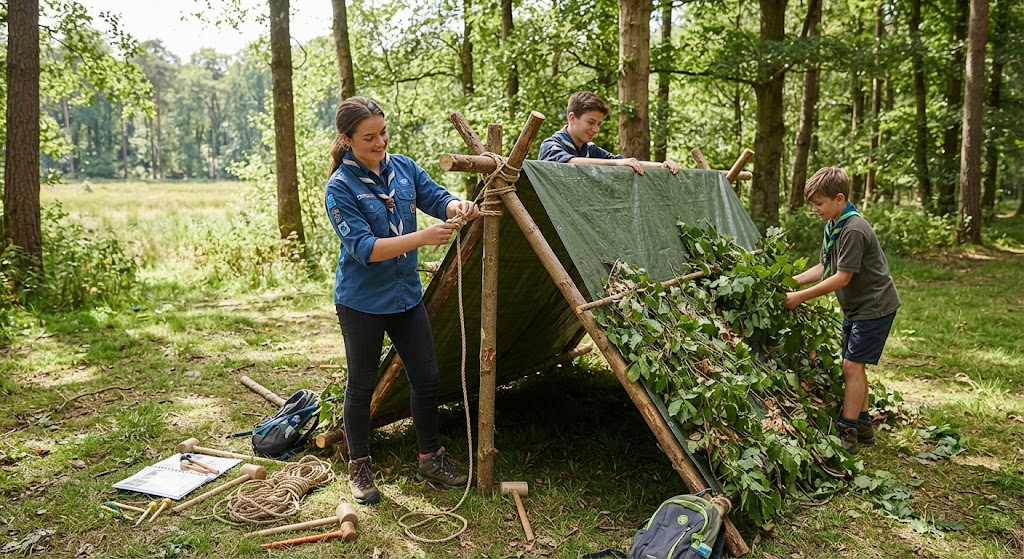
3. Recreate Traditional Campcraft
Traditional campcraft provides many opportunities for historical recreation.
Activities could include:
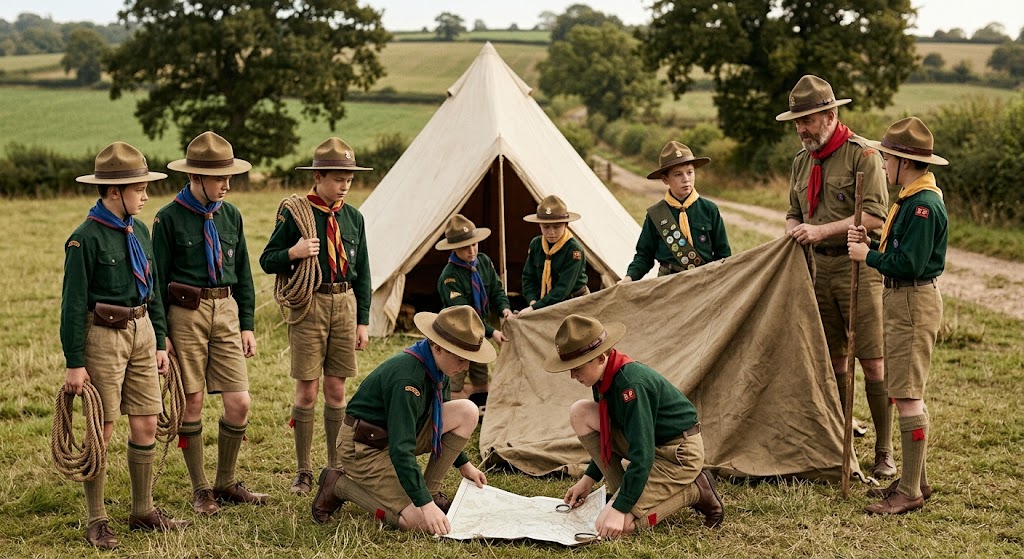
- Tent pitching.
- Camp gadgets.
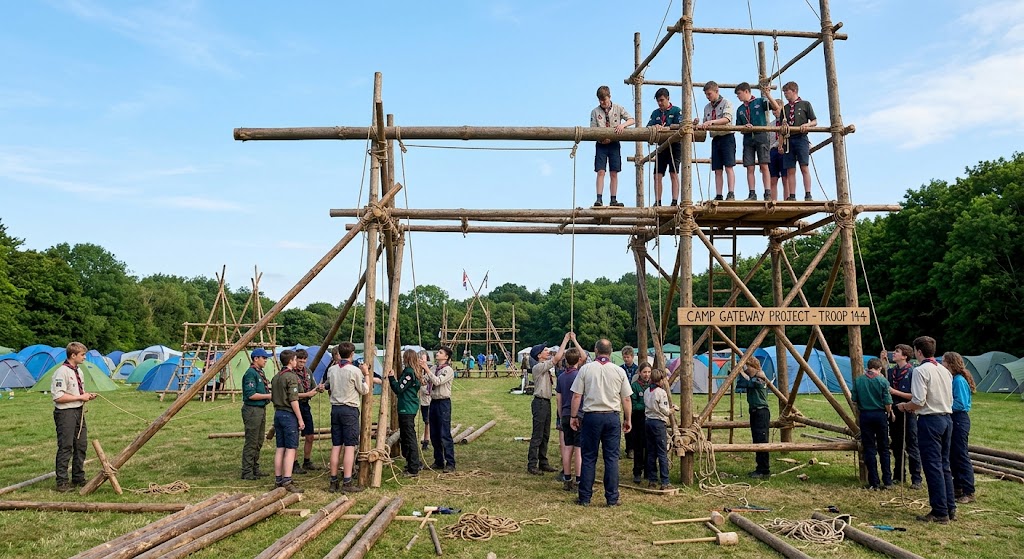
- Simple pioneering.
- Natural-material shelter building.
- Traditional campsite organisation.
- Ropework.
- Fire-lighting demonstrations.
A modern group can use the historical technique while still applying modern standards for equipment inspection, supervision and fire safety.
This allows Scouts to experience the skill without unnecessarily reproducing outdated hazards.
4. Try Historical Signalling
Signalling was an important part of traditional Scouting.
Depending on the period, activities could involve:
- Semaphore.
- Morse code.
- Flag signalling.
- Whistle signals.
- Torch signalling.
- Simple message relay games.
A good historical exercise is to divide the group into teams and have them transmit messages between two stations.
The activity becomes more interesting when Scouts discover how much concentration was required to communicate information without modern phones or radios.
5. Recreate Historical Navigation
Navigation is another excellent historical activity.
Instead of immediately giving everyone a modern GPS device, use:
- Map and compass.
- Pace counting.
- Natural landmarks.
- Bearings.
- Route cards.
- Simple navigation challenges.
Explain how Scouts historically had to rely on observation and basic instruments rather than digital mapping.
The objective is to experience the skill, not to make navigation artificially difficult or unsafe.
6. Explore Historical Cooking
Camp cooking has changed considerably over the years.
A historical cooking activity could investigate how Scouts prepared simple meals using the equipment available at the time.
Possible activities include:
- Preparing a simple camp meal.
- Cooking with basic utensils.
- Comparing historical and modern cooking equipment.
- Planning a period-appropriate camp menu.
- Investigating how food was stored.
Any cooking activity involving heat or flames should use modern fire and food-safety practices.
Don’t recreate unsafe historical food-handling practices simply for authenticity.
7. Run a Traditional Scout Competition
Historical Scout programmes often included games and competitions.
Create a series of challenges based on the period you’re studying.
For example:
Station 1: Knot tying
Station 2: Signalling
Station 3: Navigation
Station 4: Campcraft
Station 5: Observation
Station 6: Team problem-solving
Keep scoring simple.
The historical competition can then become a practical skills session rather than simply a history lesson.
8. Use Historical Clothing Carefully
Clothing can add atmosphere to a historical activity.
However, clothing should never interfere with safety.
For example, avoid historical clothing that:
- Restricts movement.
- Creates a trip hazard.
- Interferes with protective equipment.
- Is unsuitable for the weather.
- Creates an unnecessary fire risk.
A better approach is often to use period-inspired clothing for demonstrations while participants continue wearing suitable modern outdoor clothing.
9. Compare Then and Now
One of the most interesting parts of historical recreation is comparing old and modern methods.
After completing an activity, ask:
- What equipment has changed?
- What has become easier?
- What has become safer?
- What skills remain exactly the same?
- Would the historical method still be useful today?
- What would you change?
This turns the activity into a lesson about technological and social change.
10. Don’t Pretend Everything Was Better in the Past
Historical recreation should be informative rather than romanticised.
Older Scout activities may have involved equipment or practices that are no longer appropriate.
Some techniques may still be extremely useful.
Others may have been replaced because modern equipment is safer, lighter, more effective or more reliable.
The interesting question isn’t “Was Scouting better then?”
It is:
“What can we learn from how Scouts did things then?”
11. Build a Complete Historical Activity
For a larger event, create a complete period-inspired programme.
For example:
Morning: Historical navigation exercise
Late morning: Traditional pioneering
Lunch: Period-inspired camp cooking
Afternoon: Signalling competition
Late afternoon: Traditional Scout games
Evening: Historical campfire programme
Introduce each activity with a short explanation of what Scouts would have been doing at the time.
This gives participants a much stronger understanding of how the different skills fitted together.
12. Finish With a Review
After the activity, discuss what participants discovered.
Ask Scouts:
- Which activity was hardest?
- Which skill would still be useful today?
- Which historical piece of equipment surprised you?
- What modern equipment would you miss most?
- Which historical technique would you like to practise again?
A short review helps turn an enjoyable historical activity into a genuine learning experience.
Final Tip
Don’t try to recreate the past perfectly — try to understand it.
Historical Scout activities are most valuable when they show how earlier Scouts learned practical skills, solved problems and worked together.
Use historical methods where they are useful, modern safety standards where they are necessary, and the comparison between the two to help Scouts understand how outdoor skills have evolved.
🔒Ready to test your survival skills?
Join Survival Guides UK for free, complete challenges, earn badges and increase your Survival Level.
JOIN FREE →
CRAIG BURR
FOUNDER · SURVIVAL GUIDES UK
I'm Craig, the person behind Survival Guides UK. I created SGUK because I wanted somewhere people could learn real outdoor skills in a practical, straightforward way — from lighting a fire and tying knots to navigation, campcraft and everything in between.
You can read more about the story behind SGUK here as well as our approach here.