Historical Survival Methods
Activity Overview
Difficulty: Intermediate
Time: 1–3 hours depending on the activities selected
Location: Suitable indoor or outdoor training area
Best for: Scouts, Explorers and outdoor enthusiasts
Skills: Survival skills, historical awareness, fire lighting, shelter building, navigation, signalling, resourcefulness
Long before modern tents, GPS devices, synthetic clothing and lightweight camping equipment, people developed practical ways to survive outdoors using the materials and tools available to them.
Historical survival methods can provide excellent learning opportunities for Scouts. They demonstrate how people dealt with shelter, fire, water, food, navigation, warmth and communication without relying on modern technology.
Useful historical methods to explore include:
- Traditional shelter construction.
- Primitive and historical fire-lighting methods.
- Natural insulation.
- Traditional water collection and purification.
- Historical navigation.
- Natural and traditional cordage.
- Traditional food preservation.
- Historical signalling.
The aim isn’t to pretend that old techniques are better than modern equipment. It is to understand how people solved practical problems with limited resources.
What You’ll Learn
By the end of this guide, you’ll understand:
- How people historically approached outdoor survival.
- Why simple materials could be extremely valuable.
- How traditional techniques relate to modern survival skills.
- Which historical methods are suitable for Scout activities.
- How to recreate traditional skills without unnecessarily recreating historical hazards.
🟡 SAFETY – MODERATE RISK
Historical survival methods cover a wide range of activities, so the actual hazards depend on what is being practised.
Fire lighting, cooking, cutting tools and some shelter construction can introduce significant hazards.
When recreating historical methods:
- Use modern safety standards.
- Supervise activities according to their actual hazards.
- Don’t deliberately use unsafe historical equipment.
- Don’t consume wild plants or untreated water simply to make an activity more authentic.
- Keep fire and cutting-tool activities appropriately controlled.
- Stop an activity if weather or environmental conditions become unsuitable.
Historical authenticity should never take priority over sensible safety.
Equipment
The equipment depends on the method being explored.
Useful equipment can include:
- Natural cordage or suitable modern rope.
- Tarp or canvas-style shelter material.
- Flint and steel or other fire-lighting equipment.
- Cooking containers.
- Water containers.
- Map and compass.
- Simple signalling equipment.
- Suitable hand tools.
- Notebook for recording observations.
Modern equipment can be used alongside historical equipment to compare the two approaches.
Prerequisites
No specialist knowledge is required.
Before starting, Scouts should understand basic outdoor safety and be able to work responsibly as part of a group.
For activities involving fire, cutting tools, cooking or unfamiliar natural materials, make sure participants have the appropriate instruction and supervision first.
Instructions
1. Explore Historical Shelter Building
Shelter has always been one of the most important survival priorities.
People historically used whatever was available, including:
- Branches.
- Bark.
- Leaves.
- Grass.
- Animal hides.
- Wool.
- Canvas.
- Snow and earth in suitable environments.
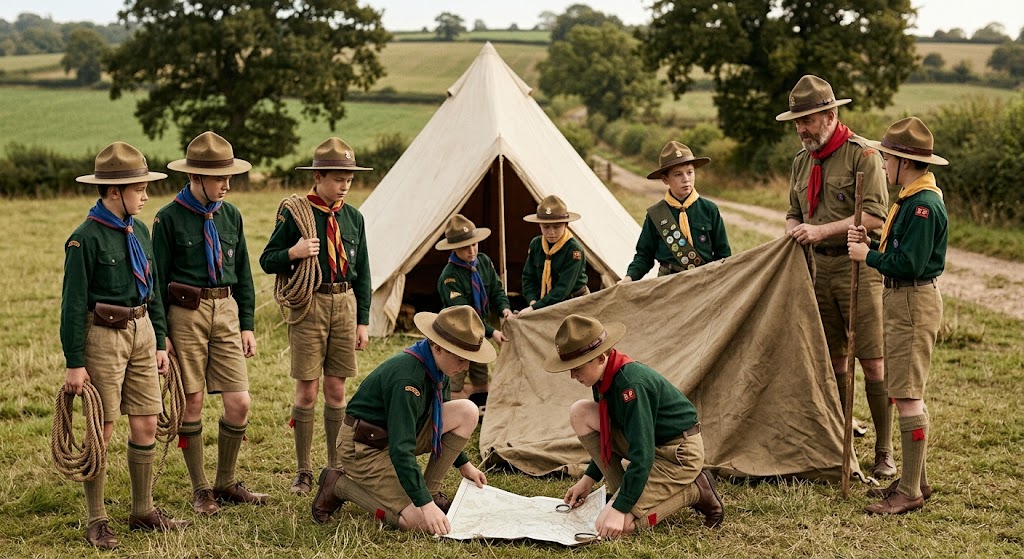
A simple historical shelter exercise could involve constructing a small lean-to or debris shelter using permitted natural materials.
The important lesson is that shelter does not have to be complicated.
A shelter needs to address the actual environmental problem, whether that is wind, rain, cold ground or excessive sun.
2. Try Historical Fire Lighting
Fire was essential for warmth, cooking, light and protection.
Different cultures and periods developed different methods of creating fire.
For a supervised demonstration, Scouts could explore methods such as:
- Flint and steel.
- Bow drill.
- Fire piston.
- Magnifying glass.
- Traditional tinder preparation.
The emphasis should be on understanding the principles involved.
For example, historical fire lighting demonstrates the importance of fuel, oxygen, heat and suitable tinder.
Modern fire-safety practices should still be used throughout.
3. Investigate Natural Insulation
Before modern sleeping mats and insulated clothing, people relied heavily on natural materials.
Dry vegetation, wool, fur and other materials could be used to reduce heat loss.
A simple experiment is to compare different insulating materials by placing them between a person and the ground or using them to insulate a container.
This demonstrates an important survival principle:
The material doesn’t need to look impressive to be effective.
Dry, trapped air is often a major part of what makes insulation work.
4. Study Historical Water Methods
Access to safe drinking water has always been a major survival concern.
Historically, people had to identify suitable water sources and develop ways of making water safer to drink.
For a training activity, Scouts can investigate:
- Where people historically obtained water.
- How they collected rainwater.
- How water was transported.
- How boiling was used.
- How different cultures developed water containers.
Don’t turn this into an exercise in actually drinking questionable water.
Use clean water for demonstrations and teach modern water-treatment practices when discussing real outdoor survival.
5. Learn Traditional Navigation
Modern navigation technology makes finding your position considerably easier, but people successfully travelled long distances using much simpler methods.
Historical navigation can involve:
- Map and compass.
- Following landscape features.
- Observing the sun.
- Understanding direction.
- Recognising landmarks.
- Using stars at night.
Scouts can complete a navigation exercise using map and compass while discussing how earlier travellers would have approached the same journey.
The lesson is observation.
A good navigator doesn’t simply follow an electronic arrow. They understand the landscape around them.
6. Investigate Traditional Cordage
Before modern synthetic ropes, people produced cordage from natural fibres.
Depending on the region and historical period, fibres could come from plants such as nettles, lime bast and other suitable materials.
A supervised demonstration can show how fibres are prepared and twisted together.
This teaches the principle of turning relatively weak individual fibres into a much stronger combined structure.
Traditional cordage can also be used to demonstrate how earlier people constructed shelters, traps, tools and other equipment.
7. Explore Historical Food Preservation
Before refrigeration, preserving food was essential.
Historical methods included:
- Drying.
- Smoking.
- Salting.
- Fermentation.
- Pickling.
These techniques provide an interesting way to explore how people extended the usable life of food.
A Scout activity could compare dried and fresh foods, investigate historical preservation methods or make a simple preserved food under appropriate food-safety conditions.
The important lesson is that survival includes managing resources before you actually need them.
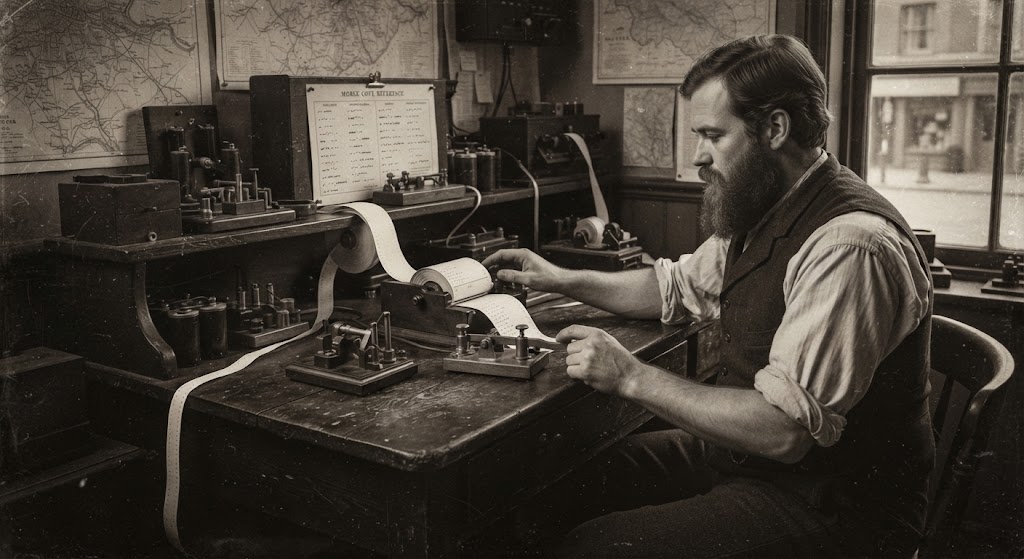
8. Study Historical Signalling
When people were separated from their group, communication could become extremely difficult.
Historical signalling methods included:
- Fire signals.
- Flags.
- Whistles.
- Mirrors.
- Torches.
- Semaphore.
- Morse code.
Scouts can recreate these as communication games.
For example, one team could transmit a short message using semaphore while another team records and decodes it.
This demonstrates why standardised signals were so valuable before modern communications.
9. Learn How Historical Travellers Carried Equipment
Survival isn’t just about knowing individual techniques.
People also had to decide what was worth carrying.
Historical expeditions often had to balance:
Weight → usefulness → durability → availability.
Give Scouts a hypothetical journey and ask them to select a limited number of items.
Then discuss why each item was chosen.
This introduces an important modern survival principle: carrying more equipment isn’t automatically better.
10. Compare Historical and Modern Methods
After each activity, compare the historical technique with its modern equivalent.
For example:
Historical: Natural shelter
Modern: Lightweight tent
Historical: Flint and steel
Modern: Lighter
Historical: Natural cordage
Modern: Synthetic rope
Historical: Map and landscape observation
Modern: GPS navigation
Ask:
- What did the historical method do well?
- What are its disadvantages?
- What has modern technology improved?
- Does the historical skill still have value?
- What would happen if the modern equipment failed?
This is where historical survival becomes particularly useful.
Scouts begin to understand that modern equipment is extremely helpful, but understanding basic principles gives you options when equipment doesn’t work.
11. Recreate a Historical Survival Challenge
Once several techniques have been learned, combine them into a single challenge.
Give the group a fictional historical scenario.
For example:
A small expedition has reached an unfamiliar area with limited equipment and must establish a temporary camp.
The team might need to:
- Choose a safe shelter site.
- Construct basic protection.
- Prepare suitable insulation.
- Establish a safe method of obtaining water.
- Create a signalling system.
- Navigate between two points.
- Explain how they would preserve or manage food.
Keep the scenario focused on skills rather than pretending that Scouts are genuinely stranded.
12. Understand What History Can Teach Us
Historical survival techniques are valuable because they show how people adapted to their surroundings.
They demonstrate:
- Resourcefulness.
- Observation.
- Planning.
- Patience.
- Understanding of materials.
- Efficient use of limited resources.
- Cooperation.
Some historical methods are still useful today.
Others have been replaced because modern technology is safer, faster or more efficient.
The real skill is knowing why something works, rather than simply copying an old technique.
Final Tip
Learn the principle, not just the historical trick.
A traditional shelter teaches insulation and weather protection. A historical fire-lighting method teaches heat and tinder. Traditional navigation teaches observation and direction.
Modern equipment makes survival easier, but understanding the underlying skills gives you the ability to adapt when conditions, equipment or circumstances change.
🔒Ready to test your survival skills?
Join Survival Guides UK for free, complete challenges, earn badges and increase your Survival Level.
JOIN FREE →
CRAIG BURR
FOUNDER · SURVIVAL GUIDES UK
I'm Craig, the person behind Survival Guides UK. I created SGUK because I wanted somewhere people could learn real outdoor skills in a practical, straightforward way — from lighting a fire and tying knots to navigation, campcraft and everything in between.
You can read more about the story behind SGUK here as well as our approach here.