Scouts Outdoor Skills
⚜️ Scouts: Build the Skills to Lead Your Own Adventure
You’ve already learned a lot.
You’ve explored the outdoors, learned basic navigation, discovered camping skills and started understanding how to deal with problems.
Now it’s time to take those skills further.
Being a Scout isn’t just about knowing how to do something.
It’s about knowing:
When should I use this skill?
Why does it matter?
What could go wrong?
What should I do if my original plan doesn’t work?
As you develop your skills, you’ll become more confident at making decisions, solving problems and taking responsibility for yourself and your team.
That’s what being an outdoor adventurer is really about.
💡 Scout Tip
Don’t measure your ability by how many skills you can demonstrate.
Measure it by whether you can choose the right skill at the right time.
🧭 Think Like an Outdoor Leader
You don’t have to be the person in charge to start thinking like a leader.
Good outdoor leaders constantly ask:
Where are we?
Where are we going?
How are we getting there?
What could affect our plan?
Is everyone coping?
What happens if something changes?
These questions help you make better decisions before problems develop.
🧠 SKILL BUILDER — SITUATIONAL AWARENESS
Situational awareness means understanding what’s happening around you and thinking about what it could mean.
It isn’t about worrying about everything that could go wrong.
It’s about noticing, thinking and responding appropriately.
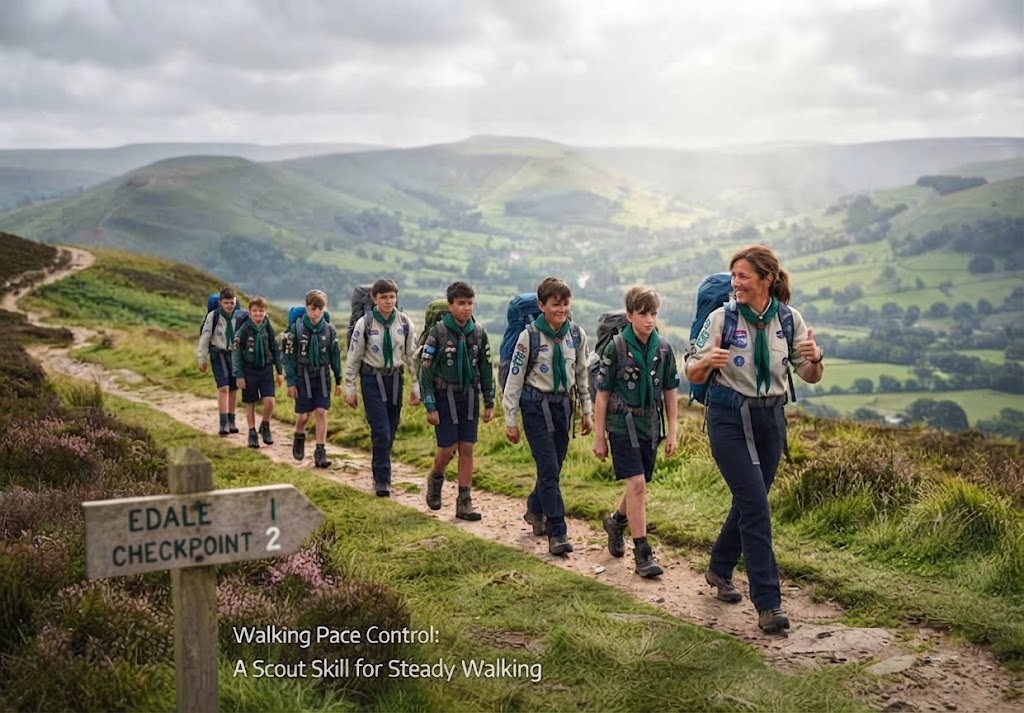
🗺️ Plan Your Route Properly
A route is more than a line drawn between two points.
Before setting out, consider:
📍 Start and finish
📏 Distance
⛰️ Terrain
🧭 Navigation
🌦️ Weather
⏱️ Time
💧 Water
🎒 Equipment
🆘 Emergency arrangements
🔄 Alternative options
Think about the people travelling with you too.
A route that’s easy for an experienced walker might be much harder for someone carrying a heavy pack or dealing with poor weather.
🗺️ SCOUT CHALLENGE
Choose a suitable route and create a simple route plan.
Include:
Start → Checkpoints → Destination → Alternative option
Estimate the distance and time.
Then explain your decisions to your leader.
Can you justify why you chose that route?
🧭 Navigate — Don’t Just Follow
Following someone else is easy.
Navigating yourself is different.
When you’re responsible for navigation, you need to continually compare:
MAP ↔ TERRAIN
Look at the map.
Then look around you.
Do the features you can see match what the map tells you should be there?
If not:
STOP.
Don’t continue hoping that everything will somehow work out.
🚨 NAVIGATION RULE
If something doesn’t make sense, stop and work it out.
Continuing in the wrong direction usually makes the problem bigger.
🌲 Navigate Using Natural Features
Natural features can provide excellent navigation information.
Look for:
⛰️ Hills
🏞️ Valleys
💧 Rivers
🌲 Woodland
🏔️ Ridges
🏔️ Distinctive rock formations
You can use these features to confirm your position and direction.
For example:
“We’re following the valley with the stream on our left.”
That gives you useful information about where you are.
🧠 THINK LIKE A NAVIGATOR
Don’t just ask:
“Where am I?”
Ask:
“What evidence tells me where I am?”
🌫️ What Happens When Visibility Gets Poor?
Navigation becomes much harder when:
🌫️ Fog arrives
🌧️ Heavy rain reduces visibility
🌙 Darkness falls
❄️ Weather obscures features
If visibility decreases, don’t simply continue as though nothing has changed.
You may need to:
- Slow down
- Increase navigation checks
- Stay together
- Reassess the route
- Use more reliable navigation techniques
- Consider turning around
- Contact your leader or appropriate help
🌫️ POOR VISIBILITY CHALLENGE
Imagine you’re halfway through a route when thick fog arrives.
What would you change?
Speed?
Navigation frequency?
Route?
Group organisation?
Equipment?
Discuss your decisions with your leader.
📏 Understand Distance and Time
Knowing how long a route should take helps you recognise when something isn’t going according to plan.
Consider:
- Distance
- Terrain
- Group ability
- Stops
- Weather
- Navigation difficulty
- Pack weight
If a route should take two hours but you’re already three hours in and still have a long way to go, that’s important information.
Don’t ignore it.
⏱️ SCOUT TIP
Time is information.
If you’re taking longer than expected, stop and ask why.
It might mean you need to change the plan.
🧠 Learn to Make Decisions
Outdoor skills aren’t just physical.
They’re about decision-making.
Imagine:
You’re on a route when the weather becomes worse than expected.
Your group is tired.
You’re behind schedule.
You still have several kilometres to go.
Don’t automatically think:
“We have to finish the route.”
Instead ask:
Is the route still appropriate?
Is everyone safe?
How much daylight do we have?
What alternatives are available?
Can we shorten the route?
Should we turn around?
Does someone need help?
🧩 PROBLEM SOLVER
The original plan is not more important than safety.
A good decision might be to change the plan completely.
🎒 Master Your Equipment
By now, you should be moving beyond simply carrying equipment.
You should understand why you’re carrying it and how to use it.
Think about:
🧭 Navigation equipment
🔦 Lighting
🧥 Clothing
💧 Water
🍲 Food
🩹 First-aid equipment
➰ Rope
🔧 Appropriate outdoor tools
Before an activity, ask:
“What problem does each item solve?”
🎒 KIT AUDIT
Take your normal outdoor equipment.
Pick five items.
For each one, explain:
What is it for?
When would I use it?
What could I use instead if it failed?
That’s the beginning of proper outdoor problem-solving.
🌦️ Read the Weather
Weather awareness becomes increasingly important as your activities become more adventurous.
Don’t just look at the temperature.
Think about:
🌡️ Temperature
💨 Wind speed and direction
🌧️ Rain
☀️ Sun exposure
🌫️ Visibility
⛈️ Storms
❄️ Snow and ice
Weather can change:
- Your route
- Your clothing
- Your equipment
- Your travel speed
- Your navigation
- Your safety margins
🌦️ WEATHER CHALLENGE
Pick an upcoming outdoor activity.
Check the forecast beforehand.
Write down three ways the weather could affect your plan.
Afterwards, compare your predictions with what actually happened.
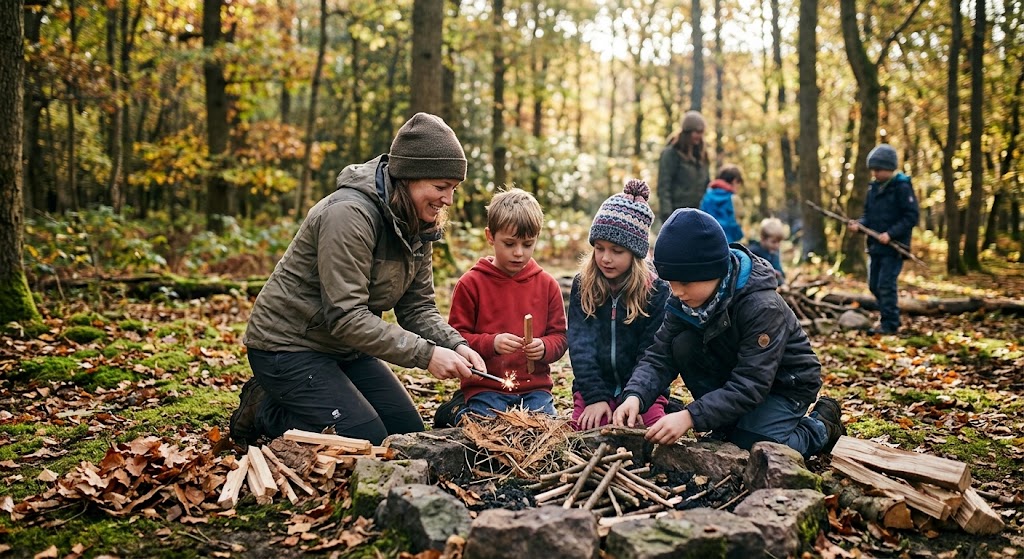
🔥 Fire & Heat
Fire is one of the oldest outdoor skills.
As a Scout, you can begin understanding fire more deeply — not simply how to light one.
Learn about:
🔥 Fire safety
⛽ Fuel
💨 Airflow
💧 Extinguishing
🍲 Outdoor cooking
🌡️ Heat management
🌲 Environmental impact
The real skill is knowing when, where and why a fire is appropriate.
🔥 FIRE MASTER TIP
Anyone can learn to light a fire.
A skilled outdoor person knows:
When to light it.
How to control it.
How to use it safely.
And when not to light one at all.
💧 Finding & Purifying Water
Water is essential during longer outdoor activities.
You should understand:
How much water might you need?
Where could you obtain more?
How can you recognise potential sources?
How can water be treated appropriately?
When should natural water be avoided?
Never assume that clear water is safe to drink.
Natural water can contain microorganisms and other contaminants that aren’t visible.
💧 IMPORTANT
Clear doesn’t mean clean.
Never drink untreated water from a stream, lake or other natural source simply because it looks safe.
Learn appropriate water-treatment methods before relying on natural water.
➰ Develop Your Rope Skills
Rope skills become increasingly useful as you learn camping, pioneering and other outdoor activities.
Don’t simply memorise knots.
Understand:
Which knot?
↓
What purpose?
↓
How is it tied?
↓
How is it checked?
↓
How is it safely untied?
A knot is only useful if it’s appropriate for the job.
➰ CHALLENGE
Choose three knots you know.
For each one, explain:
What is it used for?
Why would you choose it instead of another knot?
How do you know it’s tied correctly?
🩹 Build Real First-Aid Awareness
Your first-aid knowledge should develop alongside your outdoor skills.
You should know how to:
- Recognise when something is serious
- Get appropriate help
- Communicate clearly
- Deal with emergencies within your training
- Protect yourself
- Reassure someone
- Monitor a casualty
You should also understand the limits of your training.
Knowing when NOT to intervene is a first-aid skill too.
🩹 SCENARIO CHALLENGE
Someone on your group suffers an injury several kilometres from your starting point.
What information would you need before getting help?
Think about:
Location • Number of people • Injury • Hazards • Weather • Access
🆘 Know How to Call for Help
If an emergency occurs, communication becomes extremely important.
You should be able to provide useful information such as:
📍 Your location
🗺️ Grid reference where appropriate
👥 Number of casualties
🩹 Nature of injuries
⚠️ Hazards
🌦️ Weather conditions
🚪 Best access point
Don’t assume rescuers automatically know where you are.
Your navigation skills can make a huge difference.
📞 EMERGENCY COMMUNICATION
In the UK, emergency services can be contacted on 999 or 112.
Give clear information and follow the operator’s instructions.
Don’t end the call until you’re told to do so.
🌿 Become a Better Camper
Camping isn’t simply about sleeping in a tent.
A capable camper understands:
Shelter
How to choose an appropriate location.
Weather
How conditions could affect your campsite.
Equipment
What you actually need.
Cooking
How to prepare food safely.
Hygiene
How to keep yourself and your campsite clean.
Environment
How to minimise your impact.
Emergency planning
What happens if conditions change?
🏕️ CAMPING CHALLENGE
Imagine you arrive at a new campsite.
Before putting up your tent, identify:
Three things that would make a location good.
Three things that could make a location unsuitable.
Then explain your choices.
🌿 Become a Better Forager
Learning about wild plants can be fascinating.
But foraging requires knowledge and caution.
A beginner shouldn’t eat a plant simply because:
“It looks familiar.”
You need to be certain of the identification and understand whether it is safe and appropriate to consume.
You should also consider:
- Protected species
- Pollution
- Contamination
- Location
- Season
- Permission
- Sustainable harvesting
🌿 FORAGING RULE
If you’re not 100% certain what it is, don’t eat it.
Learning to identify plants is valuable even when you don’t collect or eat them.
🌍 Become a Responsible Adventurer
The more places you explore, the greater your responsibility becomes.
Think about:
Wildlife
Could you disturb it?
Plants
Could you damage them?
Fire
Could it spread?
Waste
What will you leave behind?
Footpaths
Could you cause erosion?
Other people
Are you affecting their experience?
🌍 LEAVE NO TRACE
Before leaving:
Stop.
Look around.
Check your campsite.
Take everything with you.
Leave the area as you found it — or better.
🧭 What If You Get Lost?
Getting lost can happen to experienced people too.
The important thing is not to panic.
A useful starting point is:
STOP
S — Stop
Don’t continue travelling blindly.
T — Think
What do you know about your location?
O — Observe
Look around. Check your map and surroundings.
P — Plan
Decide on the safest next action.
🧠 IMPORTANT
If you’re with a group, follow your leader’s instructions.
Don’t split up or leave the group without being told to do so.
🌫️ What If Your Plan Stops Working?
This is one of the most important skills you can learn.
Your plan might fail because:
🌧️ Weather changes
👣 A path is blocked
🌊 A river becomes unsafe to cross
🌫️ Visibility disappears
⏱️ You’re running late
🥾 Someone becomes tired or injured
A good adventurer doesn’t stubbornly continue.
They reassess.
🔄 PLAN B
Whenever you create an outdoor plan, ask:
“What would make me change this plan?”
Then decide what you would do.
Having a Plan B doesn’t mean you expect something to go wrong.
It means you’re prepared if it does.
🧠 The Outdoor Decision Cycle
Here’s a simple system you can use during activities:
OBSERVE → ASSESS → DECIDE → ACT → REVIEW
OBSERVE
What’s happening?
ASSESS
What does it mean?
DECIDE
What are your options?
ACT
Take the appropriate action.
REVIEW
Did it work?
If not, reassess.
⭐ SCOUT SKILL
This isn’t just an outdoor skill.
It’s a way of thinking that can help you at school, at work and throughout life.
🤝 Learn to Work as a Team
Outdoor skills become even more powerful when you work with other people.
A good team:
Communicates
Listens
Shares responsibility
Looks after others
Speaks up about problems
Asks for help
Adapts when circumstances change
Being a leader doesn’t mean doing everything yourself.
Sometimes leadership means:
Helping someone else succeed.
🤝 TEAM CHALLENGE
During your next activity, deliberately give someone else the opportunity to lead part of the task.
Afterwards, discuss:
What worked?
What could have been better?
🏆 Your Scout Skills Challenge
You’ve reached the stage where it’s time to put your skills together.
Try these ten challenges.
🧭 1 — Navigator
Plan and follow a suitable route.
🗺️ 2 — Route Planner
Create a route with checkpoints and an alternative option.
🌦️ 3 — Weather Watcher
Assess how weather could affect an activity.
🎒 4 — Equipment Expert
Explain the purpose of your essential equipment.
🔥 5 — Fire Skills
Demonstrate safe fire knowledge during an appropriately supervised activity.
💧 6 — Water Skills
Explain why natural water needs appropriate treatment before drinking.
➰ 7 — Rope Skills
Demonstrate several appropriate knots and explain their uses.
🩹 8 — First-Aid Scenario
Work through a realistic emergency scenario.
🆘 9 — Emergency Communication
Explain how you would communicate your location and situation.
🧩 10 — Plan B
Take an outdoor scenario where something goes wrong and create a new plan.
⭐ The Ultimate Scout Challenge
Plan, Navigate & Adapt
This is where everything comes together.
With appropriate supervision, plan an outdoor journey.
You should consider:
📍 LOCATION
Where are you going?
🗺️ ROUTE
How will you get there?
📏 DISTANCE
How far is it?
⏱️ TIME
How long should it take?
🌦️ WEATHER
What conditions could affect you?
🎒 EQUIPMENT
What do you need?
💧 WATER
How will you stay hydrated?
🩹 FIRST AID
What would you do if someone became injured?
🆘 EMERGENCY
How would you get help?
🔄 PLAN B
What happens if the route becomes unsuitable?
🌍 ENVIRONMENT
How will you minimise your impact?
🏆 THE REAL CHALLENGE
Don’t simply tell your leader your plan.
Explain your decisions.
Why this route?
Why this equipment?
Why this timing?
Why this alternative?
That’s the difference between following a plan and understanding a plan.
⚜️ What Have You Learned?
You’re no longer simply collecting outdoor skills.
You’re learning how to apply them.
You can:
And perhaps the most important skill:
You know that changing your plan isn’t failure.
Sometimes the best decision an adventurer can make is to turn around.
🐺 A Note for Parents & Leaders
This section is written directly for Scouts and young people and is intended to support the development of practical outdoor skills, confidence, decision-making and responsible independence.
Activities involving fire, knives/tools, water, heights, roads, remote areas, overnight camping or other hazards require appropriate supervision, training and risk assessment.
Young people should follow their leader’s instructions and should not attempt activities independently where appropriate supervision is required.
SurvivalGuidesUK is an independent educational resource and isn’t an official Scouts website.
🔒Ready to test your survival skills?
Join Survival Guides UK for free, complete challenges, earn badges and increase your Survival Level.
JOIN FREE →
CRAIG BURR
FOUNDER · SURVIVAL GUIDES UK
I'm Craig, the person behind Survival Guides UK. I created SGUK because I wanted somewhere people could learn real outdoor skills in a practical, straightforward way — from lighting a fire and tying knots to navigation, campcraft and everything in between.
You can read more about the story behind SGUK here as well as our approach here.