
SGUK Outdoor Skills Challenge 37: Find Five Types of Animal Homes
A woodland floor, hedgerow or patch of grass can look quiet until you start noticing the signs of life around you. A hole beneath a tree root, a nest tucked into a hedge or a web stretched between two branches can tell you that an animal has been using that spot for shelter, raising young or catching food.
Animal homes come in all shapes and sizes. Some are carefully constructed, while others are natural spaces that animals have adapted for their needs. Learning to recognise them is a useful wildlife skill, but it takes a little patience: the animal itself may be nowhere to be seen, and not every hole, pile of leaves or nest-like structure can be confidently identified.
For this challenge, explore a suitable outdoor area and find evidence of five types of animal homes. Observe them from a respectful distance, leave everything as you found it and see how much you can learn without disturbing the wildlife.
Your Challenge
Find five different types of animal home or shelter in a suitable outdoor location. These could include a bird’s nest, a burrow, a tree cavity, a spider’s web or a natural shelter used by insects.
For each one, record what you found, where it was located and which animal might use it. Try to explain why that particular place or structure would be useful to the animal.
You don’t have to identify the exact species in every case. A sensible observation, supported by what you can actually see, is better than a confident guess. The challenge is about learning to recognise different kinds of animal homes, not finding occupied nests or getting close enough to see inside them.
What You’ll Need
- A notebook and pencil, or a phone for recording observations.
- A camera or phone for taking photographs from a safe distance.
- Suitable outdoor clothing and footwear.
- A wildlife identification guide, if you have one.
A woodland, nature reserve, park, hedgerow-lined path or garden can all provide opportunities. You don’t need to visit a remote location, and you should only explore places where you have permission to be.
Take the Challenge
1. Look for bird nests
Birds build nests in a wide variety of places. Depending on the species, a nest might be tucked into a hedge, balanced in the fork of a tree, attached to a building or hidden in long grass.
Look for nests from a distance, paying attention to their position and the materials used. Some are made from twigs and grass, while others may contain moss, feathers, mud or fine plant fibres. Different birds have different nesting habits, so the shape and location can offer clues, although they won’t always be enough to identify the builder.
Remember that a nest may be difficult to see, even when birds are nearby. Equally, an old nest may remain after the birds have stopped using it. Don’t approach a nest to check whether it is occupied, part branches to get a better view or handle nesting material. Disturbing nesting birds can cause real harm, and some species and nests receive legal protection.
Record: where the nest is positioned, what materials you can see and why that location might offer protection.
2. Search for burrows and holes
Many mammals use burrows for shelter, resting or raising their young. Rabbits are a familiar example, creating burrow systems in suitable ground. Other animals may use holes in banks, beneath tree roots or in places where the soil is easy to excavate.
From a distance, look for openings in the ground and note their surroundings. You might see several entrances close together, worn tracks leading towards a hole or disturbed earth nearby. These signs can suggest animal activity, but they do not prove which animal lives there.
A hole could be old, unused or made by something other than an animal. Avoid putting your hand inside, poking a stick into the opening or digging around to find out what is there. You could injure an animal or expose yourself to bites and other hazards.
Record: the approximate size of the entrance, the type of ground and any visible signs of activity. If you cannot identify the animal, write down the possibilities rather than choosing one at random.
3. Find a tree cavity
A hollow in a tree can provide shelter for birds, bats, insects and other wildlife. Cavities may form as a tree grows, after a branch breaks or when decaying wood gradually creates an opening.
Look at standing trees and fallen timber from a safe distance. A cavity might be high in the trunk, close to a broken branch or near the base of an old tree. Consider how the hollow could provide shelter from wind and rain, a place to rest or somewhere to raise young.
Not every cavity is occupied, and it can be difficult to tell which animals use one. Some wildlife, including bats and nesting birds, may be present without being visible. Never reach inside a hollow, shine a torch into it to search for animals, or climb a tree to inspect it more closely.
A hollow tree is also not necessarily a safe place for a person to shelter. Decaying wood and damaged branches can be unstable.
Record: the cavity’s position, its approximate size and how the surrounding tree might protect an animal.
4. Look for spider webs
Spider webs are among the easiest animal structures to spot, particularly when morning dew catches the silk and makes it glisten. You may find a circular web stretched between plants, a tangled web in a corner or a sheet of silk close to the ground.
Different spiders make different kinds of webs, and not all spiders use webs to catch prey. Some hunt actively instead. When you find a web, look at its shape, where it is attached and whether it appears to be positioned where flying or crawling insects might pass.
A web is both a structure and a hunting tool. Its location can be just as important as its design. A web stretched across a gap between plants may intercept passing insects, while one tucked into a sheltered corner may be less exposed to wind and rain.
Avoid touching or breaking the silk to get a better view. If you photograph the web, try changing your viewing angle rather than moving the plants or disturbing the spider.
Record: the type of web, where it is positioned and what makes that spot suitable for catching prey or providing shelter.
5. Find an insect home
Insects use a remarkable range of places for shelter and reproduction. Some bees and wasps nest in the ground, while others use holes in wood or existing cavities. Certain solitary bees use hollow plant stems or small holes in suitable materials. Ants may create nests in soil, beneath stones or inside decaying wood.
Look for signs such as small entrances in bare ground, a steady trail of ants or insects repeatedly visiting the same spot. A cluster of holes in a suitable surface may indicate nesting activity, although it is not always possible to tell which species is responsible.
Don’t lift stones, pull apart rotting logs or block entrances to see what happens. These actions can damage the habitat and expose animals to predators or weather. Keep your hands away from suspected nests, especially where stinging insects may be present.
An insect home may be tiny compared with a bird’s nest or mammal’s burrow, but it can still be a complex and important part of the local habitat.
Record: where you found the signs, what you observed the insects doing and why that location might be useful to them.
6. Look beyond the obvious
If you’ve found five examples quickly, spend a little longer looking at the less obvious places. Fallen logs, thick vegetation, gaps beneath exposed roots and undisturbed patches of ground can all provide shelter for wildlife.
Some animals don’t build a recognisable home at all. They may use natural crevices, leaf litter or spaces beneath rocks. Others have temporary shelters or move between several resting places. You can still record these as potential shelters if you explain what you observed and avoid claiming that an animal lives there unless the evidence supports it.
Look for indirect signs, too. Tracks, droppings, feathers, chewed plant material and worn paths may indicate that animals use an area. These signs are useful clues, but they are not animal homes by themselves. Keep them separate in your notes so that you don’t accidentally count five signs of activity as five different homes.
7. Observe without disturbing
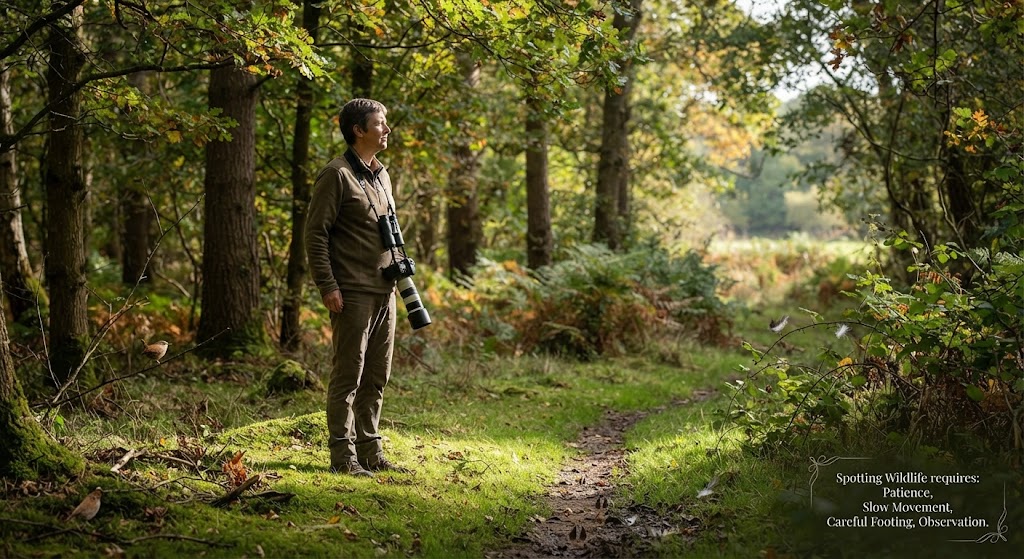
The best wildlife observations often happen when you slow down and stop trying to find something immediately. Stand quietly for a few minutes, watch the area and let your eyes adjust to the details around you.
Keep to paths where possible, respect signs and access restrictions, and avoid trampling vegetation to reach a promising-looking spot. Never remove a nest, disturb a burrow, handle a wild animal or take home materials from an occupied shelter.
If you discover what appears to be an active nest or den, leave the area undisturbed and move away calmly. In the UK, nesting birds are legally protected, and disturbing certain wildlife or damaging its resting places can also be an offence. You can learn more about responsible behaviour outdoors in the Countryside Code.
Check Your Results
Look back at your five observations. Have you found five genuinely different types of home or shelter, rather than five examples of the same thing?
For each one, check that you have recorded:
- What the structure or shelter looks like.
- Where you found it.
- Which animal or group of animals might use it.
- How the location or structure could provide shelter, protection or a place to raise young.
- What evidence supports your identification and what remains uncertain.
It’s perfectly acceptable to write “possible rabbit burrow” or “tree cavity that may provide a roosting place”. Wildlife identification isn’t always straightforward, and some of the most useful field notes make a clear distinction between what you observed and what you inferred.
If you only found three or four examples, don’t disturb wildlife to reach the target. You can complete the challenge over more than one visit or try another suitable location.
Complete the Challenge
To complete Challenge 37, you must:
- Find five different types of animal home or shelter.
- Record the location and visible features of each one.
- Explain which animal might use each shelter and why it may be suitable.
- Photograph your observations from a respectful distance.
- Check that you haven’t disturbed wildlife or damaged its habitat.
Your evidence could be five photographs, a set of field notes or a mixture of both. You don’t need a photograph of an animal itself; the home or shelter and your observations are the focus of this challenge.
How to Submit Your Challenge
Share your evidence
- Go to your SGUK member profile.
- Open Social Activity.
- Upload a photograph of your notes or one of the animal homes you observed.
- Add the hashtag #SGUKChallenge37.
- Share it for verification.
You can include a short description of the five types you found and mention which one was hardest to identify. Avoid sharing the exact location of a sensitive nest or den publicly.
Once you’ve shared your evidence and it has been verified, the SGUK Outdoor Skills Challenge 37 is complete and the completed challenges figure will be updated on your profile.
Challenge 37 Checklist
Want to Push Yourself?
Try returning to the same area at a different time of day or during another season. You may notice new signs of activity, discover that some shelters are no longer in use or find that changing vegetation makes certain structures easier to spot.
You could also choose one type of animal home and research how the animal builds or selects it. Find out what materials it uses, whether it returns to the same shelter and how the structure changes through the year. Compare your research with what you observed, but remember that a general description of a species may not explain every individual example.
For an extra challenge, sketch a small habitat map showing where you found each home. Mark the surrounding trees, hedges, water or open ground, and consider how those features might help wildlife find food and shelter.
What’s Next?
Now that you’ve practised spotting animal homes, you can build on your wildlife observation skills by learning to recognise the other clues animals leave behind.
If you haven’t completed it yet, try SGUK Outdoor Skills Challenge 36: Learn to Read the Surface of Water. It develops the same habit of careful observation, helping you notice patterns in the natural world and think about what they reveal.
You can complete SGUK Outdoor Skills Challenges in any order, so choose the next skill that interests you.
Learn. Practise. Master.
That’s what the SGUK Outdoor Skills Challenge is all about.
🔒Ready to test your survival skills?
Join Survival Guides UK for free, complete challenges, earn badges and increase your Survival Level.
JOIN FREE →
CRAIG BURR
FOUNDER · SURVIVAL GUIDES UK
I'm Craig, the person behind Survival Guides UK. I created SGUK because I wanted somewhere people could learn real outdoor skills in a practical, straightforward way — from lighting a fire and tying knots to navigation, campcraft and everything in between.
You can read more about the story behind SGUK here as well as our approach here.