Advanced Knot Challenges for Explorers
By the time young people reach Explorers, knot work can become much more interesting than simply learning a list of knots.
The real skill is knowing which knot to use, why to use it and how to check that it has been tied correctly.
That’s where challenges work particularly well.
Instead of saying:
“Tie a clove hitch.”
Give them a problem.
“You need to attach this rope securely to this pole. What knot would you choose?”
Now they’re having to think.
Start With the Knots They Know
Before introducing anything new, check that Explorers are confident with the basics.
Depending on their experience, this might include the:
Reef knot.
Sheet bend.
Clove hitch.
Round turn and two half hitches.
Bowline.
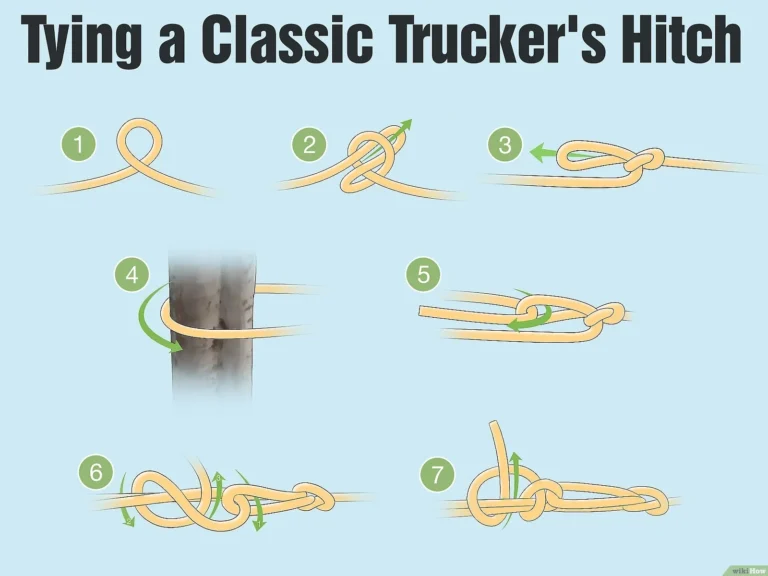
Taut-line hitch.
Simple lashings.
The aim isn’t to see who can name the most knots.
It’s to make sure they understand what those knots are actually useful for.
Challenge 1: Choose the Right Knot
Give Explorers several practical situations and a selection of ropes.
Don’t tell them which knot to use.
Ask:
“Which knot would you choose, and why?”
After they make their choice, ask them to demonstrate it.
This develops knot selection rather than memorisation.
Challenge 2: Knot Identification
Tie several knots and ask Explorers to identify them.
Then make it harder.
Ask:
“What is this knot normally useful for?”
And finally:
“Would you use it in this situation?”
This encourages them to understand the purpose behind the knot.
Challenge 3: The Wrong Knot
Tie an inappropriate knot for a particular job.
Ask Explorers to inspect it.
“Would you trust this for the task?”
They need to explain why or why not.
This is a useful lesson in checking other people’s work rather than automatically assuming that a tied knot is a suitable knot.
Challenge 4: Knot Relay
Set up several stations.
Each station has a different challenge.
For example:
Tie a knot around a pole.
Join two ropes.
Create an adjustable loop.
Secure a rope to an object.
Tie a lashing.
Teams move between stations.
Don’t make speed the only measure of success.
A correctly tied, appropriately selected knot is more important than a rushed knot.
Challenge 5: Blindfolded Knot Identification
Instead of tying knots blindfolded, which can introduce unnecessary safety issues, have Explorers identify knots by touch.
Give them a previously tied knot.
They feel it without looking and try to identify it.
This can be surprisingly difficult and encourages them to understand the structure of the knot.
Challenge 6: The One-Hand Challenge
Ask Explorers to tie a simple, previously learned knot using one hand.
This should only involve straightforward, low-risk tasks.
The purpose isn’t to develop an emergency technique.
It’s to make them think carefully about how the rope is manipulated.
You can then discuss how difficult knot tying would become if someone had an injured hand.
Challenge 7: Speed Versus Accuracy
Have Explorers tie a familiar knot normally.
Then give them a short time limit.
Afterwards, inspect the knots.
Ask:
“Did going faster improve the result?”
This makes an excellent lesson about outdoor skills.
Speed is useful sometimes.
But accuracy and reliability come first.
Challenge 8: Knot Inspection
Give each team several completed knots.
Some are correctly tied.
Others have deliberate mistakes.
Ask Explorers to identify the problems.
They should look for:
Incorrect structure.
Loose tying.
Poor dressing.
Insufficient working end.
Wrong knot for the task.
This teaches them an essential skill:
Being able to inspect a knot rather than simply tying one.
Challenge 9: The Rope Joining Challenge
Give teams two ropes of different sizes or materials, where appropriate.
Ask:
“How would you join these securely?”
This introduces the idea that different rope characteristics can affect knot choice.
The important part is understanding why one knot may be more appropriate than another.
Challenge 10: Adjustable Tension
Give Explorers a simple setup where a rope needs to be tensioned and adjusted.
Ask them to find a suitable method using knots they’ve learned.
Then ask:
“Can you adjust the tension without completely undoing the system?”
This can lead naturally into discussing adjustable hitches.
Challenge 11: Tarp Challenge
Give each team a tarp and suitable cordage.
Ask them to create a simple shelter or cover.
They need to decide:
How to attach the ropes.
How to create tension.
How to adjust the setup.
Which knots are suitable.
This turns individual knot skills into a practical campcraft problem.
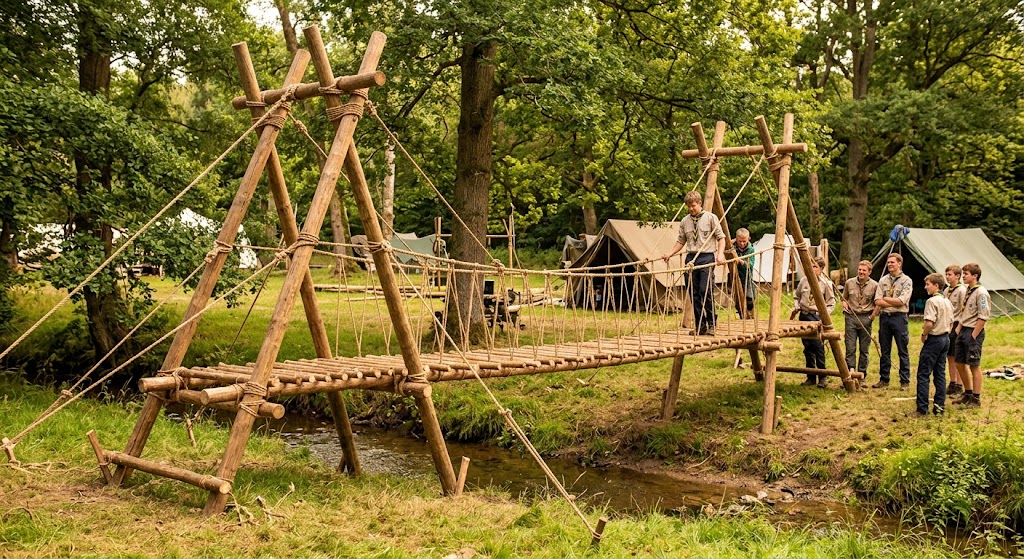
Challenge 12: Lashing Challenge
Introduce pioneering-style lashings if the group has appropriate experience.
Give them poles and rope and ask them to create a simple structure.
Start with a basic square or tripod arrangement before progressing to more complicated builds.
The important lesson is that a lashing is a system, not just a knot.
The poles, rope, tension and construction all need to work together.
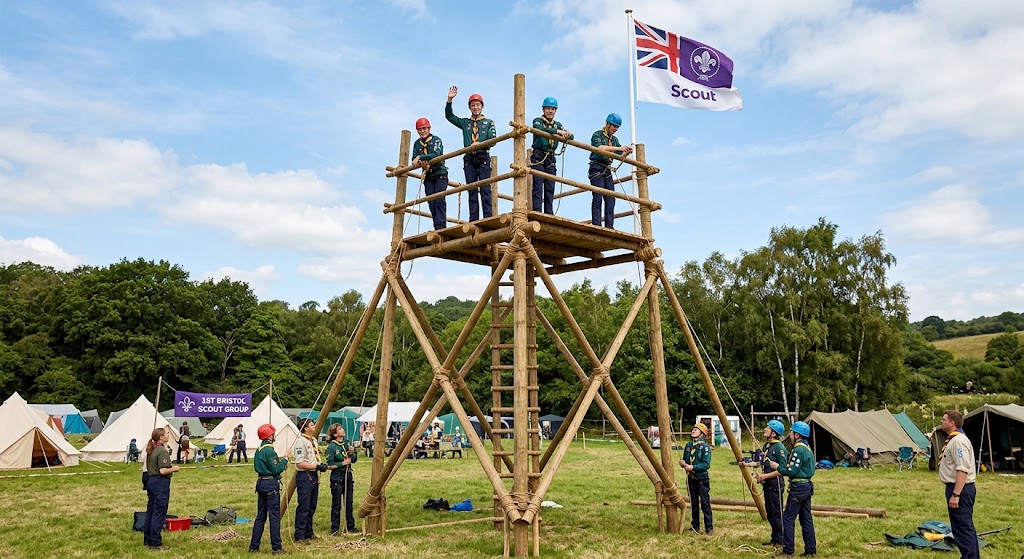
Challenge 13: Build Something Useful
Give teams a practical objective.
For example:
“Build a small free-standing structure.”
Or:
“Create a simple equipment rack.”
Or:
“Make a frame that can support a lightweight object.”
Keep the construction appropriate to the materials and supervision available.
The challenge isn’t to build the biggest structure.
It’s to select appropriate knots and lashings and construct something stable.
Challenge 14: Limited Rope
Give every team the same limited amount of rope.
Now they have to think carefully.
They can’t simply use several lengths for every connection.
Ask:
“How can you achieve the objective using the rope you have?”
This introduces resource management and planning.
Challenge 15: The Knot Puzzle
Give Explorers a sequence of tasks.
For example:
Join two ropes.
Attach the rope to a pole.
Create a loop.
Make an adjustable connection.
They have to decide which knot should be used at each stage.
This works particularly well as a team challenge.
Challenge 16: Knot Memory
Give Explorers a few seconds to look at a completed knot.
Hide it.
Can they recreate it?
Start with familiar knots and gradually increase the difficulty.
This develops observation as well as rope skills.
Challenge 17: Teach Someone Else
Pair up the Explorers.
One person has to teach the other how to tie a particular knot.
The instructor isn’t allowed to physically tie the knot for their partner.
They have to explain the process.
This is a surprisingly effective advanced challenge.
If you can’t explain how a knot works, you may not understand it as well as you think.
Challenge 18: The Knot Selection Board
Create a series of scenarios.
For each one, Explorers choose the most appropriate knot from the knots they know.
Then they have to justify their choice.
For example:
“You need to join two ropes.”
“You need a fixed loop.”
“You need to attach a rope to a pole.”
“You need an adjustable connection.”
The discussion is just as important as the tying.
Challenge 19: Knot Failure Investigation
Set up a simple, low-risk demonstration where a knot has failed or slipped.
Ask Explorers:
“Why do you think it happened?”
Possible factors include:
The wrong knot.
Poor tying.
Insufficient tension.
Incorrect dressing.
Unsuitable rope.
Excessive load.
The lesson should be that a knot is only one part of a rope system.
Challenge 20: Design Your Own Knot Challenge
Once Explorers are confident, give them responsibility for creating an activity for another team.
They have to decide:
The objective.
The equipment.
The knots involved.
The rules.
How success will be judged.
Any safety considerations.
This develops leadership and demonstrates whether they genuinely understand the skills.
Don’t Encourage Unsafe Load Testing
Some knot challenges can be tempting to turn into strength competitions.
Avoid asking Explorers to test knots with people, climbing loads or other potentially dangerous systems unless the activity is specifically designed and supervised by appropriately qualified personnel.
For ordinary Explorer activities, keep tests low-risk and appropriate to the equipment.
The goal is to learn about knots, not discover their breaking point.
Make Knot Challenges About Decisions
The biggest progression from younger sections is moving away from:
“Can you tie this knot?”
towards:
“Which knot should you use?”
And eventually:
“Is a knot actually the best solution to this problem?”
That final question is where advanced rope skills really begin.
Finish With a Knot Review
At the end of the session, ask Explorers:
“Which knot did you find most useful?”
“Which was hardest to tie correctly?”
“Did you ever choose the wrong knot?”
“How did you check your knots?”
“What would you do differently next time?”
This helps turn practical experience into knowledge.
Final Thoughts
Advanced knot work shouldn’t simply mean learning dozens of increasingly obscure knots.
A strong Explorer should be able to look at a situation, understand what the rope needs to do and select an appropriate solution.
They should also be able to inspect their work, recognise mistakes and know when a particular knot or rope system isn’t suitable.
That’s much more valuable than being able to recite a long list of knot names.
THE BIG IDEA
The best knot isn’t the most complicated knot. It’s the right knot for the job.
Give Explorers problems rather than instructions.
Let them choose the knot, explain their reasoning, check their work and improve it.
That’s how knot tying becomes a genuine outdoor skill rather than a memory exercise.
🔒Ready to test your survival skills?
Join Survival Guides UK for free, complete challenges, earn badges and increase your Survival Level.
JOIN FREE →
CRAIG BURR
FOUNDER · SURVIVAL GUIDES UK
I'm Craig, the person behind Survival Guides UK. I created SGUK because I wanted somewhere people could learn real outdoor skills in a practical, straightforward way — from lighting a fire and tying knots to navigation, campcraft and everything in between.
You can read more about the story behind SGUK here as well as our approach here.