How to Tie a Trucker’s Hitch | Step-by-Step Guide
The trucker’s hitch is a useful rope system for creating adjustable tension. It is commonly used when securing loads, tightening guy lines and tensioning ropes where a firm pull is needed.
Unlike a simple hitch, the trucker’s hitch uses a loop in the rope to create mechanical advantage. This allows you to pull the rope tighter before securing it with a final hitch.
What You’ll Learn
By the end of this guide, you should be able to:
- Create the adjustable loop used in a trucker’s hitch.
- Use the loop to tension a rope.
- Secure the tension with a finishing hitch.
- Recognise and check a correctly tied system.
Equipment
- A length of rope or cord.
- Two suitable fixed points, such as posts or anchor points, to practise between.
For learning, two sturdy posts placed a short distance apart work well.
Understanding the Knot
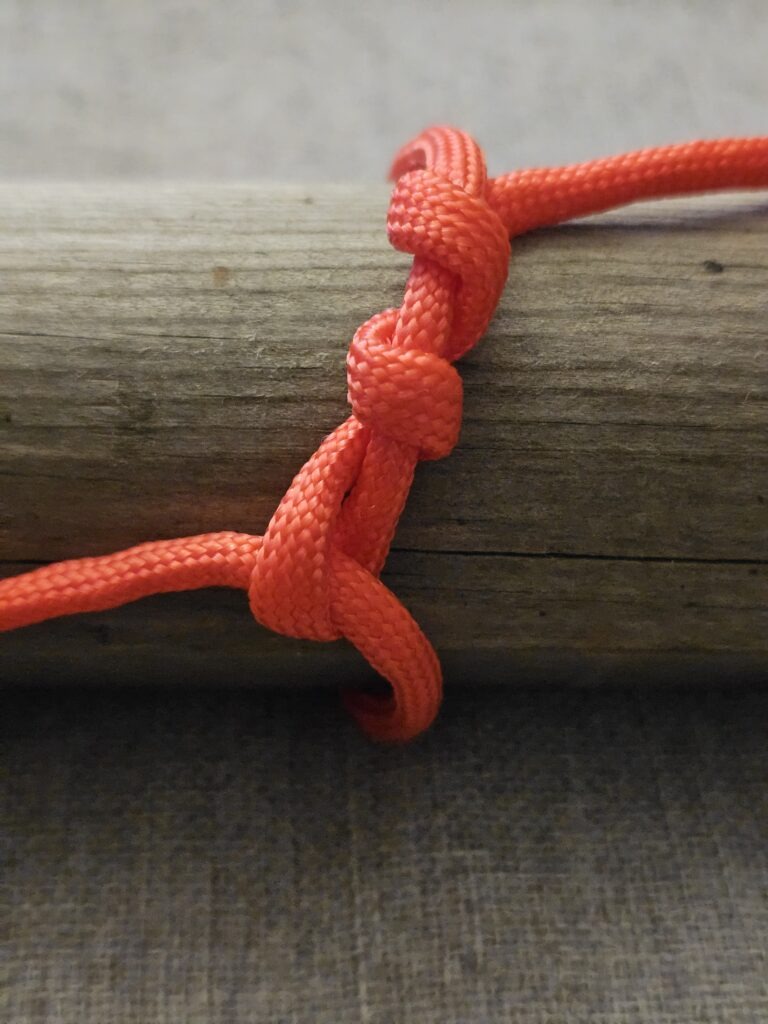
The trucker’s hitch is actually a tensioning system made from several parts rather than a single simple knot.
A typical version consists of:
- A fixed or adjustable loop in the rope.
- The rope passing around a second anchor.
- The working end passing through the loop.
- The rope being pulled tight.
- A finishing hitch securing the tension.
The loop acts like a simple pulley, allowing you to generate greater tension than you could by simply pulling the rope by hand.
How to Tie a Trucker’s Hitch
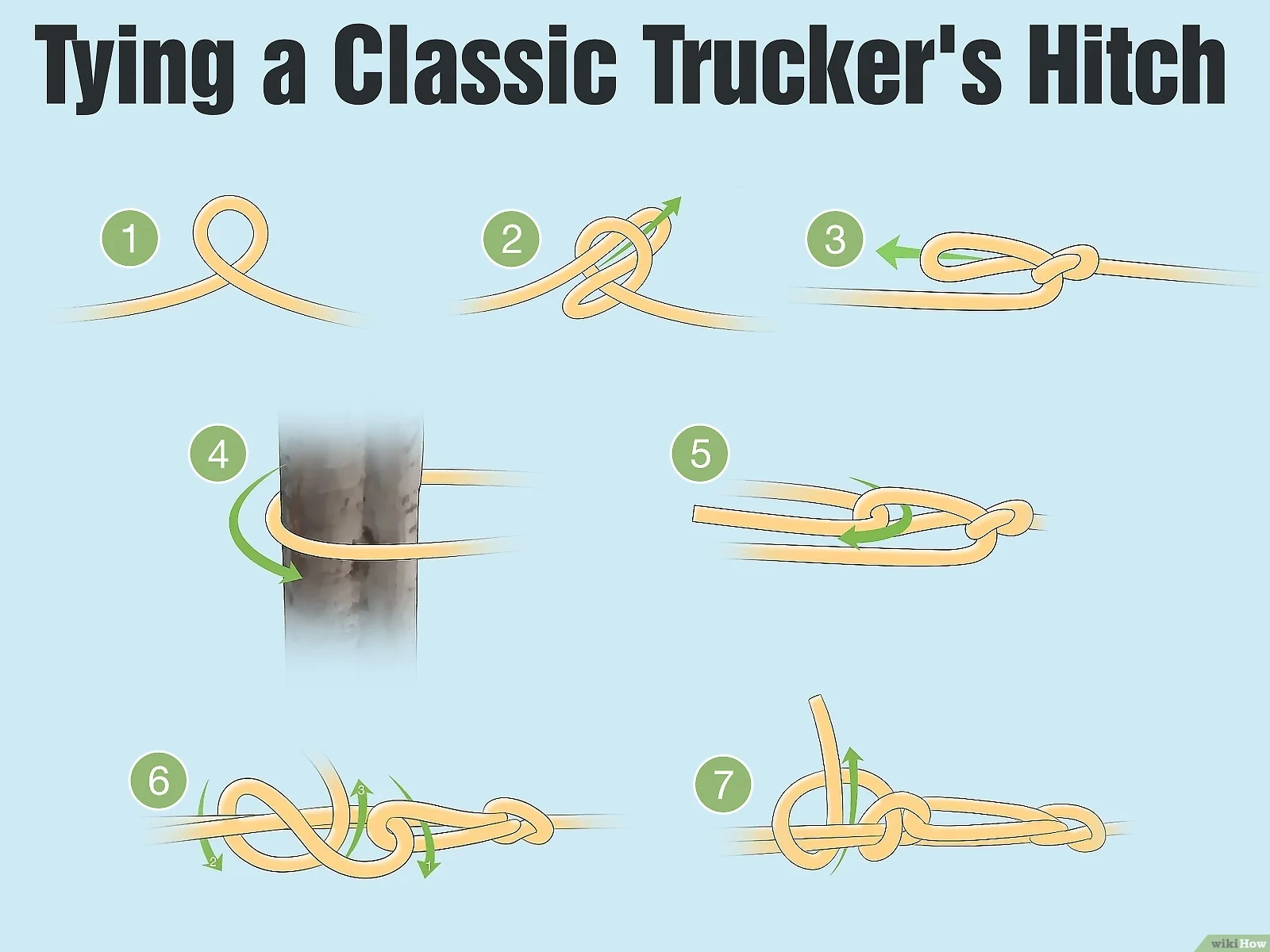
1. Attach one end of the rope
Secure one end of the rope to a suitable anchor.
A round turn and two half hitches, bowline or another appropriate attachment can be used depending on the situation.
2. Create a fixed loop
Create a loop in the standing part of the rope some distance from the second anchor.
One common method is to tie a figure eight on a bight to create the loop.
The loop should be large enough for the rope to pass through easily.
3. Take the rope around the second anchor
Pass the working end around the second anchor and bring it back towards the loop.
4. Pass the working end through the loop
Take the working end through the loop you created in the standing part.
5. Pull the rope tight
Pull the working end away from the loop.
The loop creates mechanical advantage, allowing you to increase the tension in the main line.
Pull steadily rather than using sudden or excessive force.
6. Secure the tension
Once the desired tension has been achieved, keep the rope under tension and secure the working end around the standing part.
Two half hitches are commonly used as the finishing hitch.
Pull the finishing hitch snug against the loop.
How to Check Your Trucker’s Hitch
Before using the system, check that:
- The initial loop is secure.
- The rope passes correctly through the loop.
- The working end is properly routed around the second anchor.
- The rope has been tensioned evenly.
- The finishing hitch is secure.
- The rope is not crossed or trapped in an unexpected way.
- The anchors are strong enough for the intended load.
The finished system should hold the tension when you release the working end.
Common Uses
A trucker’s hitch can be useful for:
- Securing loads to trailers or vehicles where appropriate.
- Tensioning tent and shelter guy lines.
- Securing equipment during transport.
- Tightening temporary rope lines.
- Outdoor campcraft and general ropework.
It is particularly useful when you need considerably more tension than can be achieved by simply pulling the rope tight by hand.
Important Safety Information
The mechanical advantage created by a trucker’s hitch can generate significant tension in the rope and anchors.
Do not over-tighten the system. Excessive tension can damage rope, equipment or anchor points, and a sudden failure can cause the rope or hardware to move rapidly.
Make sure the anchors are suitable and secure before applying tension.
Never use improvised trucker’s hitches for critical lifting, climbing, rescue or other life-safety applications unless the complete system has been specifically designed and approved for that purpose.
Final Tip
Learn the system in stages rather than trying to memorise the entire knot at once:
Anchor → loop → second anchor → through the loop → tension → secure.
Once you understand what the loop does, the trucker’s hitch becomes much easier to tie and use correctly.
🔒Ready to test your survival skills?
Join Survival Guides UK for free, complete challenges, earn badges and increase your Survival Level.
JOIN FREE →
CRAIG BURR
FOUNDER · SURVIVAL GUIDES UK
I'm Craig, the person behind Survival Guides UK. I created SGUK because I wanted somewhere people could learn real outdoor skills in a practical, straightforward way — from lighting a fire and tying knots to navigation, campcraft and everything in between.
You can read more about the story behind SGUK here as well as our approach here.