Building a Pioneering Tower: Scout Pioneering Guide
Activity Overview
Difficulty: Challenging
Time: 3–5 hours
Location: Scout campsites and suitable pioneering areas
Best for: Scouts, Explorers, Patrol Leaders and experienced pioneering teams
Skills: Pioneering, knots, lashings, teamwork, planning, structural awareness and campcraft
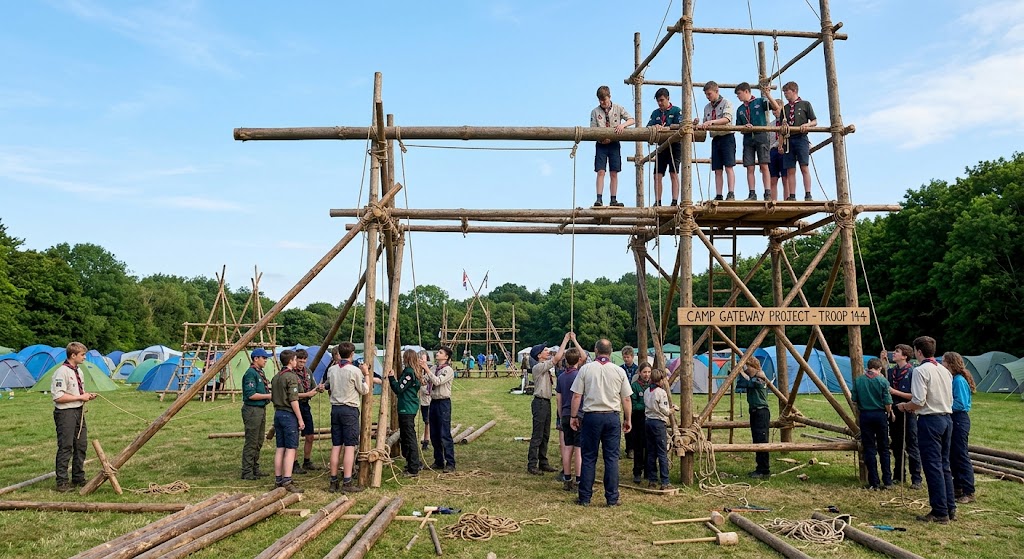
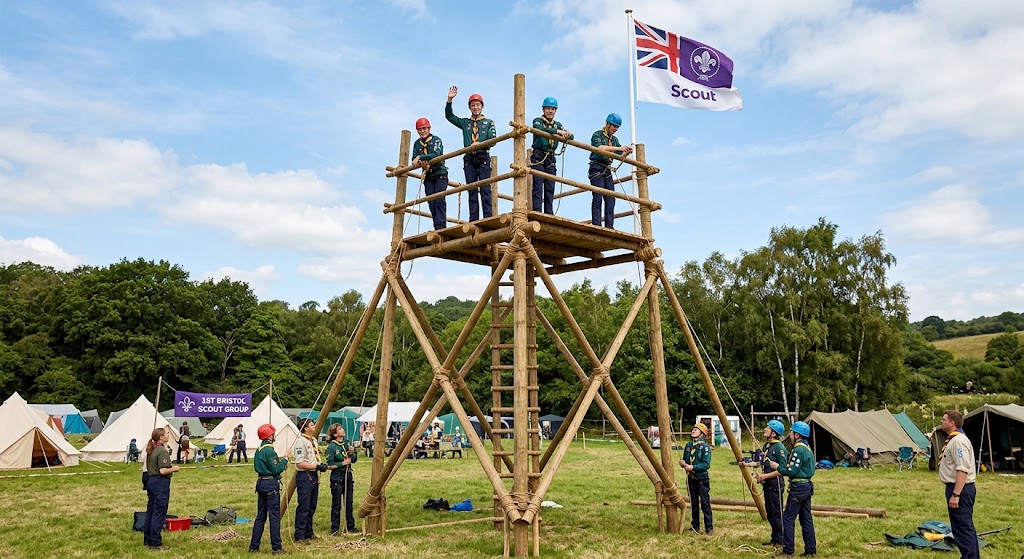
A pioneering tower is a temporary structure made from poles joined with rope lashings. It is an advanced pioneering project requiring careful planning, sound construction and thorough inspection.
For Scout activities, a tower should only be climbed or used when it has been specifically designed, assessed and approved for that purpose by suitably competent people. A low-level practice tower is a much safer way to learn the construction techniques.
What You’ll Learn
You’ll learn how a pioneering tower is planned and how its main framework, lashings and bracing work together.
You’ll also practise accurate ropework, teamwork and systematic inspection while understanding why height introduces additional risks to an otherwise simple pioneering project.
🔴 SAFETY – HIGH RISK
A pioneering tower can collapse or cause a serious fall if it is poorly designed, incorrectly lashed, unstable or overloaded.
Do not climb or stand on a pioneering tower simply because it has been successfully constructed. Construction and use are separate safety decisions.
For Scout activities, any tower intended to support people at height requires appropriate competence, supervision, risk assessment and equipment. Follow the relevant rules and guidance for your group and campsite.
Keep everyone clear of the structure while it is being erected, adjusted or tested.
Never improvise additional uses such as jumping, swinging, hanging from the structure or adding extra people beyond its approved design.
Equipment
A pioneering tower requires suitable pioneering poles and rope appropriate to the design.
You’ll need enough poles for the main uprights, horizontal members and diagonal bracing, together with sufficient rope for the required lashings and stabilisation.
For an advanced tower, additional equipment may be required depending on its design and intended use.
Use only equipment that has been inspected and is in suitable condition.
Prerequisites
Scouts should already be confident with basic pioneering skills.
You should understand the square lashing, diagonal lashing and clove hitch, as well as how to tension and finish lashings correctly.
The team should also understand basic structural concepts such as bracing, stability and load distribution.
A responsible and appropriately competent adult should supervise the project.
Instructions
1. Choose a Suitable Site
Select level, stable ground with plenty of space around the construction area.
Keep away from roads, water, steep slopes, overhead hazards and other areas where a collapse or fall could have serious consequences.
Establish a clear working area so that people aren’t walking underneath or through the construction.
2. Design the Tower First
Don’t start by standing poles upright and working out the design as you go.
Sketch the tower before construction begins.
Decide its approximate dimensions, the position of the uprights, horizontal members and diagonal bracing.
Consider how forces will travel through the structure and how it will remain stable.
3. Inspect the Poles
Lay out all the poles and inspect them before construction.
Look for cracks, splits, rot, severe damage or other defects.
Make sure the poles are appropriate for the design.
Never assume that a pole is safe simply because it has been used successfully before.
4. Sort the Construction Materials
Organise poles and ropes before beginning.
Group poles according to their intended role and prepare suitable lengths of rope for the lashings.
This makes construction more efficient and prevents the team from repeatedly stopping to search for equipment.
5. Build the First Framework
Construct the initial framework according to the design.
Use the appropriate lashings at each joint and keep the poles correctly aligned.
Don’t rush the first section. A small error at the beginning can become a much larger problem as the tower gets taller.
6. Keep the Structure Supported
As the tower becomes higher, don’t rely on unfinished lashings or a person holding a pole to keep it upright.
Use the planned construction method and temporary support arrangements where necessary.
Keep people outside the potential collapse area.
7. Add Horizontal Members
Connect the main uprights using horizontal poles.
These provide the framework for the different levels of the tower.
Each joint should be properly lashed and checked before the next stage begins.
8. Add Diagonal Bracing
Diagonal bracing is essential for reducing sideways movement.
Add the bracing shown in the design rather than assuming that a few extra poles will automatically make the tower stronger.
Use appropriate diagonal lashings and check each connection as you work.
9. Keep the Tower Square
Regularly check the alignment of the structure.
A tower that gradually twists or leans as it is built can become increasingly difficult to correct.
Measure or visually compare corresponding sides where appropriate.
Don’t continue building upwards if the lower structure isn’t properly aligned.
10. Inspect the Lashings
Work systematically around the tower.
Check that lashings are tight, correctly constructed and properly finished.
Look for ropes that have slipped, poles that have moved or joints that are under unusual strain.
If a lashing is unsatisfactory, rebuild it before continuing.
11. Check the Base
The bottom of the tower is particularly important because it transfers the structure’s forces into the ground.
Check that the uprights are properly positioned and that the ground is firm and suitable.
Don’t build on soft, unstable or waterlogged ground.
12. Complete the Upper Framework
Once the lower structure is secure, continue with the upper sections according to the design.
Keep the construction sequence controlled.
As height increases, the consequences of falling equipment or structural movement also increase, so maintain the exclusion zone around the tower.
13. Inspect the Complete Structure
When construction is finished, stop and carry out a thorough inspection.
Check the overall alignment, every major joint, all bracing and the stability of the base.
Look for movement or distortion.
Do not allow anyone to climb it during this inspection.
14. Have the Structure Approved
A pioneering tower intended for use at height needs an appropriate inspection and approval process.
The person who built the tower should not simply assume that it is safe because they have finished it.
The responsible person should consider the design, construction, equipment, site, intended use and supervision before deciding whether it can be used.
15. Keep Use Within the Approved Design
If the tower is approved for a particular activity, don’t change the way it is used without reassessing it.
Adding people, equipment or additional activities changes the loads and risks.
A tower designed as a visual pioneering project isn’t automatically suitable for climbing.
16. Monitor the Tower During Use
If an approved tower is being used, continue monitoring it.
Ropes can loosen, poles can shift and ground conditions can change.
Stop the activity immediately if there is unexpected movement, damage or deterioration.
17. Dismantle Systematically
When the project is finished, dismantle the tower in a controlled sequence.
Don’t simply remove a few critical lashings and allow the structure to fall.
Keep everyone clear of sections that could move unexpectedly.
18. Check and Store the Equipment
Inspect the rope and poles after dismantling.
Clean and dry equipment as appropriate before storage.
Set aside damaged equipment so that it cannot accidentally be used on another pioneering project.
Why Bracing Matters
A tower needs more than four upright poles.
Without sufficient bracing, the structure can move sideways or distort when forces are applied.
Diagonal members help maintain the shape of the framework and transfer forces through the structure.
This is why accurate bracing and lashings are just as important as getting the main poles into position.
Pioneering Tower Skills
Building a tower brings several pioneering skills together.
Scouts need to combine accurate knots and lashings with planning, communication and observation.
The project is also a good lesson in teamwork. One person cannot safely manage a large pioneering structure alone, so the patrol needs to communicate clearly and follow an agreed construction sequence.
Ground-Level Practice
If the aim is to learn tower construction rather than climb a tower, build a smaller structure close to the ground.
This allows Scouts to practise:
These skills can then form the foundation for more advanced pioneering under suitable supervision.
Final Tip
A pioneering tower is an impressive Scout project, but height isn’t what makes it successful.
Good pioneering comes from accurate lashings, sound materials, careful planning and a structure that has been properly inspected.
Build progressively, keep people away from the collapse zone and never assume that a tower is safe to climb just because it stands up. For any structure involving people at height, use the appropriate competence, supervision and safety controls.
🔒Ready to test your survival skills?
Join Survival Guides UK for free, complete challenges, earn badges and increase your Survival Level.
JOIN FREE →
CRAIG BURR
FOUNDER · SURVIVAL GUIDES UK
I'm Craig, the person behind Survival Guides UK. I created SGUK because I wanted somewhere people could learn real outdoor skills in a practical, straightforward way — from lighting a fire and tying knots to navigation, campcraft and everything in between.
You can read more about the story behind SGUK here as well as our approach here.