Outdoor First Aid Scenarios for Explorers
⚠️ SAFETY FIRST
Use fictional scenarios, role-play or appropriately trained simulated patients rather than creating real injuries.
Explorers should only practise first aid techniques they have been taught by a suitably qualified instructor. Don’t ask young people to perform procedures beyond their training.
For a real emergency, follow current first-aid guidance, contact the emergency services when appropriate and follow your organisation’s emergency procedures.
First aid training becomes much more useful when young people have to decide what to do, rather than simply recall a list of procedures.
Explorers can handle more complicated scenarios than younger sections, particularly when activities focus on assessment, communication, prioritisation and knowing when to get help.
The scenarios don’t need to be dramatic.
A simple situation such as someone slipping on a muddy path can become a valuable exercise if the group has to work out what happened, assess the situation and decide what should happen next.
The aim is to practise safe decision-making, not to recreate a genuine emergency.
1. The Injured Walker
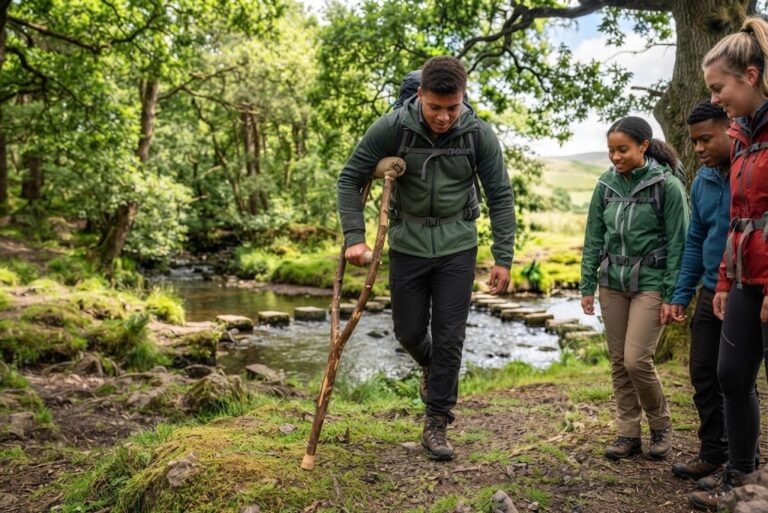
Scenario: Someone has slipped while walking and says their leg hurts.
Ask the team:
“What do you do first?”
The important lesson is not immediately treating the injury.
They should first consider their own safety, the surroundings and the casualty’s condition before deciding what help is needed.
2. The Cut Hand
Scenario: Someone has cut their hand while undertaking a supervised campcraft activity.
Ask:
“What information do you need before deciding what to do?”
Explorers can consider the severity of the bleeding, the person’s general condition and whether further help is required.
Keep the scenario focused on assessment and appropriate response rather than detailed treatment beyond their training.
3. The Burn
Scenario: Someone has accidentally touched hot equipment and has a burn.
Ask:
“What are your priorities?”
This can test whether Explorers remain calm and know the appropriate first-aid response they’ve previously been taught.
You can then introduce complications:
“The person is very upset.”
“You’re several minutes from the main group.”
How does that change the team’s response?
4. Someone Feels Faint
Scenario: During a walk, someone says they feel faint.
Ask:
“What would you do?”
Explorers should think about stopping the activity, assessing the person and considering the surrounding circumstances.
You can introduce additional information gradually rather than giving them the whole scenario at once.
5. Heat Illness
Scenario: On a warm day, someone becomes weak, dizzy and confused.
Ask:
“What concerns you?”
“What should happen next?”
This is a good opportunity to reinforce recognition of heat-related illness and the importance of getting appropriate help when someone’s condition is serious or worsening.
6. Hypothermia
Scenario: During a cold, wet activity, someone becomes very cold and starts behaving unusually.
Ask:
“What has changed?”
“What could be causing this?”
“What are your priorities?”
The team should recognise that environmental conditions can become a medical concern.
7. An Asthma Scenario
Scenario: Someone with asthma begins experiencing breathing difficulties during an outdoor activity.
Ask the team what they should do according to the person’s existing action plan and their first-aid training.
This can also test communication:
“Who needs to be informed?”
“When should emergency help be requested?”
Don’t encourage Explorers to guess at medication or treatment.
8. The Allergic Reaction
Scenario: Someone develops signs of a serious allergic reaction.
This should be treated as a serious scenario.
Ask:
“What are the warning signs?”
“What would you do?”
“When would you call emergency services?”
If your Explorers have been taught how to assist with an adrenaline auto-injector, keep the exercise within that training.
9. The Person Who Won’t Get Up
Scenario: Someone falls during a walk and says:
“I’m fine. I just want to keep going.”
Ask Explorers:
“Would you let them continue?”
This tests judgement and communication.
A person insisting they’re fine doesn’t automatically mean it’s safe for them to continue.
10. The Head Injury Scenario
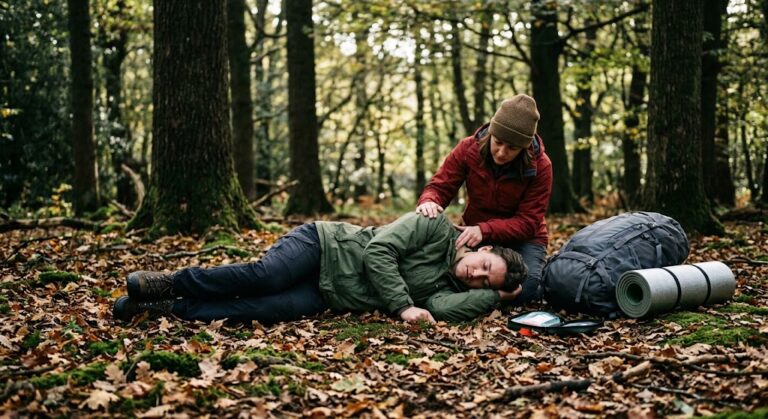
Scenario: Someone has fallen and hit their head.
Don’t turn this into a diagnosis exercise.
Instead, ask:
“What concerns you?”
“What information would you want?”
“Should this person continue the activity?”
“When would you seek medical help?”
This teaches Explorers to take potentially serious injuries seriously.
11. The Unresponsive Casualty
This is an important scenario for Explorers who have appropriate first-aid training.
Give them a fictional situation:
“You find someone who doesn’t respond when you speak to them.”
Ask what their priorities are.
They should follow the emergency-response sequence they’ve been taught and know when to contact emergency services.
This is an excellent scenario for practising communication and teamwork.
12. The Isolated Location
Take a familiar first-aid scenario and change the environment.
“The casualty is injured, but you’re away from the main campsite.”
Ask:
“What additional problems do you now have?”
The team might need to think about:
Communication.
Location.
Weather.
Access.
Supervision.
Getting appropriate help.
This demonstrates why outdoor first aid is different from first aid in a building.
13. The Lost Phone
Scenario: Someone needs help, but the person carrying the group’s phone can’t find it.
Ask:
“What are your options?”
This isn’t about teaching complicated improvisation.
It’s about contingency planning.
Explorers should understand that losing one piece of equipment shouldn’t automatically mean the group has no way to communicate.
14. The Wrong Location
Give the team a fictional emergency call scenario.
They know they need help, but don’t know exactly where they are.
Ask:
“What information could you give the emergency services?”
They can think about:
Map references.
GPS information.
Named landmarks.
Roads.
Buildings.
Nearby paths.
This connects first aid with navigation.
15. Two Casualties
Give the group a more complicated scenario.
“Two people are injured. One has a minor injury, while the other appears seriously unwell.”
Ask:
“Who needs your attention first?”
This introduces prioritisation.
The objective isn’t to overwhelm the Explorers with medical detail.
It’s to teach them that first aid involves assessing the situation and dealing with the most serious problem first.
16. The Panicking Casualty
The injury itself might be relatively minor, but the person is extremely distressed.
Ask:
“How would you communicate with them?”
This is a useful reminder that first aid isn’t only about physical treatment.
Keeping someone calm, explaining what you’re doing and getting appropriate help are all important.
17. The Group Has to Make a Decision
Give Explorers a scenario where there are several possible choices.
For example:
“Someone has hurt their ankle during a walk. They’re able to communicate, but continuing the planned route may make things worse.”
Ask:
“Do you continue, turn around, wait for help or change the route?”
There’s no need to make the scenario artificially complicated.
The important thing is getting Explorers to consider the person’s condition, the environment and the available support.
18. The Weather Changes
Take any scenario and introduce a weather change.
“It’s now getting colder and heavier rain is arriving.”
Ask:
“Does this change your plan?”
This demonstrates that outdoor first aid is affected by the environment.
The safest response may change as conditions change.
19. The Scenario With Missing Information
Don’t tell the Explorers everything.
Start with:
“Someone has collapsed.”
That’s all.
Ask:
“What do you want to know?”
Then provide information as they ask sensible questions.
This is an excellent way to teach assessment.
Instead of jumping to a conclusion, they learn to gather information first.
20. The Full Explorer Scenario
For an end-of-session challenge, combine several elements.
For example:
“Your team is on an outdoor activity when someone falls and injures themselves. The weather is deteriorating and you’re some distance from the main group.”
The Explorers have to:
Assess the situation.
Keep themselves safe.
Communicate with the casualty.
Decide what help is needed.
Communicate their location.
Consider the environment.
Work as a team.
Review whether their plan needs to change.
The leader can introduce new information as the scenario develops.
Make Someone the Team Leader
One useful progression is to give one Explorer responsibility for coordinating the response.
They’re not necessarily the person providing first aid.
Their job is to make sure the team works together.
They might need to decide:
Who stays with the casualty.
Who contacts the leader.
Who provides information.
Who keeps other group members safe.
Then rotate the leadership role.
Don’t Reward Drama
A good first-aid scenario isn’t necessarily the one with the most convincing acting.
Focus on the response.
Did the Explorers stay calm?
Did they assess the situation?
Did they recognise when something could be serious?
Did they communicate clearly?
Did they get appropriate help?
Did they avoid making the situation worse?
Those are the skills that matter.
Debrief Every Scenario
After each exercise, ask:
What went well?
What did you find difficult?
What information did you need?
Did you recognise the most serious problem?
Who should have been contacted?
What would you do differently next time?
This discussion can be more valuable than the role-play itself.
Keep Skills Within Their Training
It’s important not to turn Explorer Scouts into pretend paramedics.
If they have been taught basic first aid, practise basic first aid.
If they’ve completed more advanced training, you can build scenarios around those skills.
But don’t introduce medical procedures simply because they make a scenario sound more realistic.
The most useful lesson is often:
Recognise the problem, stay calm, get help and don’t make things worse.
Final Thoughts
Outdoor first aid is about more than knowing what to do with a bandage.
Explorers need to learn how to assess a situation, prioritise problems, communicate effectively and make sensible decisions when circumstances aren’t ideal.
Scenarios are a great way to practise those skills because they allow young people to make decisions without anyone actually being in danger.
Keep the situations realistic.
Keep the activities controlled.
And give Explorers enough space to think for themselves.
🩹 THE BIG IDEA
Good first aid starts before you touch the casualty.
Stop.
Look at the situation.
Keep yourself safe.
Assess what’s happening.
Get the right help.
Then act within your training.For Explorers, learning how to make those decisions calmly can be just as valuable as learning the individual first-aid techniques.
🔒Ready to test your survival skills?
Join Survival Guides UK for free, complete challenges, earn badges and increase your Survival Level.
JOIN FREE →
CRAIG BURR
FOUNDER · SURVIVAL GUIDES UK
I'm Craig, the person behind Survival Guides UK. I created SGUK because I wanted somewhere people could learn real outdoor skills in a practical, straightforward way — from lighting a fire and tying knots to navigation, campcraft and everything in between.
You can read more about the story behind SGUK here as well as our approach here.