How to Make an Improvised Crutch
If someone injures their leg while you’re outdoors, getting them back to safety can become a real problem, particularly if you’re some distance from a road or other help. In a minor injury, a temporary walking aid can sometimes make moving around easier. If the injury could be a fracture or is otherwise serious, however, trying to make the person walk on it may make things worse.
An improvised crutch is therefore an emergency aid, not a treatment. The priority is always to assess the injury, get appropriate help and avoid causing further harm.
Important
This article is for general first-aid education and is not a substitute for recognised practical first-aid training or professional medical advice. If someone has a serious leg injury, cannot safely walk, or may have a broken bone, seek medical help and follow the instructions of emergency services. NHS guidance advises avoiding movement and weight-bearing when a broken leg is suspected.
When an Improvised Crutch Might Help
There is a big difference between someone who has a painful but relatively minor injury and someone who may have seriously damaged a bone or joint.
For example, someone might have a painful ankle after a minor twist and be able to stand and take some weight, but find walking difficult. In a situation like that, a temporary support may make movement easier.
If the person has severe pain, obvious deformity, significant swelling, cannot put any weight on the leg, or the leg looks shorter, twisted or bent, don’t make an improvised crutch and encourage them to walk out. These can be signs of a more serious injury requiring medical assessment.
Find Suitable Materials
For a traditional improvised crutch, you need a strong, reasonably straight length of wood.
A fallen branch can be suitable if it is sound and strong enough to support the person’s weight. Avoid rotten wood, badly cracked branches, thin poles and anything with obvious weaknesses. If the branch bends significantly when you put pressure on it, choose something else.
The length matters too. A crutch that is far too short will provide very little support, while one that is excessively long will be awkward to use and difficult to control.
If you’re carrying walking poles, a sturdy trekking pole may be a better option than making something from scratch.
A Simple Emergency Design
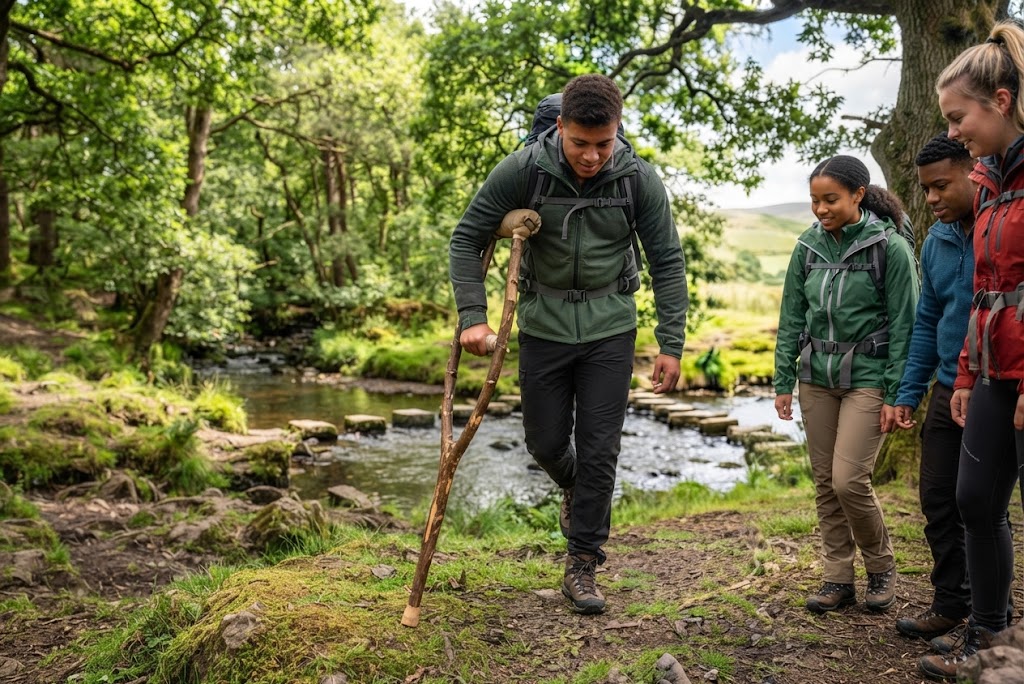
A basic improvised crutch can be made from a strong branch with a suitable handgrip and enough length to provide support beside the body.
The simplest approach is to find a natural fork in a strong branch, where two limbs meet to form a reasonably comfortable V shape. The person’s armpit should not be resting directly on the wooden fork. The support should be held through the hands, with the upper part positioned beside the body rather than jammed into the armpit.
This is important because putting body weight through the armpit can cause pressure on nerves and blood vessels.
If you don’t have a suitable forked branch, two strong poles can sometimes be arranged to create a similar support, but this needs to be secure enough that the pieces cannot separate while being used.
Check the Crutch Before Using It
Don’t hand the first suitable-looking branch to the injured person and immediately expect them to trust it with their weight.
Put the crutch on the ground and test its strength yourself as far as it is safe to do so. Look for cracks, loose bark, weak joints and places where the wood is beginning to split.
The contact point with the ground also matters. A narrow, slippery end can be unstable, particularly on wet grass, mud or loose ground. A sound natural end or a broad enough contact surface is preferable.
If the crutch feels flexible, unstable or damaged, don’t use it.
Make a Comfortable Handgrip
The handgrip needs to be comfortable enough for the injured person to hold without having to squeeze excessively hard.
If the branch is awkward or rough, wrap the grip with clothing, spare fabric, a bandage or another suitable material. This can also make the crutch easier to hold in cold or wet conditions.
Keep the padding secure. Loose material that slips around while someone is walking can make the crutch less stable rather than improving it.
Let the Person Test It Slowly
If the injury is suitable for assisted walking, don’t expect the person to immediately walk normally.
Have them stand somewhere stable and place the crutch where they can comfortably grip it. Let them test a small amount of weight through it first.
If they feel unstable, the crutch bends, the grip slips or their pain increases significantly, stop.
The aim is to provide a little extra support, not to turn an injured person into someone who can suddenly walk normally.
Don’t Use a Crutch for a Suspected Fracture
This is one of the most important parts of the skill.
If you think the person may have broken their leg, don’t use an improvised crutch to get them walking. NHS advice is to avoid moving the injured leg or putting weight on it while waiting for medical help. Padding around the leg can provide support while help is arranged.
Signs that need urgent medical attention include a leg that is twisted or bent, a bone sticking through the skin, a serious wound, severe symptoms of shock or difficulty breathing. In these situations, call 999 or 112 and follow the emergency call handler’s instructions.
The same principle applies if you simply aren’t sure how serious the injury is. It is better to keep someone still and get advice than to turn a manageable injury into a much bigger problem.
Think About the Journey
Even if someone can use the crutch, consider whether they actually need to walk.
If you’re in a remote location, it may be safer to stay where you are and arrange help rather than attempting a long walk out on an injured leg. Look at the terrain, weather, distance and the person’s condition before making that decision.
A short walk over level ground is very different from crossing a steep hillside, slippery woodland or rough moorland.
If the person is struggling to use the crutch, stop and reassess rather than simply encouraging them to carry on.
Keep Monitoring the Injury
Pain and swelling can change as time passes. Keep checking how the casualty is doing and whether they are becoming less able to move.
Don’t concentrate so much on constructing the crutch that you forget the person you’re trying to help. Keep them warm, calm and reassured while arranging appropriate assistance.
If their condition deteriorates, seek emergency help.
A Useful Emergency Skill
Knowing how to improvise a walking aid can be useful outdoors, but it is more important to know when not to use one.
A good first aider doesn’t automatically try to move an injured person. They look at the whole situation, consider what might have happened and decide whether moving the casualty is actually safe. St John Ambulance’s general first-aid guidance emphasises protecting yourself and the casualty from danger and only moving someone when leaving them would cause more harm.
An improvised crutch is therefore best thought of as a temporary solution for a suitable minor injury, not something that replaces proper medical assessment. Knowing how to make one is useful, but knowing when to leave it in the woods and call for help is just as important.
🔒Ready to test your survival skills?
Join Survival Guides UK for free, complete challenges, earn badges and increase your Survival Level.
JOIN FREE →
CRAIG BURR
FOUNDER · SURVIVAL GUIDES UK
I'm Craig, the person behind Survival Guides UK. I created SGUK because I wanted somewhere people could learn real outdoor skills in a practical, straightforward way — from lighting a fire and tying knots to navigation, campcraft and everything in between.
You can read more about the story behind SGUK here as well as our approach here.