Compass Basics: A Beginner’s Guide
Affiliate disclosure: This article contains affiliate links. If you purchase something through one of our links, we may earn a commission at no additional cost to you.
Compass Basics
A compass is one of the simplest and most useful navigation tools you can carry outdoors.
Unlike a phone, GPS device or electronic navigation system, a traditional magnetic compass doesn’t need batteries or a signal.
But owning a compass isn’t enough.
You need to understand how to use it.
Learning compass basics gives you the foundation for more advanced navigation skills, including taking bearings, following a route, using a map and navigating in poor visibility.
This guide introduces the fundamentals.
⚠️ SAFETY FIRST
Navigation is an important outdoor skill, but a compass should never be treated as a magic solution.
Before heading outdoors:
- Plan your route
- Check the weather
- Tell someone where you’re going when appropriate
- Carry a suitable map
- Take a reliable means of communication
- Know your limits
- Have a backup plan
A compass can help you navigate, but it doesn’t tell you whether a route is safe.
Always consider the terrain as well as your direction.
If you’re unsure where you are, stop and reassess rather than continuing blindly.
What Does a Compass Do?
A magnetic compass uses a magnetised needle that aligns with the Earth’s magnetic field.
The needle points towards magnetic north.
This gives you a reference direction from which you can work out other directions.
The four main cardinal directions are:
NORTH
=
Never
EAST
=
Eat
SOUTH
=
Soggy
WEST
=
Waffles
True North vs Magnetic North
There are two different ideas of north that beginners should understand.
True North
The direction towards the geographic North Pole.
Magnetic North
The direction indicated by a magnetic compass.
These aren’t exactly the same location.
The difference between them is called magnetic declination, or magnetic variation.
For many basic navigation exercises, the important lesson is simply:
A compass points to magnetic north, not necessarily grid or true north.
When you progress to map-and-compass navigation, you’ll need to understand how your map and compass handle magnetic variation.
The Main Parts of a Compass
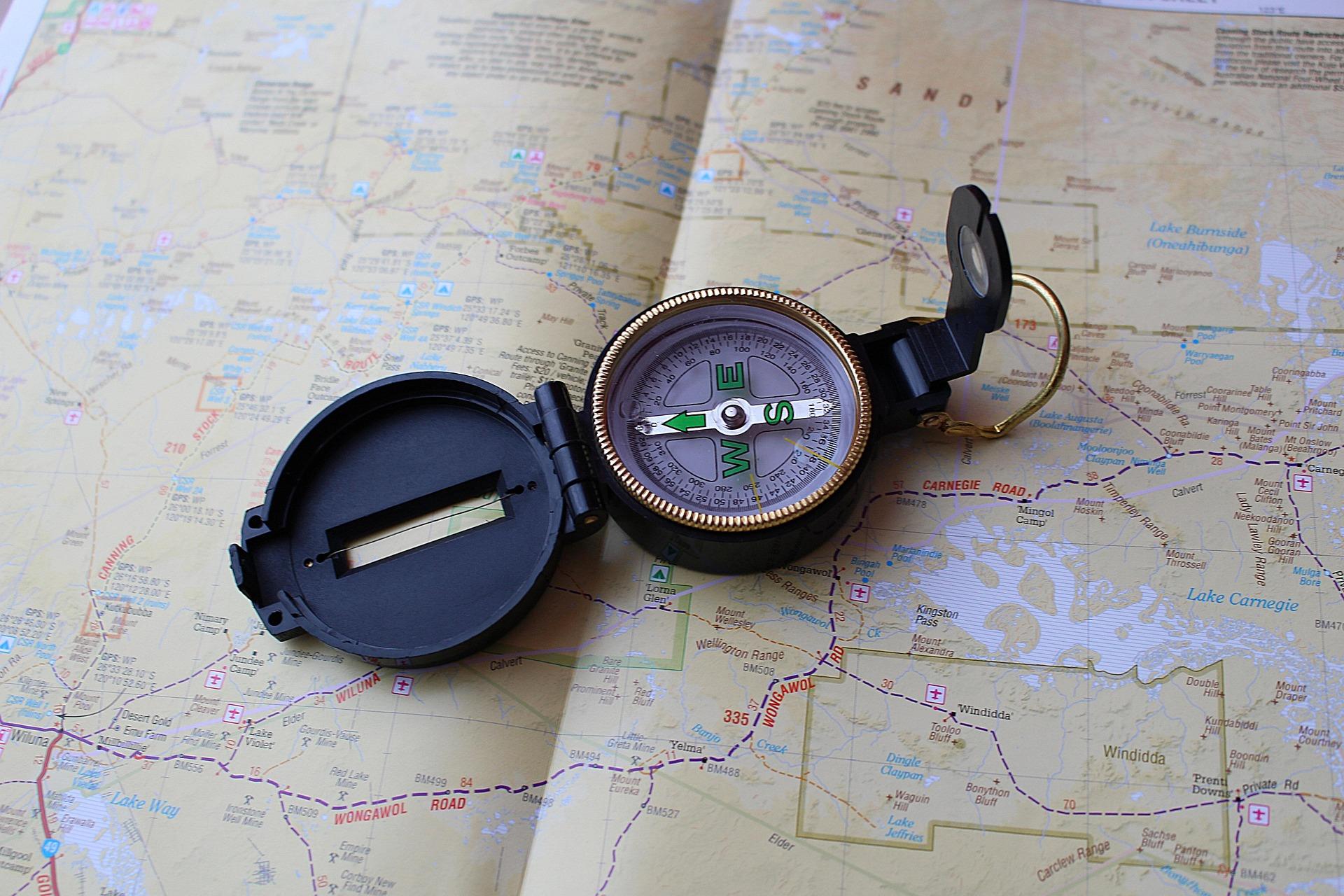
A typical baseplate compass has several important components.
1. Magnetic Needle
The magnetised needle rotates freely and aligns with magnetic north.
The coloured or marked end normally indicates the north-seeking end.
2. Baseplate
The transparent plate forms the main body of the compass.
It allows you to place the compass over a map.
3. Direction-of-Travel Arrow
This shows the direction you intend to travel.
4. Rotating Bezel
Also called the compass housing or rotating dial.
It contains the degree markings and can be rotated to set a bearing.
5. Scale
The edges of the baseplate can include measurements for working with maps.
Different compasses use different scales.
6. Orienting Lines
These lines inside the housing help you align the compass with the grid lines on a map.
Understanding Degrees
A compass isn’t limited to north, south, east and west.
A full circle contains:
360°
North is:
000° / 360°
East is:
090°
South is:
180°
West is:
270°
These numbers are called bearings when used as directions of travel.
For example:
090° = East
180° = South
270° = West
315° = Northwest
What Is a Bearing?
A bearing is a direction expressed as an angle measured clockwise from north.
Instead of saying:
“Walk roughly northeast.”
You can give a precise direction such as:
“Follow a bearing of 045°.”
This makes navigation more repeatable.
Someone else using the same reference system can follow the same bearing.
Your First Compass Exercise
Before taking bearings, get comfortable holding the compass.
Stand somewhere open and safe.
Hold the compass:
Let the needle settle.
Now rotate yourself until the north end of the needle aligns with the north marking on the compass.
You are now facing approximately magnetic north.
Turn slowly and identify:
North → East → South → West
Then repeat.
This simple exercise helps you understand what the compass is actually doing.
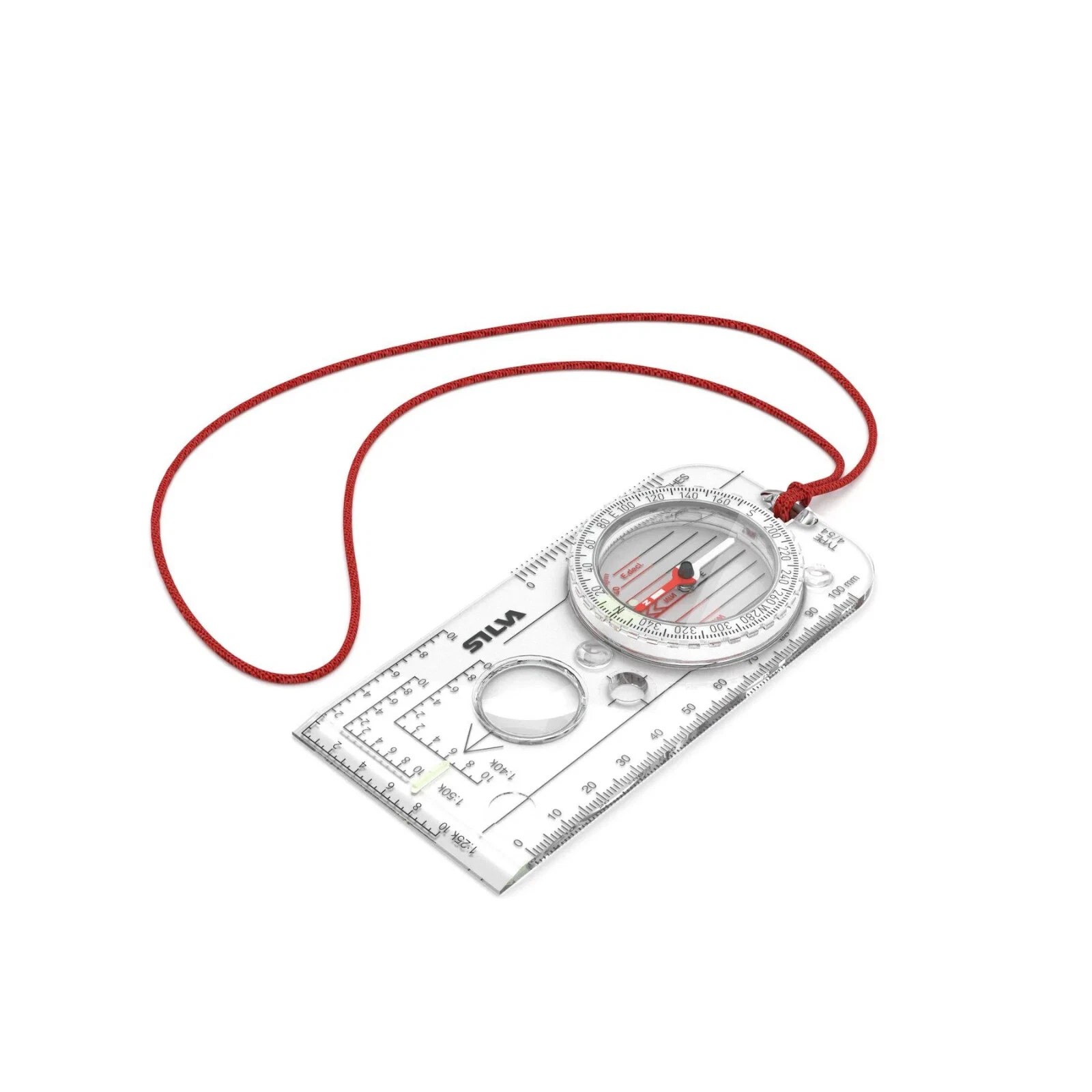
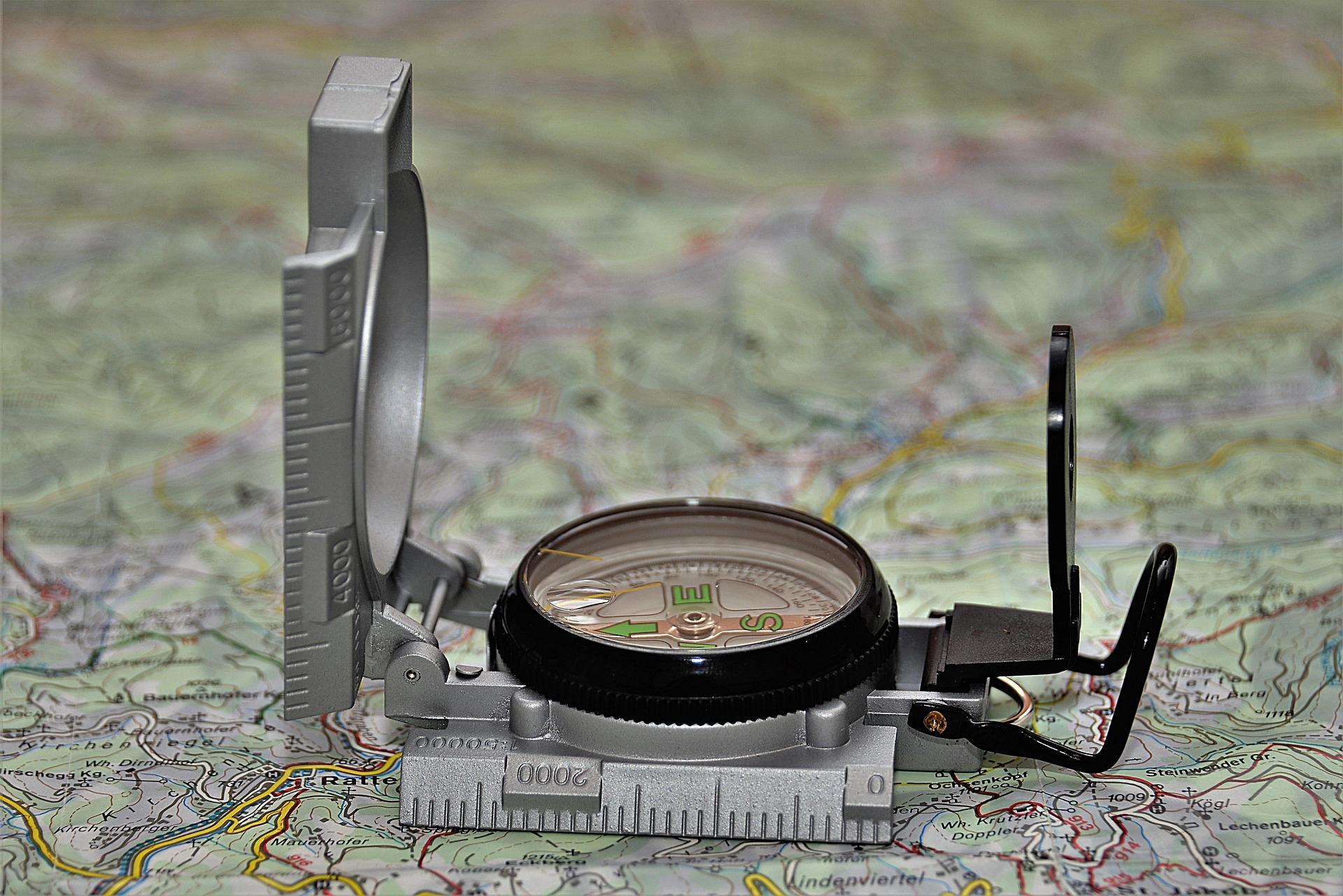
Silva Expedition 4-360 Compass
The “full-size” base plate compass for experienced navigators.
Contains everything you need in a compass and has added functionality for GPS.
The Expedition 4 is used by many defence forces around the world.
Finding North
Finding north is the first basic compass skill.
Hold the compass level and allow the needle to settle.
The north-seeking end of the needle indicates magnetic north.
Now turn your body until the needle lines up with the compass’s north reference.
You should now be facing north.
Important:
Don’t rotate the compass housing when you’re simply trying to find north.
You’re learning to use the needle as your reference.
Turning to a Direction
Once you can find north, you can use the compass to face a particular direction.
For example, suppose you want to face east.
East is:
090°
Turn the compass so the direction-of-travel arrow points away from you.
Then rotate your body until the magnetic needle lines up with the north reference on the compass.
The direction-of-travel arrow now indicates approximately east.
This is the basic principle behind following a bearing.
Taking Your First Bearing
Let’s say you want to travel on a bearing of 090°.
Step 1
Hold the compass level.
Step 2
Set the compass housing to 090°.
Step 3
Hold the compass in front of you.
Step 4
Turn your entire body until the magnetic needle lines up with the north reference.
Step 5
Look along the direction-of-travel arrow.
That is the direction you should travel.
The important part is understanding that the needle and the housing work together.
Following a Bearing
Following a bearing isn’t simply a matter of staring at your compass while walking.
Instead:
This is sometimes called aiming off to a visible feature or simply using intermediate landmarks to maintain your route.
Why do this?
Walking while constantly looking down at a compass is poor navigation practice.
You need to pay attention to:
The compass gives you direction.
Your eyes tell you what’s actually in front of you.
Use Landmarks
Imagine your bearing takes you through woodland.
Rather than staring at the compass and walking continuously, look ahead.
Can you identify:
Walk to the feature, check your direction again and continue.
This makes navigation easier and safer.
Compass and Map
A compass becomes much more powerful when combined with a map.
The map tells you:
Where things are.
The compass tells you:
Which direction you’re facing or travelling.
Together they allow you to:
This is why learning compass basics is only the beginning.
Orientating a Map
Orientating a map means aligning it with the landscape so that the features shown on the map correspond with the features around you.
A compass can help you do this.
The basic idea is:
- Place the map on a reasonably flat surface.
- Put the compass on the map.
- Align the map’s north direction appropriately.
- Rotate the map and compass together until the map is correctly aligned with the surrounding landscape.
The exact method depends on the map, compass and navigation system you’re using.
Why orientate the map?
An orientated map is much easier to understand.
If a path on the map runs east-west, it should correspond to the path you’re seeing in the landscape.
Grid North, True North and Magnetic North
As you progress beyond the basics, you’ll encounter three different north references:
TRUE NORTH
Geographic north.
GRID NORTH
The north direction represented by the map’s grid.
MAGNETIC NORTH
The direction indicated by a magnetic compass.
These can differ.
The difference changes depending on location and over time.
For serious map-and-compass navigation, always check the information printed on the map and use the appropriate current correction.
Don’t guess.
What Can Affect a Compass?
A magnetic compass can be affected by nearby magnetic or metallic objects.
Be cautious around:
If your compass behaves strangely, move away from potential sources of interference and allow the needle to settle again.
Good habit:
Check your compass in a clear area before relying on it.
Common Compass Mistakes
❌ Holding the compass at an angle
The needle needs to move freely.
❌ Looking at the wrong end of the needle
Make sure you know which end indicates magnetic north.
❌ Confusing the bearing with the needle direction
The bearing is your intended direction of travel.
❌ Forgetting to check the map
A compass doesn’t tell you what terrain is ahead.
❌ Walking while staring at the compass
Look ahead and use landmarks.
❌ Ignoring magnetic interference
Metal objects can affect compass readings.
❌ Assuming every compass works exactly the same way
Learn the specific features and markings of your compass.
Don’t Follow a Bearing Blindly
This is one of the most important navigation lessons.
Suppose your compass tells you to travel:
045°
But you reach:
You don’t simply continue because the compass says 045°.
Stop.
Check your map.
Find an appropriate alternative route.
A compass gives you a direction.
It does not give you permission to cross hazards.
Compass Navigation in Poor Visibility
A compass becomes particularly valuable when visibility is reduced.
Fog, darkness, heavy rain or woodland can make landmarks difficult to see.
In these conditions:
Don’t wait until visibility disappears before taking out your map and compass.
Navigation is easier when you stay ahead of the problem.
Compass Navigation: The Skills You’re Really Learning
Learning to use a compass teaches much more than remembering directions.
Observation
Can you relate the compass to the landscape?
Accuracy
Can you set and follow a bearing carefully?
Planning
Can you choose a sensible route?
Awareness
Can you recognise hazards around you?
Patience
Can you stop and check rather than rushing?
Confidence
Can you navigate without relying entirely on electronic devices?
These are the foundations of good outdoor navigation.
Your Compass Basics Challenge
The Compass Challenge
Before moving on to advanced navigation, see if you can:
□ Identify the north end of your compass needle.
□ Find magnetic north.
□ Identify north, east, south and west.
□ Explain what a bearing is.
□ Identify 000°, 090°, 180° and 270°.
□ Hold your compass correctly.
□ Set a simple bearing.
□ Turn your body to follow that bearing.
□ Walk towards a landmark while maintaining your direction.
□ Explain why you shouldn’t stare at the compass while walking.
□ Explain the difference between magnetic and true north.
□ Explain why a map and compass work better together.
The real challenge?
Go somewhere safe and familiar and see if you can identify four different landmarks — one approximately in each cardinal direction.
Scout Connection
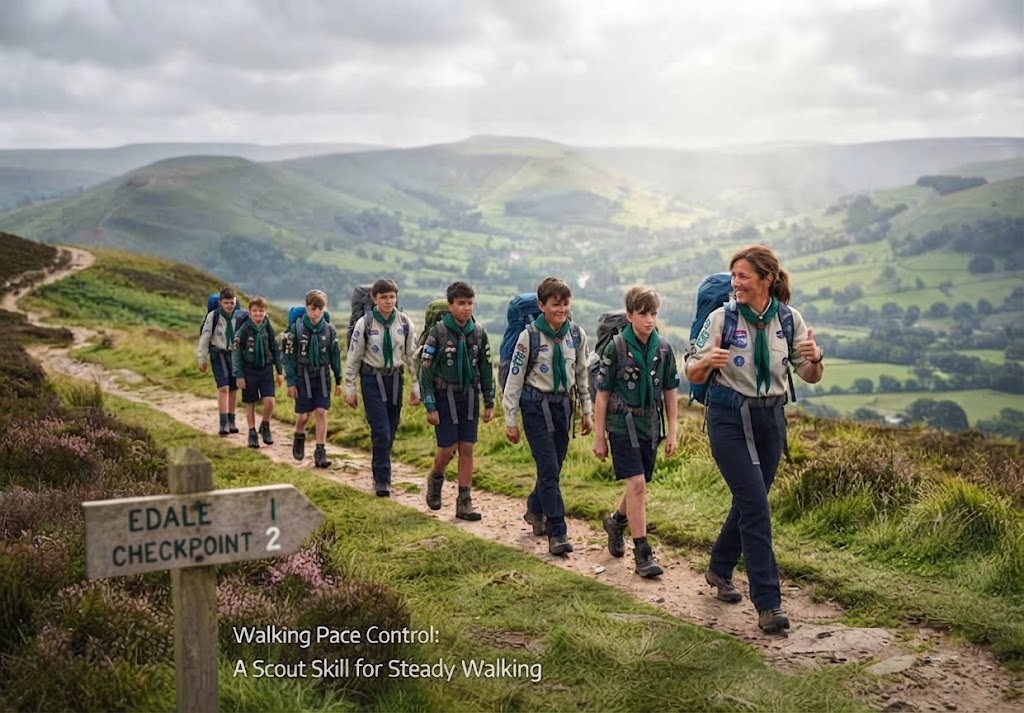
Compass work is an important part of traditional outdoor navigation and campcraft.
Learning to use a compass can develop:
For Scouts, the exact requirements associated with badges and programme activities can change.
If you’re working towards a particular badge or activity:
Always check the current official Scouts requirements and speak to your leader.
SurvivalGuidesUK is an independent educational resource and isn’t an official Scouts website.
The Golden Rules of Compass Use
If you remember nothing else:
1. Keep the compass level.
2. Know which end of the needle indicates north.
3. Remember that bearings are measured clockwise from north.
4. Use the map and compass together.
5. Look ahead rather than staring at the compass.
6. Use landmarks to help maintain your route.
7. Watch for magnetic interference.
8. Check your bearing regularly.
9. Never follow a bearing blindly into a hazard.
10. If you’re unsure where you are, stop and reassess.
A compass is a simple tool.
Learning to use it well is a valuable skill.
⚠️ SurvivalGuidesUK Safety Notice
Navigation errors can lead to getting lost, entering hazardous terrain or becoming exposed to changing weather conditions.
This article provides general educational information and does not replace appropriate navigation training, route planning, local knowledge, weather checks or organisational safety procedures.
Children and young people should practise navigation skills with appropriate adult supervision and within terrain suitable for their experience.
🔒Ready to test your survival skills?
Join Survival Guides UK for free, complete challenges, earn badges and increase your Survival Level.
JOIN FREE →
CRAIG BURR
FOUNDER · SURVIVAL GUIDES UK
I'm Craig, the person behind Survival Guides UK. I created SGUK because I wanted somewhere people could learn real outdoor skills in a practical, straightforward way — from lighting a fire and tying knots to navigation, campcraft and everything in between.
You can read more about the story behind SGUK here as well as our approach here.