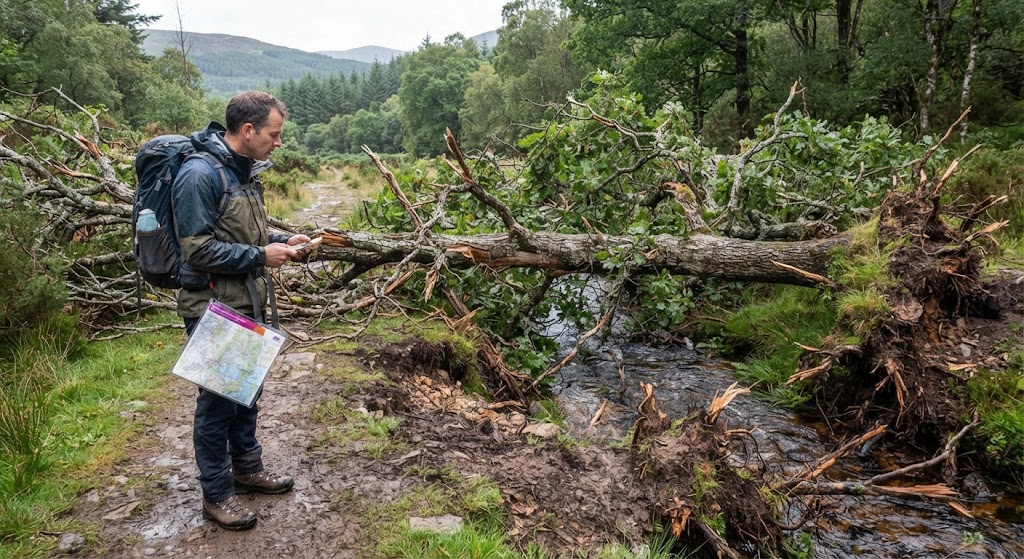
What to Do When a Hiking Route Is Blocked
You have planned your route, checked the weather, packed your bag and set off for a good day’s walking.
Then you reach a footpath and discover that you cannot continue.
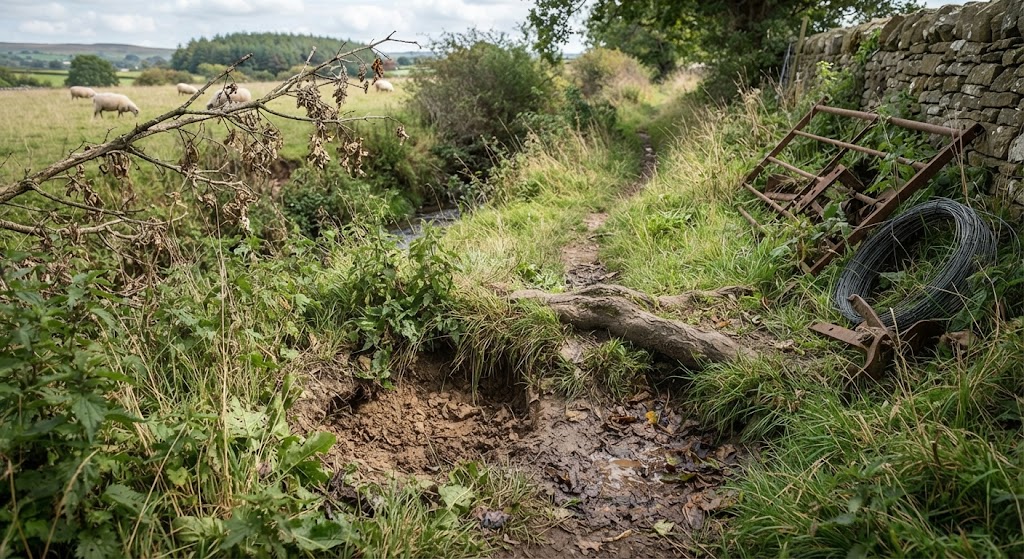
It might be a fallen tree, flooding, a damaged bridge, a locked gate, a landslip, fallen branches or a temporary closure.
The important thing is not to treat a blocked route as a challenge that must be overcome. The safest option is often to stop, work out why the route is blocked and decide whether you can safely take another route.
Knowing what to do when a hiking route is blocked is an important navigation and outdoor safety skill.
Stop Before You Try to Get Around It
The first mistake people make is continuing automatically.
Stop and look carefully at the obstacle.
Ask:
- What exactly is blocking the route?
- Is the obstacle temporary or likely to be permanent?
- Is there a safe way around it?
- Does the map show another path?
- Would going around it take you into private land?
- Has the weather made the situation more dangerous?
- Does the alternative add significant distance or time?
A few minutes spent assessing the situation can prevent a much bigger problem.
Do Not Assume You Can Cross
A blocked path can tempt you to improvise.
That might mean climbing a fence, scrambling around a landslip or attempting to cross a stream.
Be particularly cautious if the obstacle involves:
- Fast-flowing water
- Steep slopes
- Unstable ground
- Damaged bridges
- Deep mud
- Fallen trees under tension
- Barbed wire or fencing
- Rockfall
- Floodwater
If you cannot confidently identify a safe way through, don’t go through.
If the Path Is Flooded
Floodwater can look shallower and slower than it really is.
Do not assume that because you can see the ground on the other side, you can safely cross.
Water can hide:
- Holes
- Broken ground
- Deep channels
- Slippery surfaces
- Debris
- Damaged paths
If a normal footpath has become a stream, consider turning around or finding an alternative route.
Your planned destination is less important than getting there safely.
If a Tree Has Fallen Across the Path
A fallen tree may look like a simple obstacle, but large trees can be surprisingly dangerous.
Branches can be under tension, trunks can roll and root plates can remain unstable after a tree has fallen.
Do not climb over a large fallen tree simply because it is technically possible.
Look for a clearly established alternative path if one exists.
If there isn’t one, backtrack and reassess the route.
If There Has Been a Landslip
Landslips and eroded paths deserve particular caution.
Ground can continue moving after the original collapse.
Watch for:
- Cracks
- Loose soil
- Exposed roots
- Undercut edges
- Falling stones
- Steep unstable slopes
Never assume that the edge of a collapsed path is safe simply because other walkers have crossed it.
Check Your Map
This is where good navigation skills become useful.
Stop somewhere safe and look at your map.
Identify:
- Your current position.
- The blocked section.
- The direction you originally intended to travel.
- Nearby paths or tracks.
- A possible point where you can rejoin your route.
- How much extra distance the alternative will involve.
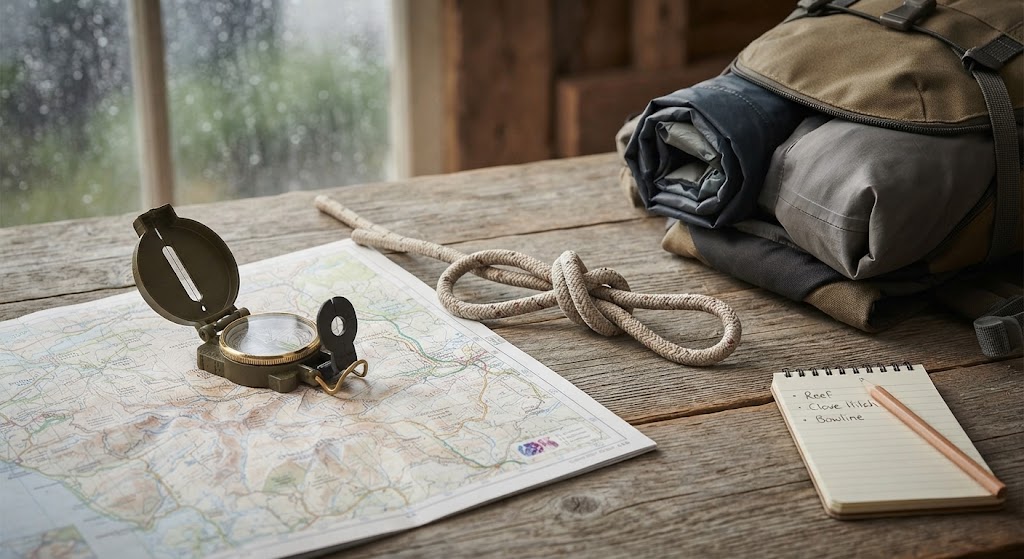
A paper map is particularly useful because it does not depend on battery life or mobile signal.
A phone or GPS device can be useful too, but it should complement rather than replace basic map-reading skills.
Look for an Alternative Route
The best alternative is not necessarily the shortest one.
Consider the terrain as well as the distance.
A route that adds 2 km along a straightforward path may be preferable to a route that saves 1 km but involves steep ground, difficult navigation or an uncertain crossing.
Think about the whole group.
An alternative suitable for an experienced adult may not be suitable for younger walkers.
Know When to Turn Around
Turning around is not a failure.
Sometimes the correct navigation decision is simply to return the way you came.
This is particularly sensible when:
- The alternative route is unclear.
- Darkness is approaching.
- Weather conditions are deteriorating.
- You have little daylight left.
- Someone in the group is tired or injured.
- You are carrying insufficient food or water for a longer route.
- You cannot establish a safe way forward.
A successful walk is one where everyone gets back safely, not one where the original route is completed at any cost.
Tell the Group What Is Happening
If you are walking with other people, don’t quietly disappear to investigate an alternative.
Stop the group somewhere safe.
Explain what has happened and what the options are.
For a youth group, this is also an excellent opportunity to teach navigation.
Ask questions such as:
- Where are we now?
- What is blocking the path?
- What does the map show?
- Which alternative looks possible?
- What extra distance would it add?
- What might we need to consider before choosing it?
What If a Route Is Officially Closed?
If there are signs, barriers or notices telling walkers not to use a route, treat the closure seriously.
Do not move barriers or ignore warning signs simply to stay on your planned route.
A closure may be in place because of:
- Unsafe bridges
- Flooding
- Tree damage
- Construction
- Erosion
- Land management work
- Dangerous ground
Use an established diversion where one is provided.
Make Blocked Routes Part of Your Navigation Practice
You can practise this skill without actually being caught out on a walk.
Take a map and choose a familiar route.
Pick one section and pretend it has suddenly become unavailable.
Then work out:
- Where you would turn around.
- What alternative paths exist.
- How much distance would be added.
- Where you would stop for a break.
- Whether the new route changes your arrival time.
- What you would do if the alternative was also blocked.
This is a simple but very useful navigation exercise for Scouts, Explorers and hiking groups.
The Golden Rule
When a hiking route is blocked, stop, assess, navigate and decide.
Do not let the fact that you have already walked several miles persuade you to take an unnecessary risk.
A blocked path is simply new information.
Good walkers adapt their plans when conditions change.
🔒Ready to test your survival skills?
Join Survival Guides UK for free, complete challenges, earn badges and increase your Survival Level.
JOIN FREE →
CRAIG BURR
FOUNDER · SURVIVAL GUIDES UK
I'm Craig, the person behind Survival Guides UK. I created SGUK because I wanted somewhere people could learn real outdoor skills in a practical, straightforward way — from lighting a fire and tying knots to navigation, campcraft and everything in between.
You can read more about the story behind SGUK here as well as our approach here.