Outdoor Skills You Can Practise on a Rainy Day
Rain Doesn’t Have to Stop Skill Practice
Some outdoor skills are actually easier to practise when you are not rushing around outdoors.
A rainy day gives you an opportunity to work on navigation, knots, equipment organisation, planning and observation without needing a full expedition.
If the weather is severe, stay indoors.
You can still practise plenty of useful skills.
1. Practise Your Knots
Choose three or four useful knots and practise tying them repeatedly.
Try:
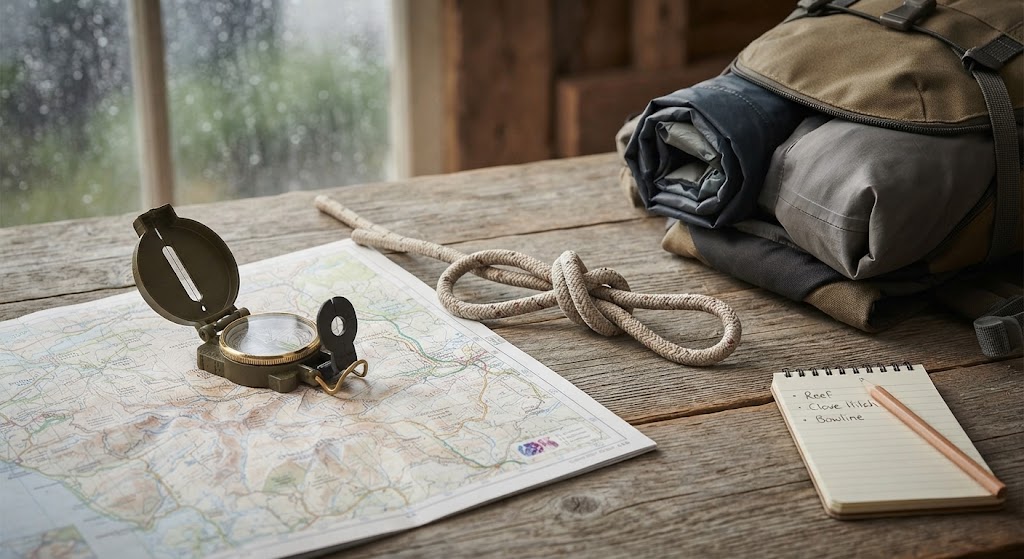
- Reef knot
- Clove hitch
- Bowline
- Round turn and two half hitches
The goal isn’t simply to memorise the names.
Practise tying them smoothly and checking whether they have been tied correctly.
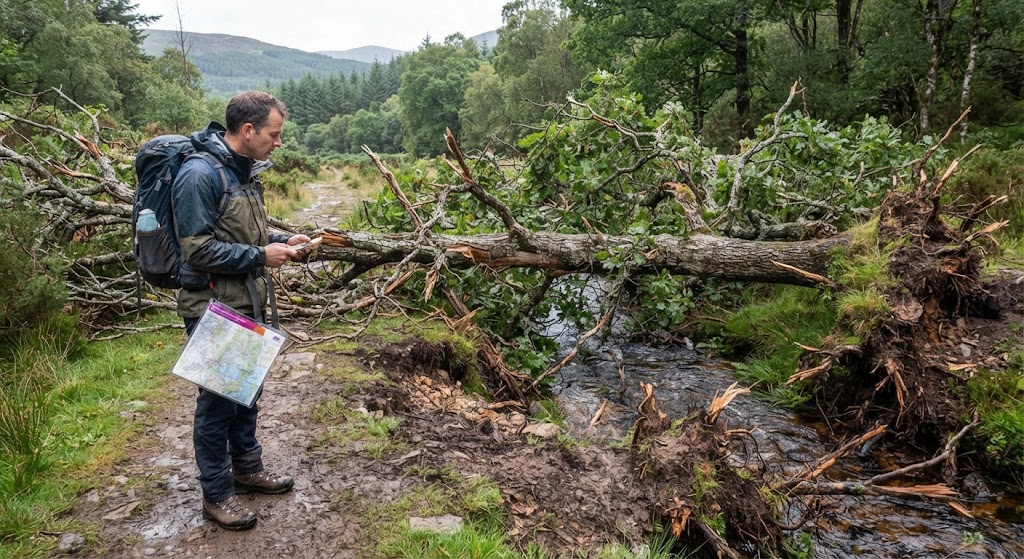
2. Practise Reading a Map
Choose a familiar local area on a map.
Find:
- Roads
- Paths
- Streams
- Woodland
- Hills
- Buildings
- Grid references
Then describe a route without actually walking it.
3. Practise Using a Compass
If you have a compass, practise identifying directions.
Try setting a bearing and following it across a garden or open indoor space where appropriate.
Learn what the compass is showing you before attempting complicated navigation exercises.
4. Pack a Rucksack
Empty your rucksack and pack it again.
Think about what you actually need.
Heavy items generally need sensible positioning, while frequently needed items should be easy to reach.
Then practise finding important items without emptying the whole bag.
5. Build a Waterproof Packing System
Take a selection of clothing and camping equipment.
Work out what needs extra protection from rain.
Practise using dry bags, waterproof liners or suitable waterproof storage.
The objective is simple: keep important items dry and know where they are.
6. Practise Putting on Outdoor Clothing
This sounds simple, but clothing systems are a genuine outdoor skill.
Practise organising:
- Base layers
- Warm layers
- Waterproofs
- Hats
- Gloves
- Spare socks
Learn how your clothing works together rather than treating every item separately.
7. Learn to Inspect Your Kit
Choose one piece of equipment and inspect it carefully.
Check for:
- Damage
- Missing parts
- Worn straps
- Broken buckles
- Dirt
- Dampness
Regular inspection helps prevent small equipment problems becoming big ones.
8. Plan a Walk
Use a map to plan a short route.
Work out:
- Start point
- Finish point
- Distance
- Major landmarks
- Possible stopping points
- Alternative route
- Approximate walking time
Then deliberately introduce a problem.
For example: “The bridge is closed. What do we do?”
9. Practise Shelter Planning
You don’t need to build a full shelter indoors.
Instead, design one.
Decide:
- Where you would build it
- Which direction the weather is coming from
- How you would keep the ground dry
- How you would secure the structure
- Where the entrance would be
This is useful preparation for real outdoor shelter building.
10. Learn About Weather
Look outside and make a weather observation.
Record:
- Cloud cover
- Wind direction
- Wind strength
- Rainfall
- Temperature
Then make a prediction about how the weather might change.
Compare your prediction with what actually happens.
11. Practise Emergency Decisions
Create imaginary scenarios.
For example:
“You are halfway through a walk and someone has twisted an ankle. What do you do?”
Discuss the priorities rather than rushing to produce a dramatic solution.
Think about:
- Keeping everyone safe
- Staying calm
- Assessing the situation
- Getting help when needed
- Looking after the rest of the group
12. Organise Your Camping Equipment
Empty a camping box or kit cupboard.
Group items together.
For example:
- Cooking
- Sleeping
- Lighting
- Navigation
- Clothing
- First aid
- Campcraft
You’ll quickly discover which equipment is missing or needs attention.
13. Practise Route Instructions
Ask someone to describe a route without showing you the map.
Try to draw the route from their instructions.
Then compare your drawing with the original.
This is an excellent way to practise communication and navigation language.
14. Try a Nature Observation From Indoors
Rain can make wildlife interesting.
Look through a window and record what you see.
You might notice:
- Birds visiting feeders
- Birds sheltering
- Worms appearing on paths
- Changes in puddles
- Moving water
- Different behaviour from animals
Keep a record and compare it with a dry day.
15. Create Your Own Rainy Day Challenge
Choose three skills and combine them.
For example:
Navigation + packing + knots
Plan a route, pack the equipment you would need and choose three knots you might use during the activity.
The challenge doesn’t have to be complicated.
The important thing is to practise deliberately.
Safety Comes First
Rain itself isn’t necessarily a reason to stay indoors, but severe weather can be.
Avoid outdoor practice during conditions involving dangerous winds, flooding, lightning or other obvious hazards.
There is nothing wrong with moving an outdoor activity indoors.
Good outdoor skills include knowing when conditions are unsuitable.
Rainy Days Can Be Training Days
A rainy day doesn’t have to mean cancelling all progress.
Use the time to practise the skills that are difficult to develop when you’re concentrating on getting somewhere.
Then, when the weather improves, you’ll have better skills to use outside.
🔒Ready to test your survival skills?
Join Survival Guides UK for free, complete challenges, earn badges and increase your Survival Level.
JOIN FREE →
CRAIG BURR
FOUNDER · SURVIVAL GUIDES UK
I'm Craig, the person behind Survival Guides UK. I created SGUK because I wanted somewhere people could learn real outdoor skills in a practical, straightforward way — from lighting a fire and tying knots to navigation, campcraft and everything in between.
You can read more about the story behind SGUK here as well as our approach here.