15 Signs That Wildlife Has Been Active Nearby
Wildlife spotting is not just about seeing animals.
In fact, most wild animals are much better at avoiding people than people are at finding them.
The good news is that animals leave clues behind.
Tracks, feathers, chewed nuts, droppings, burrows and disturbed vegetation can all tell you that an animal has been active nearby.
Learning to recognise these signs turns an ordinary walk into a wildlife investigation.
1. Footprints and Tracks
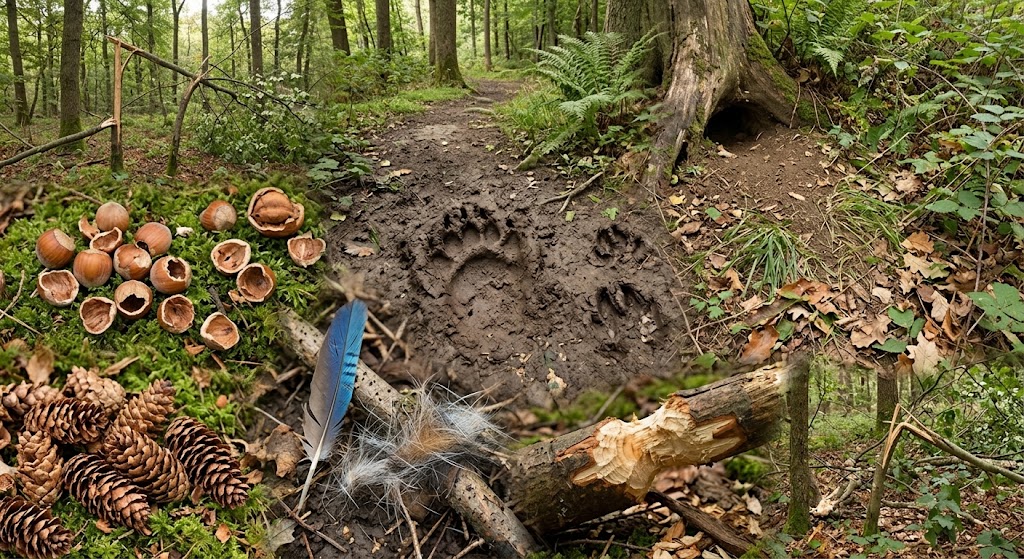
Tracks are one of the most obvious signs.
Look at muddy paths, soft soil, sand and wet ground.
Don’t just look for a perfect footprint. A trail of several prints can tell you much more about where an animal was travelling.
Look for:
- Shape
- Size
- Number of toes
- Direction
- Spacing between prints
Avoid disturbing the tracks before you have finished looking at them.
2. Nibbled Nuts
Find a collection of nuts or seeds and look closely.
Squirrels, mice and other animals can leave distinctive feeding marks.
Hazelnut shells are particularly interesting because the way they have been opened can provide clues about what has been feeding nearby.
You don’t need to identify the animal immediately. Record what you see and investigate later.
3. Gnawed Wood
Look at fallen branches and exposed pieces of wood.
Animals may chew wood for food, to reach insects or for other reasons.
Fresh gnaw marks can look very different from old weathered damage.
Try comparing fresh-looking marks with older ones.
4. Feathers
A single feather can tell you that a bird has been nearby.
A group of feathers may provide a different clue.
However, don’t automatically assume that a pile of feathers means a predator made a kill. Feathers can be moved by wind, scavengers and other animals.
Record what you actually observe rather than jumping to a conclusion.
5. Droppings
Animal droppings can be useful signs, but don’t touch them.
Size, shape, location and contents can sometimes help identify which animal left them.
Use photographs, a guidebook or a knowledgeable leader to help with identification.
Always wash your hands after wildlife observation and before eating.
6. Burrows and Holes
Look for holes in banks, under tree roots and around woodland edges.
A hole might be:
- A permanent animal home
- A temporary shelter
- An entrance to a larger network
- An old abandoned burrow
Don’t put your hands into holes.
Instead, observe the entrance from a safe distance.
7. Runs Through Vegetation
Animals often create repeated routes through grass, bracken and low vegetation.
These can look like narrow trails.
Look for flattened plants, repeated footprints and a route leading towards cover, food or water.
8. Nests
Birds, mammals and insects can all create structures that might be described as nests.
Look carefully in trees, hedges, banks and dense vegetation.
Never disturb an occupied nest.
During spring and summer, be particularly careful around dense vegetation where young animals may be present.
9. Fur or Hair
Small pieces of fur can sometimes become caught on fences, branches or rough vegetation.
Finding hair doesn’t necessarily tell you exactly which animal was present, but it can be another piece of evidence.
Look at the colour, length and texture without touching it.
10. Disturbed Leaves
A patch of leaves that has been moved or pushed aside may indicate animal activity.
Animals may search through leaf litter for food or use it for shelter.
Look for several signs together rather than treating one disturbed leaf as proof.
11. Scratches and Digging
Some animals dig through soil, leaf litter and soft ground while searching for food.
Look for freshly disturbed earth.
Compare the colour of exposed soil with the surrounding ground.
Fresh digging may also be associated with tracks or feeding remains.
12. Chewed Seeds and Fruits
Woodland floors can contain plenty of evidence.
Look for:
- Empty seed cases
- Chewed fruit
- Broken shells
- Partly eaten berries
- Pine cones with missing scales
Try to work out what has been eaten and what remains.
13. Broken or Bent Vegetation
Animals moving repeatedly through an area can leave vegetation bent or broken.
A single broken stem isn’t particularly useful.
Several broken stems forming a route can be much more interesting.
This is where observation skills matter.
14. Bird Calls
Wildlife signs don’t have to be physical.
You may hear birds before you see them.
Stop walking occasionally and listen.
Try to identify:
- Repeated calls
- Alarm calls
- Different species calling from different directions
- Changes in sound as you approach
Listening can be one of the easiest ways to become better at wildlife spotting.
15. Signs That Something Has Been Feeding
Perhaps the biggest clue is simply evidence of food being eaten.
Look for:
- Nibbled plants
- Chewed bark
- Empty shells
- Partly eaten fruit
- Digging around roots
- Damaged seeds
Try to ask three questions:
What has been eaten?
How has it been eaten?
What animal might have done it?
Turn It Into a Wildlife Detective Challenge
Choose a short section of woodland, parkland or countryside.
Give everyone a notebook and ask them to find five different signs of wildlife.
For every sign, record:
- What you found
- Where you found it
- What it might indicate
- Whether you are certain or guessing
The final point is important.
Good wildlife observation is not about pretending to know everything.
It is about noticing details and forming sensible questions.
Leave Wildlife Undisturbed
Wildlife watching should not become wildlife chasing.
Don’t:
- Follow animals closely
- Handle wild animals
- Touch nests
- Put your hands into burrows
- Move eggs
- Feed animals just to attract them
- Damage vegetation to get a better view
The best wildlife observer is often the person who notices the most while disturbing the least.
The More You Look, the More You See
Once you start looking for tracks, feeding marks, feathers and other clues, an ordinary walk becomes much more interesting.
You may not see a fox, deer, squirrel or badger.
But you might discover that several of them passed through the same area before you arrived.
🔒Ready to test your survival skills?
Join Survival Guides UK for free, complete challenges, earn badges and increase your Survival Level.
JOIN FREE →
CRAIG BURR
FOUNDER · SURVIVAL GUIDES UK
I'm Craig, the person behind Survival Guides UK. I created SGUK because I wanted somewhere people could learn real outdoor skills in a practical, straightforward way — from lighting a fire and tying knots to navigation, campcraft and everything in between.
You can read more about the story behind SGUK here as well as our approach here.