Water Purification Methods Explained
Knowing that you should purify outdoor water is important. Knowing how different purification methods work is even more useful.
There is no single method that deals with every type of contamination. Boiling, filtration and chemical disinfection each work in different ways, and the most suitable option depends on the water source, the equipment available and what you are trying to remove.
Understanding these differences allows you to make better decisions when you are collecting and treating water outdoors.
What You’ll Learn
By the end of this lesson, you will understand:
- The main methods used to treat outdoor water
- How filtration works
- How boiling makes water safer
- How chemical purification works
- The difference between filtration and disinfection
- Why some methods can be combined
- Why the water source still matters
Equipment
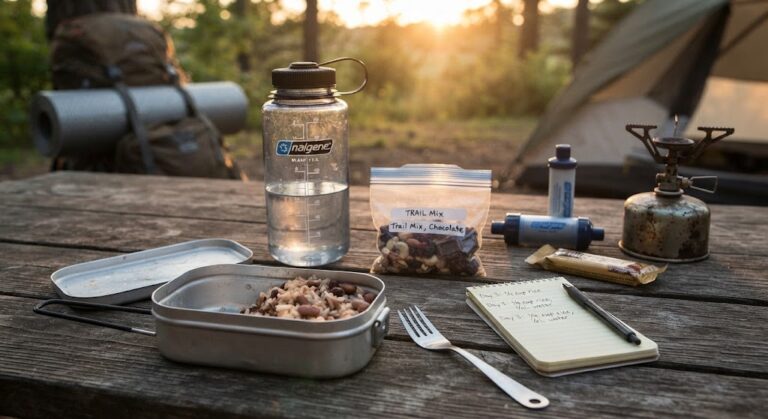
For practical learning, you may use:
- An outdoor water filter
- A suitable water container
- Water purification tablets
- A camping stove or other suitable heat source
- A heatproof container
- Clean storage bottles
Always follow the manufacturer’s instructions for any treatment equipment or purification products.
Prerequisites
You should already understand how to collect water without unnecessarily contaminating the source or your equipment.
It is also useful to understand how to recognise potentially contaminated water and why clear-looking water is not automatically safe to drink.
Filtration
Filtration works by physically passing water through a material designed to trap or remove particular contaminants.
Outdoor filters vary considerably. Some are designed mainly to remove sediment and particles, while others are designed to reduce specific microorganisms.
This means you should never assume that every outdoor filter provides the same level of protection.
Check the manufacturer’s specifications to find out what the filter is designed to remove.
What Filtration Is Good For
Depending on the filter, filtration can help remove:
- Dirt and sediment
- Suspended particles
- Some microorganisms
- Other contaminants that the particular filter has been designed to capture
Filtration can also make water clearer, which can be useful before another treatment method.
What Filtration May Not Remove
A filter does not necessarily remove dissolved chemicals, toxins or every type of microorganism.
This is why understanding the specification of your particular filter matters.
If the manufacturer recommends additional disinfection after filtration, follow that advice.
Boiling
Boiling uses heat to kill or inactivate many disease-causing microorganisms.
It is one of the most straightforward treatment methods when you have enough fuel and a suitable container.
Bring the water to a rolling boil and then allow it to cool safely before drinking.
Boiling is effective against many bacteria, viruses and parasites. However, it does not remove every chemical contaminant, so it should not be regarded as a universal solution for heavily contaminated water.
Advantages of Boiling
Boiling has several practical advantages:
- It does not require specialist filtration equipment.
- It can deal with many different microorganisms.
- The equipment needed is commonly carried on camping trips.
- You can see when the water has reached a boil.
Limitations of Boiling
Boiling also has disadvantages.
It requires fuel and time, and hot water presents a burn risk.
It also does not remove dissolved chemicals or other contaminants that are not destroyed by heat.
This is why choosing a sensible water source remains important.
Chemical Disinfection
Chemical purification uses a disinfectant to kill or inactivate microorganisms in the water.
Common outdoor products include water purification tablets or drops.
The exact chemical used varies between products, so always follow the manufacturer’s instructions rather than assuming that all products work in the same way.
Contact Time Matters
Chemical treatment needs time to work.
Adding a tablet and immediately drinking the water is not the same as allowing it to complete the required treatment period.
The instructions will tell you how long to wait.
Factors such as water temperature, clarity, dosage and the microorganisms present can affect how effective chemical disinfection is.
Ultraviolet Treatment
Some outdoor water-treatment devices use ultraviolet light to inactivate microorganisms.
UV treatment can be convenient because it does not require boiling or adding chemicals to the water.
However, it normally works best with relatively clear water because suspended particles can interfere with the treatment.
The device must also have sufficient battery power and be used according to its instructions.
If the water is visibly cloudy, pre-filtering may be necessary depending on the device.
Sedimentation
Sedimentation is not usually enough on its own to make outdoor water safe to drink, but it can be a useful preparation step.
Allowing muddy water to stand gives heavier particles time to settle to the bottom.
You can then carefully transfer the clearer water without disturbing the sediment.
This can reduce the amount of material that a filter or other treatment method has to deal with.
Think of sedimentation as preparation, rather than complete purification.
Filtering and Disinfecting Together
Sometimes the most sensible approach is to use more than one treatment method.
For example:
Collect → Settle → Filter → Disinfect → Store
Filtering can remove particles and some microorganisms, while a subsequent disinfection stage can provide another barrier against microorganisms.
Using multiple barriers is a common principle in water treatment because different processes can address different types of contamination.
However, more treatment is not automatically better in every situation. Your method should be appropriate for the source and the equipment you have available.
Which Method Should You Use?
There is no universal answer.
Consider:
What is the source?
A clean-looking upland stream is different from stagnant water beside a heavily used campsite.
Is the water cloudy?
Cloudy water may need settling or filtration before some other treatment methods.
What equipment do you have?
A filter, stove, purification tablets and UV device all have different requirements.
What are you trying to remove?
Different treatment methods deal with different contaminants.
How much water do you need?
Treating a small bottle of water is very different from treating several litres for a group.
A Simple Comparison
| Method | Main purpose | Main limitation |
|---|---|---|
| Sedimentation | Removes heavier particles | Does not make water safe by itself |
| Filtration | Removes particles and contaminants the filter is designed to capture | Performance varies between filters |
| Boiling | Kills or inactivates many microorganisms | Requires fuel and does not remove all chemicals |
| Chemical disinfection | Kills or inactivates many microorganisms | Requires correct dosage and contact time |
| UV treatment | Inactivates microorganisms | Usually requires relatively clear water and powered equipment |
The table is a guide rather than a substitute for checking the instructions and specifications of the equipment you are actually using.
Choosing the Best Approach
The strongest water-treatment decision often starts before you begin treating the water.
If you can choose between several sources, select the least contaminated-looking source available.
Then consider whether the water needs to be settled, filtered, disinfected or treated using another appropriate method.
For example, muddy water might first be allowed to settle and then filtered. If the filter is not designed to provide complete microbiological protection, you may then disinfect the water.
The important skill is understanding why you are choosing each stage rather than simply following a fixed recipe.
Practical Exercise
Take the water-treatment equipment you normally carry outdoors and identify what each item actually does.
For your filter, check:
- What it removes
- What it does not remove
- Its capacity
- How it should be cleaned
- How it should be stored
- What happens if the filter becomes blocked
For your purification tablets, check:
- The active ingredient
- The amount of water each tablet treats
- The required contact time
- The product’s expiry date
- Any restrictions on its use
Finally, think through how you would treat water if your preferred method became unavailable.
This helps you develop water-treatment options rather than depending on a single piece of equipment.
Final Tip
Don’t think of water purification as one method. Think of it as a decision.
Choose the best available source, understand what contaminants may be present, select a treatment method that addresses those risks, and protect the water once it has been treated.
The more you understand about how each method works, the better prepared you are to adapt when conditions change.
🔒Ready to test your survival skills?
Join Survival Guides UK for free, complete challenges, earn badges and increase your Survival Level.
JOIN FREE →
CRAIG BURR
FOUNDER · SURVIVAL GUIDES UK
I'm Craig, the person behind Survival Guides UK. I created SGUK because I wanted somewhere people could learn real outdoor skills in a practical, straightforward way — from lighting a fire and tying knots to navigation, campcraft and everything in between.
You can read more about the story behind SGUK here as well as our approach here.