Magnifying-Glass Fire Lighting: Scout Campcraft Guide
Activity Overview
Difficulty: Moderate
Time: 30–45 minutes
Location: Scout campsites and suitable outdoor areas
Best for: Scouts, Explorers, Patrol Leaders and experienced Cubs under close supervision
Skills: Fire lighting, solar energy, tinder preparation, observation, patience and fire safety
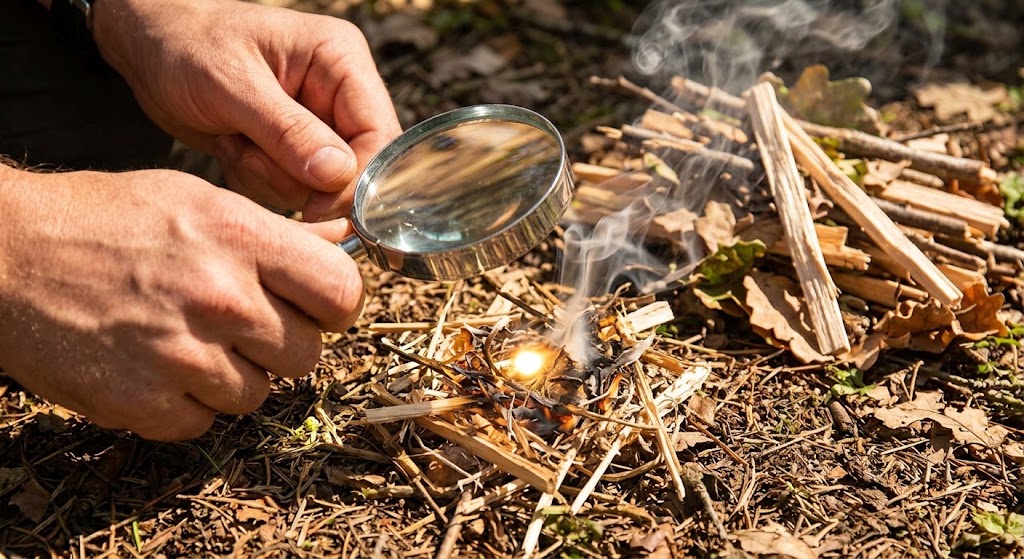
A magnifying glass can concentrate sunlight onto a small area of tinder, increasing its temperature until it begins to smoulder and eventually ignite.
The technique works best in strong, direct sunlight with very dry, easily ignited tinder.
Because a magnifying glass can concentrate enough sunlight to ignite materials unintentionally, treat it as a genuine fire hazard even when you’re not deliberately lighting a fire.
What You’ll Learn
You’ll learn how concentrated sunlight can generate enough heat to ignite suitable tinder.
You’ll practise positioning a magnifying glass to create the smallest, brightest possible focal point and learn how to develop the resulting ember into a flame.
You’ll also learn why weather, tinder preparation and careful supervision are important when using solar fire-lighting techniques.
🔴 SAFETY – HIGH RISK
A magnifying glass can concentrate sunlight intensely enough to ignite dry materials.
Never leave a magnifying glass in direct sunlight where it can focus sunlight onto grass, leaves, paper, tents or other combustible materials.
Keep the lens pointed away from people and never look directly at the concentrated sunlight.
Do not use the technique near dry vegetation, woodland or other areas where an accidental fire could spread.
Only carry out the activity where fires are permitted and where the fire can be properly controlled.
Have suitable means of extinguishing the fire immediately available.
A responsible adult should supervise the activity.
Equipment
You’ll need a suitable magnifying glass or other convex lens.
You’ll also need very dry tinder capable of catching concentrated heat.
Prepare dry kindling and suitable fuel before attempting to create a flame.
Use a designated fire area or approved fire container.
Keep water or another suitable means of extinguishing the fire close by.
Prerequisites
Scouts should understand basic fire safety before attempting solar fire lighting.
Check that fires are permitted at the location.
The fire area and tinder should be prepared before focusing sunlight.
Instructions
1. Check the Weather
You need direct sunlight for this technique.
Bright, strong sunlight produces the best results.
If the sun is obscured by heavy cloud, the technique may not work effectively.
Don’t compensate for weak sunlight by taking the lens closer to combustible materials or trying to create an uncontrolled ignition point.
2. Prepare the Fire Area
Use an established fire area where available.
Make sure the surrounding area is clear of unnecessary combustible material.
Keep dry grass, leaves and other easily ignited materials away from the working area.
3. Prepare Your Tinder
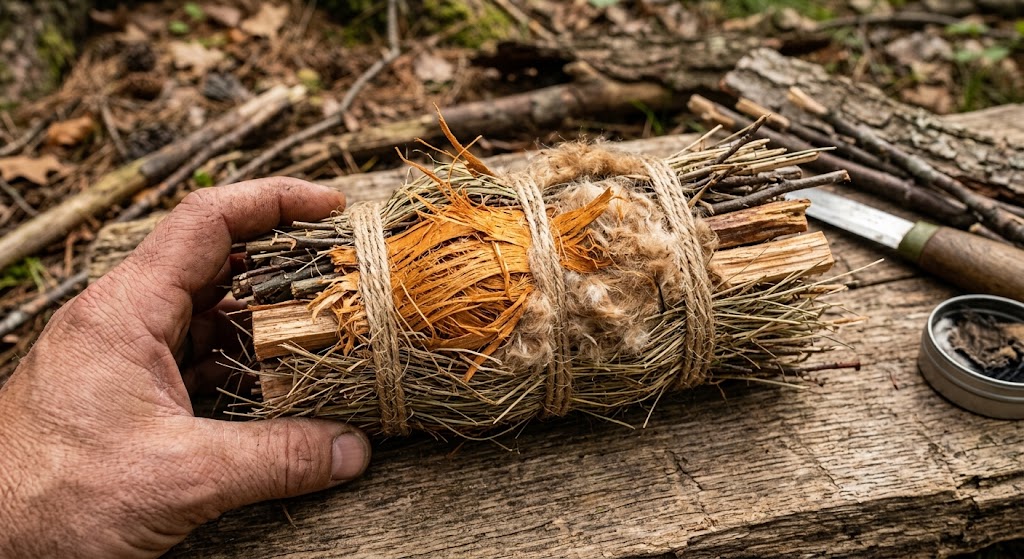
Use very dry, fine tinder that can begin to smoulder when concentrated sunlight is applied.
Fine natural tinder or a suitable commercial fire-lighting material can be used where appropriate.
Have the tinder ready before bringing the magnifying glass into position.
4. Position Yourself Safely
Choose a position where you can control the lens comfortably.
Keep the lens away from your face and body.
Make sure the concentrated beam won’t cross another person’s position.
5. Hold the Magnifying Glass
Hold the magnifying glass securely by its handle.
Don’t place your fingers across the lens.
Keep the lens under control throughout the activity.
6. Find the Focal Point
Point the magnifying glass towards the sun.
Move the lens carefully until the sunlight forms the smallest, brightest spot on the tinder.
This concentrated point is where the greatest amount of solar energy is being focused.
7. Keep the Lens Steady
Once you have found the focal point, keep the lens as steady as possible.
Small movements can cause the concentrated spot to move away from the tinder.
Don’t lean over the tinder while making adjustments.
8. Watch for Smouldering
With suitable dry tinder and strong sunlight, the focused point may begin to darken and smoulder.
Don’t touch the tinder to check it.
Keep the lens controlled and watch for the development of an ember.
9. Develop the Ember
Once an ember forms, carefully encourage it to spread through the tinder.
Remove the lens from the area if it is no longer required.
Use gentle airflow to help the ember develop, taking care not to scatter the tinder.
10. Create a Flame
Transfer the developing ember to a suitable tinder bundle if necessary.
Carefully encourage the ember until a small flame develops.
Keep your face away from the tinder and avoid sudden movements.
11. Add Kindling
Once you have a stable flame, add small pieces of dry kindling.
Place them carefully so they don’t smother the flame.
Leave enough space for air to circulate.
12. Build the Fire Gradually
As the kindling catches, gradually add larger fuel.
Don’t overload the fire.
A controlled fire should develop progressively.
13. Put the Magnifying Glass Away
Once you have finished using the lens, put it somewhere where sunlight cannot pass through it and focus onto combustible materials.
Don’t leave it lying in direct sunlight.
This is particularly important when the activity is finished and attention has moved to the campfire.
14. Extinguish the Fire
When the fire-lighting activity is finished, extinguish the fire completely according to the campsite’s procedures.
Check for remaining embers and smouldering material.
Don’t leave the area until the fire is properly dealt with.
Why Does It Work?
Sunlight carries energy, but it normally arrives over a relatively large area.
A magnifying glass concentrates that sunlight into a much smaller area.
The concentrated energy raises the temperature of the tinder.
Once the material becomes hot enough, it can begin to break down and smoulder, eventually producing a flame if sufficient heat and oxygen are available.
Best Tinder
The finer and drier the tinder, the easier it is to start.
Dark materials often absorb more sunlight than pale materials, making them useful for demonstrating the principle.
The tinder needs to be capable of holding heat rather than simply allowing the focused spot to move across its surface.
Why It May Not Work
The most common reason is insufficient sunlight.
Other problems include damp tinder, an unstable focal point or a lens that isn’t concentrating the sunlight effectively.
If the focal point is large and dull rather than small and bright, adjust the distance between the lens and tinder rather than moving the tinder around unnecessarily.
Cloudy Conditions
Solar fire lighting depends directly on sunlight.
Thin cloud may still allow some concentrated heat, but heavy cloud generally makes the technique ineffective.
Don’t keep moving closer to combustible materials in an attempt to compensate for weak sunlight.
Wait for suitable conditions or use another permitted fire-lighting method.
Final Tip
Magnifying-glass fire lighting is a great way for Scouts to see solar energy turned directly into heat.
The key is very dry tinder, strong sunlight and a steady focal point.
Remember that the lens doesn’t stop being a fire hazard when you’re finished using it—always store it out of direct sunlight and make sure it cannot accidentally focus sunlight onto anything combustible.
🔒Ready to test your survival skills?
Join Survival Guides UK for free, complete challenges, earn badges and increase your Survival Level.
JOIN FREE →
CRAIG BURR
FOUNDER · SURVIVAL GUIDES UK
I'm Craig, the person behind Survival Guides UK. I created SGUK because I wanted somewhere people could learn real outdoor skills in a practical, straightforward way — from lighting a fire and tying knots to navigation, campcraft and everything in between.
You can read more about the story behind SGUK here as well as our approach here.