How to Start a Nature Journal
You don’t need to know the names of hundreds of plants and animals to keep a nature journal. In fact, one of the best things about starting one is that it gives you a reason to slow down and pay attention to what is happening around you.
A nature journal can be as simple as a notebook with a few words and sketches in it. Over time, those little observations build into a record of the places you’ve visited and the changes you’ve noticed through the seasons.
Choose a Notebook You Will Actually Use
The best nature journal isn’t necessarily the biggest, most expensive or most beautifully designed notebook. It is the one you’re happy to take outside and write in.
A small notebook is easy to carry on walks, while a larger one gives you more room for drawings and longer observations. A hard-wearing notebook can be useful if you’re going to be taking it into woodland or using it in wet weather.
Don’t worry about keeping every page perfect. A nature journal is meant to be used.
Decide What You Want to Record
There isn’t a set list of things that belong in a nature journal. You might record a bird you saw, a strange-looking leaf, a spider’s web, a change in the weather or something you simply found interesting.
You can also record things that aren’t alive. A particularly interesting rock, a fallen tree, a stream that has changed after heavy rain or an unusual cloud formation can all make good entries.
The important thing is that you’re recording something you actually noticed.
Start With the Date and Place
At the beginning of each entry, write down when and where you were.
You don’t need to write a detailed description of your location. Something as simple as the name of the woodland, park or walking route can be enough.
Adding the date becomes particularly useful as your journal grows because you can look back and see what was happening at the same time of year.
Write Down What You Notice
Don’t worry about trying to sound like a scientist.
Instead of writing that you saw “a bird”, describe what actually happened. Perhaps it was sitting high in a tree, making a particular sound, or flew away when you approached.
Those details are often more interesting than simply recording the species name, especially when you’re still learning.
Draw What You See
You don’t need to be good at drawing to use sketches in your journal.
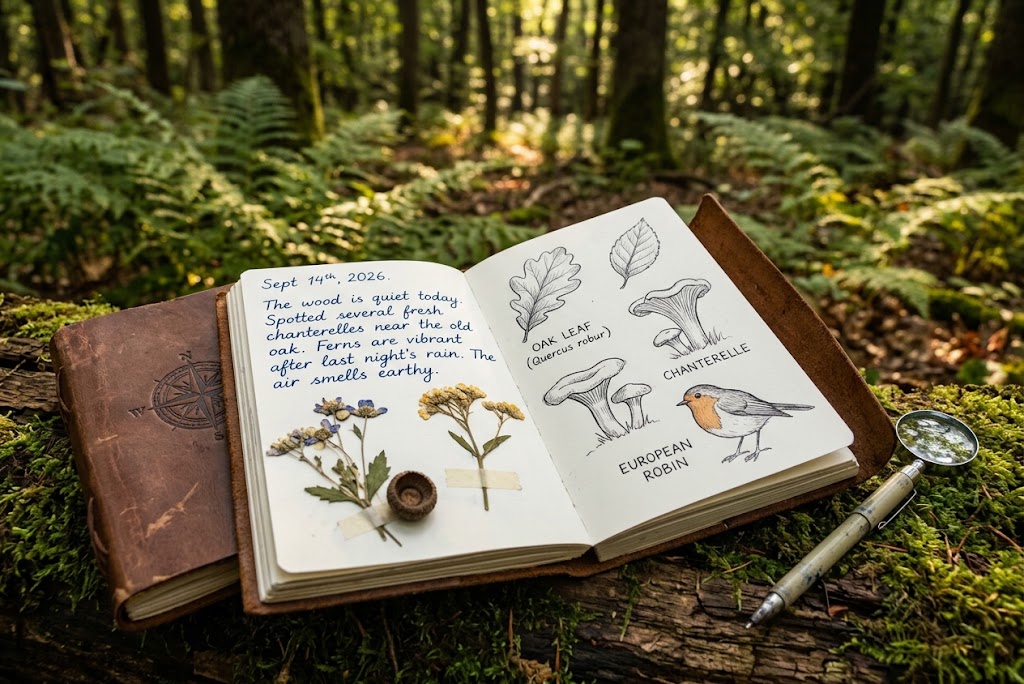
Try drawing the shape of a leaf, the pattern on a feather, the outline of a tree or the way a particular flower is arranged. You can add arrows and notes to point out details that you want to remember.
Don’t erase every mistake. A rough sketch can still be useful, and you’ll probably be surprised at how much your drawings improve after a few months of practice.
Record the Weather
Weather can completely change what you notice outdoors, so it is worth including it in your entries.
Write down whether it was sunny, cloudy, windy or raining, and perhaps add the temperature if you have a way of measuring it. You could also record things such as frost, heavy rain, strong winds or an unusually warm day.
When you look back through your journal later, these details can help explain why the landscape looked different.
Record Questions as Well as Answers
One of the best things you can put in a nature journal is a question.
Perhaps you notice that one tree has lost its leaves while another nearby hasn’t. Maybe you find a strange mark on a leaf or hear a bird you don’t recognise.
Write down the question rather than immediately trying to solve it. You can research it later and add the answer to your journal.
This turns the journal into a way of learning rather than simply a collection of observations.
You Don’t Have to Know What Everything Is
It’s perfectly fine to write “small brown bird” or “yellow flower” if you don’t know the name.
Try to describe what you can actually see and, if you want to identify it later, add your best guess or a question mark.
Learning to observe something carefully before looking up its name is a useful skill in itself. It also stops you from deciding what something is before you’ve really looked at it.
Try a Sit-Spot
A simple way to start nature journaling is to choose one place and return to it regularly.
It could be the same bench in a park, a patch of woodland, the edge of a pond or even somewhere in your garden. Spend ten or fifteen minutes sitting quietly and record what you notice.
The first few visits might not seem very different, but over time you’ll begin to notice seasonal changes, different animals, new plants and changes in the weather.
Use Your Senses
A nature journal doesn’t have to be entirely visual.
Write down sounds you hear, smells you notice and changes in temperature or the feel of the ground beneath your feet. You might notice the sound of insects on a warm afternoon or the smell of wet leaves after rain.
You don’t need to touch everything you find. Observing carefully without disturbing the environment is an important part of exploring outdoors.
Add Small Collections of Information
As your journal develops, you can start adding useful little records.
You could keep a list of birds you’ve seen, record the first appearance of a particular flower each year or note when you hear your first frog of spring. You could even keep track of the weather on every visit.
These small records become much more interesting when you have several months or years of them to compare.
Don’t Tear Things Out Just to Put Them in Your Journal
You don’t need to collect specimens to make a good nature journal.
Instead of picking flowers or removing leaves from living plants, draw them or take a photograph. Fallen leaves, seeds and other natural materials can sometimes be useful for closer study, but only collect where it is appropriate and permitted.
Your journal should help you notice nature without causing unnecessary damage to it.
Make Your Journal Your Own
There is no correct way to keep a nature journal.
Some people fill pages with detailed drawings, while others prefer short notes and lists. You might enjoy adding photographs, maps, pressed fallen leaves, weather symbols or little diagrams.
Don’t worry about making every page look impressive. The value of a nature journal comes from the observations it contains, not how neat it looks.
Look Back at Older Entries
One of the most rewarding parts of keeping a nature journal comes later.
After a few months, look back at your earlier entries and compare them with what you’re seeing now. You might notice that you’ve started recognising more species, drawing with more confidence or spotting details that you would previously have missed.
You’ll also have a record of how the places you visit change throughout the year.
Keep Going
You don’t need to write in your nature journal every day. Take it with you when you go for a walk, sit outside for a while or visit somewhere you’ve never explored before.
Start with one observation. Write down what you saw, add a sketch if you feel like it and record any questions that come to mind.
The more often you stop and look, the more you’ll begin to notice. And that is really what a nature journal is for: helping you pay attention to the outdoors.
🔒Ready to test your survival skills?
Join Survival Guides UK for free, complete challenges, earn badges and increase your Survival Level.
JOIN FREE →
CRAIG BURR
FOUNDER · SURVIVAL GUIDES UK
I'm Craig, the person behind Survival Guides UK. I created SGUK because I wanted somewhere people could learn real outdoor skills in a practical, straightforward way — from lighting a fire and tying knots to navigation, campcraft and everything in between.
You can read more about the story behind SGUK here as well as our approach here.