How to Tell How Long a Walk Will Take
Knowing how long a walk will take is an important part of route planning.
It affects what time you start, how much food and water you carry, whether you will finish before dark and whether the route is suitable for everyone in your group.
The simplest calculation is:
Walking time = distance ÷ walking speed
But that only works reasonably well on straightforward, relatively flat ground.
Once hills, difficult terrain, breaks and a mixed-ability group are involved, you need to think about more than distance.
The Basic Walking Time Calculation
Start with the distance.
For example, imagine a route is 6 kilometres long.
If you walk at an average speed of 4 kilometres per hour:
6 ÷ 4 = 1.5 hours
So the basic walking time is approximately 1 hour 30 minutes.
This is only a starting point.
It does not automatically account for hills, muddy ground, navigation, stops or the ability of the people walking with you.
How Fast Do People Walk?
There is no single walking speed that applies to everyone.
A person’s pace depends on:
- Age
- Fitness
- Terrain
- Weather
- Footwear
- Backpack weight
- Group size
- Experience
- How often they stop
A useful planning exercise is to work out your own group’s comfortable pace on a familiar route.
Don’t assume that the fastest person’s speed represents the speed of the whole group.
Why Distance Isn’t Enough
Two walks can have exactly the same distance but take very different amounts of time.
Imagine two 10 km routes.
Route A is mostly flat.
Route B climbs several hills and includes rough ground.
The second route can take considerably longer even though both routes are 10 km.
This is why hikers need to look at elevation and terrain, not just the distance.
Allow Extra Time for Hills
One traditional way of estimating walking time on hilly routes is Naismith’s Rule.
The commonly used metric version allows approximately:
1 hour for every 5 km of distance
plus
1 hour for every 600 metres of ascent.
It is a planning rule rather than a guarantee.
For example, a 10 km route with 600 metres of total ascent gives:
10 km = 2 hours
600 m ascent = 1 hour
Estimated walking time:
3 hours
The actual time could be shorter or longer depending on the walkers and conditions.
What Does “Total Ascent” Mean?
This is an important detail.
Total ascent is not simply the difference between your starting height and highest point.
Imagine you start at 100 metres, climb to 300 metres, descend to 200 metres and then climb to 400 metres.
You have climbed:
200 m + 200 m = 400 m total ascent
even though your final height is only 300 metres above your starting point.
When planning a hilly walk, look for the total climbing involved, not just the highest point.
Use Contour Lines to Understand the Route
A map’s contour lines can help you see where the climbing happens.
Contour lines join points of equal elevation. When they are close together, the ground is steeper; when they are further apart, the slope is gentler.
This lets you spot difficult sections before you start.
A route that appears simple when viewed only as a line on a map can look very different once you examine its contours.
Add Time for Breaks
Walking-time formulas generally describe moving time rather than the complete time you will spend away from home.
You may need to stop for:
- Food
- Water
- Navigation
- Photos
- Clothing changes
- Wildlife observation
- Toilet breaks
- Rest
For a short walk, these might add only a small amount of time.
For a full-day expedition, they can make a significant difference.
Allow More Time for Groups
Groups rarely move at the speed of the fastest person.
A group may need to stop to:
- Regroup
- Wait at junctions
- Check the map
- Help someone with equipment
- Deal with slower sections
- Take breaks
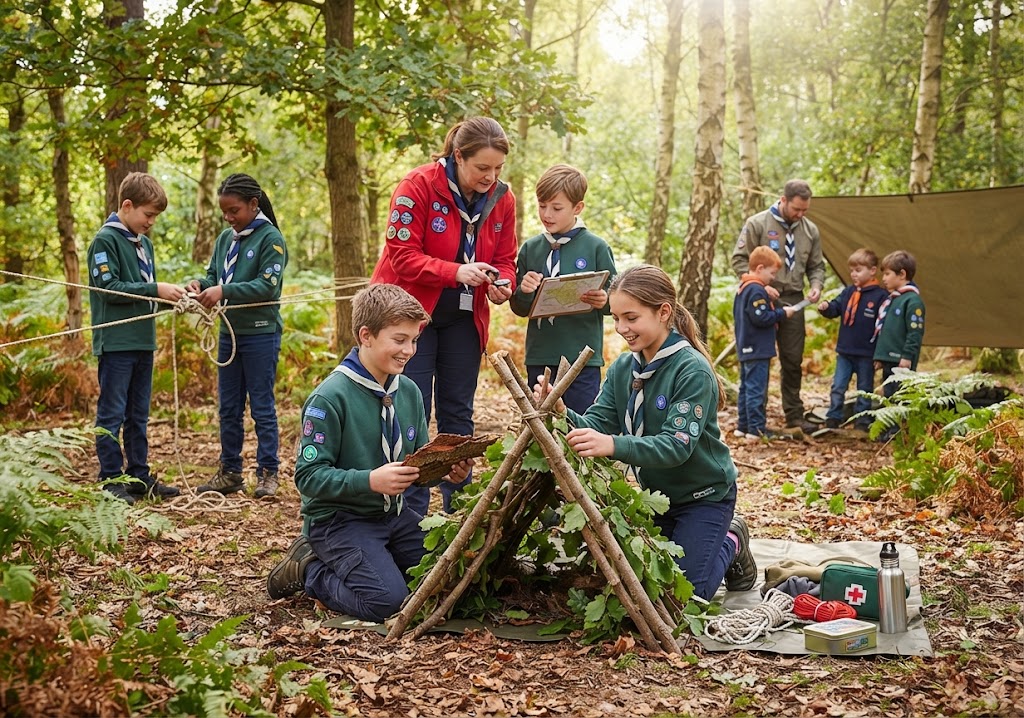
For youth groups, this is particularly important.
The planned pace should be realistic for the whole group, not just the adults or fastest walkers.
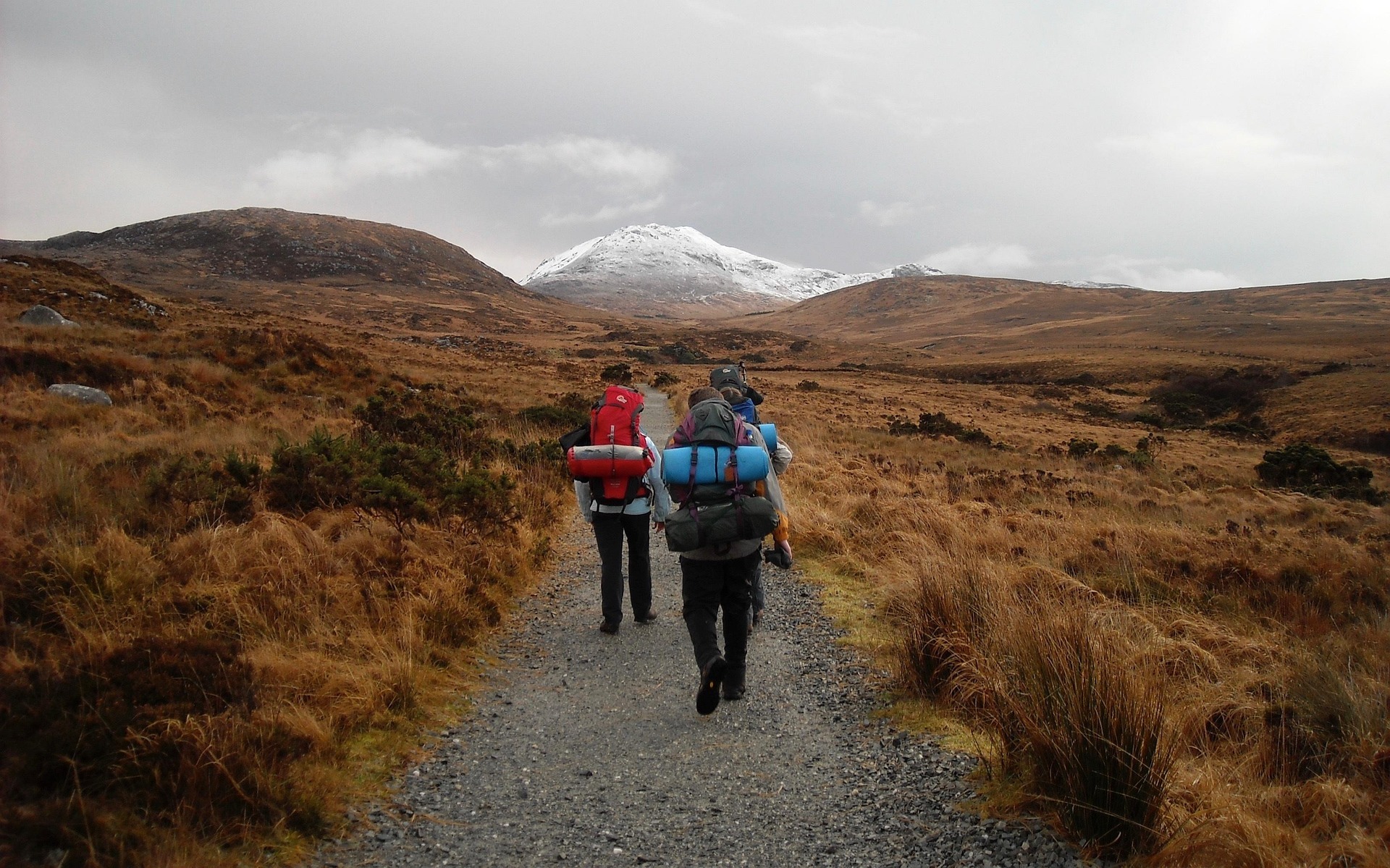
Terrain Can Change Your Walking Time
A kilometre of smooth path is not necessarily equivalent to a kilometre of:
- Mud
- Deep grass
- Rocky ground
- Bog
- Loose stones
- Steep steps
- Dense vegetation
Terrain affects both speed and effort.
When estimating a route, look at the surface as well as the distance.
Weather Can Slow You Down
Weather is another reason not to treat your estimated finishing time as exact.
Rain can make paths muddy.
Strong wind can slow progress.
Heat can increase the need for rest and water.
Poor visibility can make navigation slower.
Snow and ice can change a familiar route dramatically.
If conditions deteriorate, be prepared to change the plan rather than trying to maintain an unrealistic schedule.
Build in a Safety Margin
If your calculation says you’ll finish at 5 pm, don’t necessarily plan your entire day around arriving at exactly 5 pm.
Allow some spare time.
Your safety margin might be needed for:
- A navigation error
- An unexpected obstacle
- Longer breaks
- Slower terrain
- Someone becoming tired
- Weather changes
The longer or more remote the route, the more important this becomes.
A Simple Walking-Time Formula
For straightforward walks, start with:
Distance ÷ expected speed = basic walking time
For hilly routes, you can then use a Naismith-style estimate as a second check:
Distance time + ascent allowance = estimated moving time
Then consider:
Moving time + breaks + likely delays = realistic trip time
That final figure is much more useful for planning.
Worked Example
Suppose you are planning a 12 km countryside walk with 300 metres of total ascent.
Using a basic 5 km/h walking pace:
12 ÷ 5 = 2.4 hours
That’s approximately 2 hours 24 minutes.
The ascent allowance adds:
300 ÷ 600 = 0.5 hours
That’s another 30 minutes.
Estimated moving time:
2 hours 54 minutes
Now add your planned stops.
If you expect 30 minutes of breaks, your overall walking period becomes approximately:
3 hours 24 minutes
You could then add a further margin if the route includes difficult terrain, navigation challenges or a group with varied walking speeds.
Don’t Forget the Return Journey
One common mistake is planning only the interesting part of a route.
If you’re walking out and back, check whether the stated distance is:
- One way
- Total return distance
- A complete circular route
A “5 km walk” can mean very different things depending on how the route has been described.
Always check the route itself.
How to Work Out a Walking Time Before You Leave
Use this checklist:
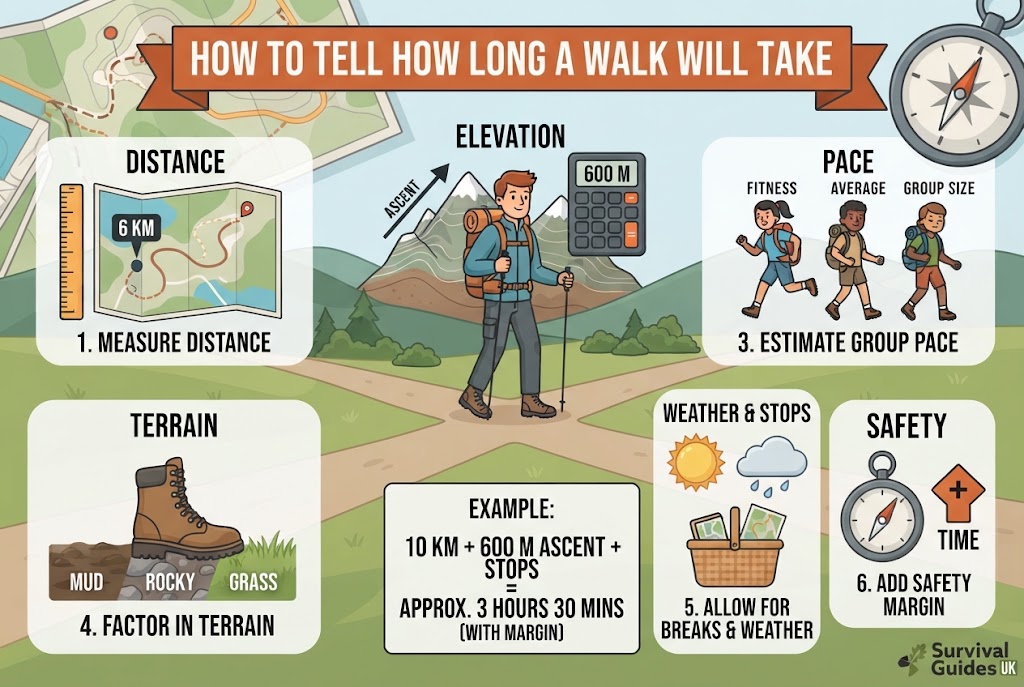
Step 1: Find the total distance
Measure the actual walking route rather than estimating from a straight line.
Step 2: Check the elevation
Look for total ascent and identify the major climbs.
Step 3: Estimate your group’s pace
Use a realistic speed rather than an optimistic one.
Step 4: Consider the terrain
Ask whether the route is mostly:
- Road
- Good path
- Grass
- Mud
- Rocks
- Steep ground
Step 5: Add breaks
Decide where you are likely to stop.
Step 6: Add a safety margin
Allow time for things not going according to plan.
The Most Useful Question Isn’t “How Long Will It Take?”
A better question is:
“How long could this reasonably take?”
That small change in thinking makes route planning much safer.
You’re not trying to predict the exact minute you will finish.
You’re trying to create a realistic window that gives you enough time to deal with ordinary delays and unexpected problems.
Once you start combining distance, ascent, terrain, weather, breaks and group pace, you’ll have a much better idea of what a walk actually involves.
🔒Ready to test your survival skills?
Join Survival Guides UK for free, complete challenges, earn badges and increase your Survival Level.
JOIN FREE →
CRAIG BURR
FOUNDER · SURVIVAL GUIDES UK
I'm Craig, the person behind Survival Guides UK. I created SGUK because I wanted somewhere people could learn real outdoor skills in a practical, straightforward way — from lighting a fire and tying knots to navigation, campcraft and everything in between.
You can read more about the story behind SGUK here as well as our approach here.