10 Knots Every Scout Should Know
⚠️ SAFETY FIRST
Knots are useful outdoor skills, but a knot should never be used beyond what it is designed for.
Always use appropriate equipment and follow manufacturer guidance when ropes are being used for climbing, lifting, rescue or supporting a person’s weight.
The knots below are intended for general Scout activities, camping and campcraft rather than technical climbing or rescue.
10 Knots Every Scout Should Know
Knowing how to tie a few useful knots is one of those classic Scouting skills.
You don’t need to know dozens of complicated knots.
A Scout who can confidently tie 10 useful knots has a great foundation for camping, pioneering, shelter building and everyday outdoor activities.
The key isn’t just memorising the names.
A good Scout should understand:
Here are 10 knots worth learning.
1. Reef Knot
The reef knot is one of the best-known basic knots.
It’s useful for joining two ends of the same type and size of rope when you want a temporary connection.
Common uses
The important warning
A reef knot should not be used for joining two ropes where safety is critical.
It’s also easy to accidentally tie a granny knot, which is less secure.
Scout challenge
Can you tie a reef knot behind your back?
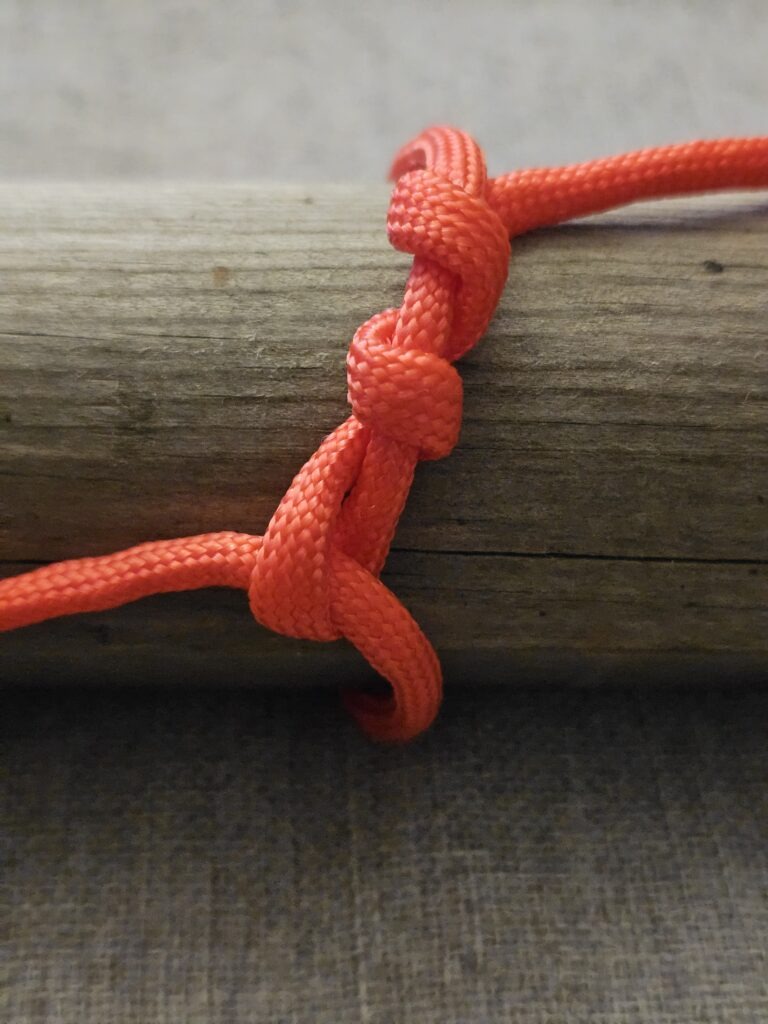
2. Clove Hitch
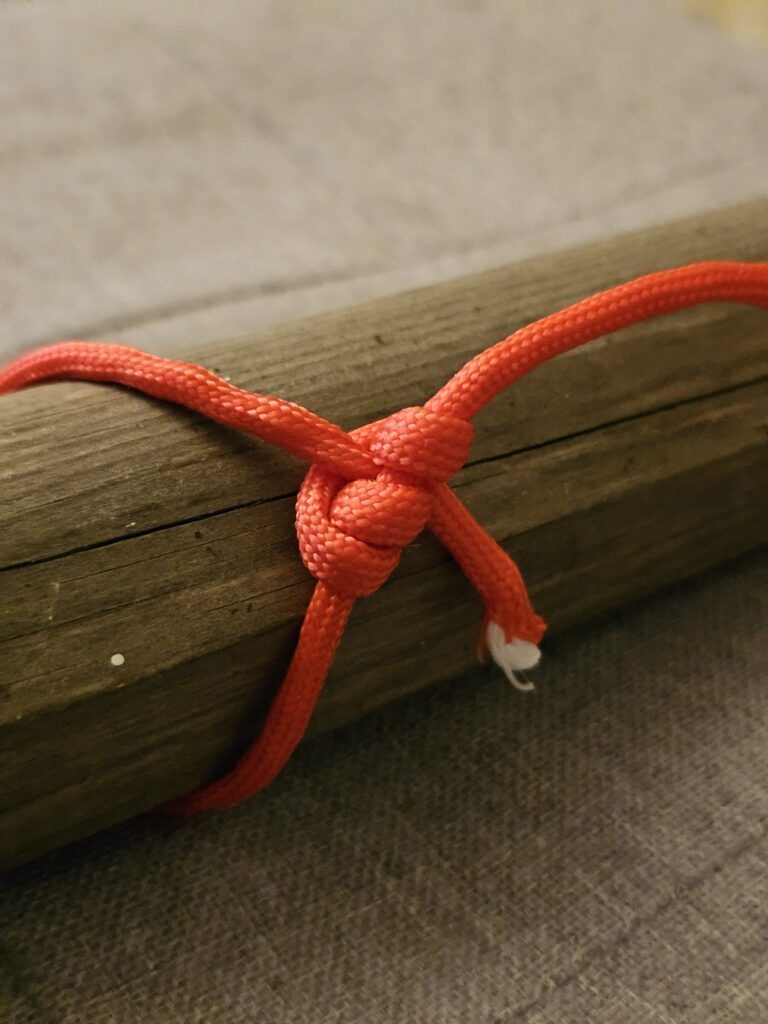
The clove hitch is a useful way of attaching a rope to a post, pole or other suitable object.
It’s particularly useful in pioneering and campcraft.
Common uses
One of its biggest advantages is that it’s quick to tie and untie.
However, it can slip under certain loading conditions, so it isn’t automatically the right choice for every situation.
KNOT TIP
Don’t just ask:
“Can I tie it?”
Ask:
“Is this the right knot for the job?”
3. Bowline
The bowline creates a fixed loop at the end of a rope.
It’s one of the most useful knots for Scouts to learn.
Common uses
The loop stays a fairly consistent size while the knot is loaded.
A properly tied and dressed bowline is relatively easy to untie after loading compared with some other knots.
Scout challenge
Tie a bowline around a post without putting the rope over the top of the post.
4. Sheet Bend
The sheet bend is designed for joining two ropes, particularly when they aren’t the same diameter.
That’s something the reef knot isn’t designed to do reliably.
Common uses
A useful variation is the double sheet bend, which can provide a more secure connection in some situations.
5. Round Turn and Two Half Hitches
This sounds like a complicated knot, but it’s really a combination of simple techniques.
The round turn and two half hitches is useful for attaching a rope securely to a post or other suitable anchor.
Common uses
The round turn takes the initial load, while the half hitches secure the working end.
6. Taut-Line Hitch
The taut-line hitch is particularly useful around camp.
It creates an adjustable hitch that can be moved to tighten or loosen a line.
Common uses
This makes it particularly useful when you’re setting up a tarp.
As the line is loaded, the hitch grips the rope, while still allowing adjustment when properly tied and dressed.
🏕️ CAMPING TIP
Learn the taut-line hitch alongside your tarp shelter skills.
Being able to adjust your guy lines without completely retieing them makes setting up camp much easier.
7. Figure-Eight Knot
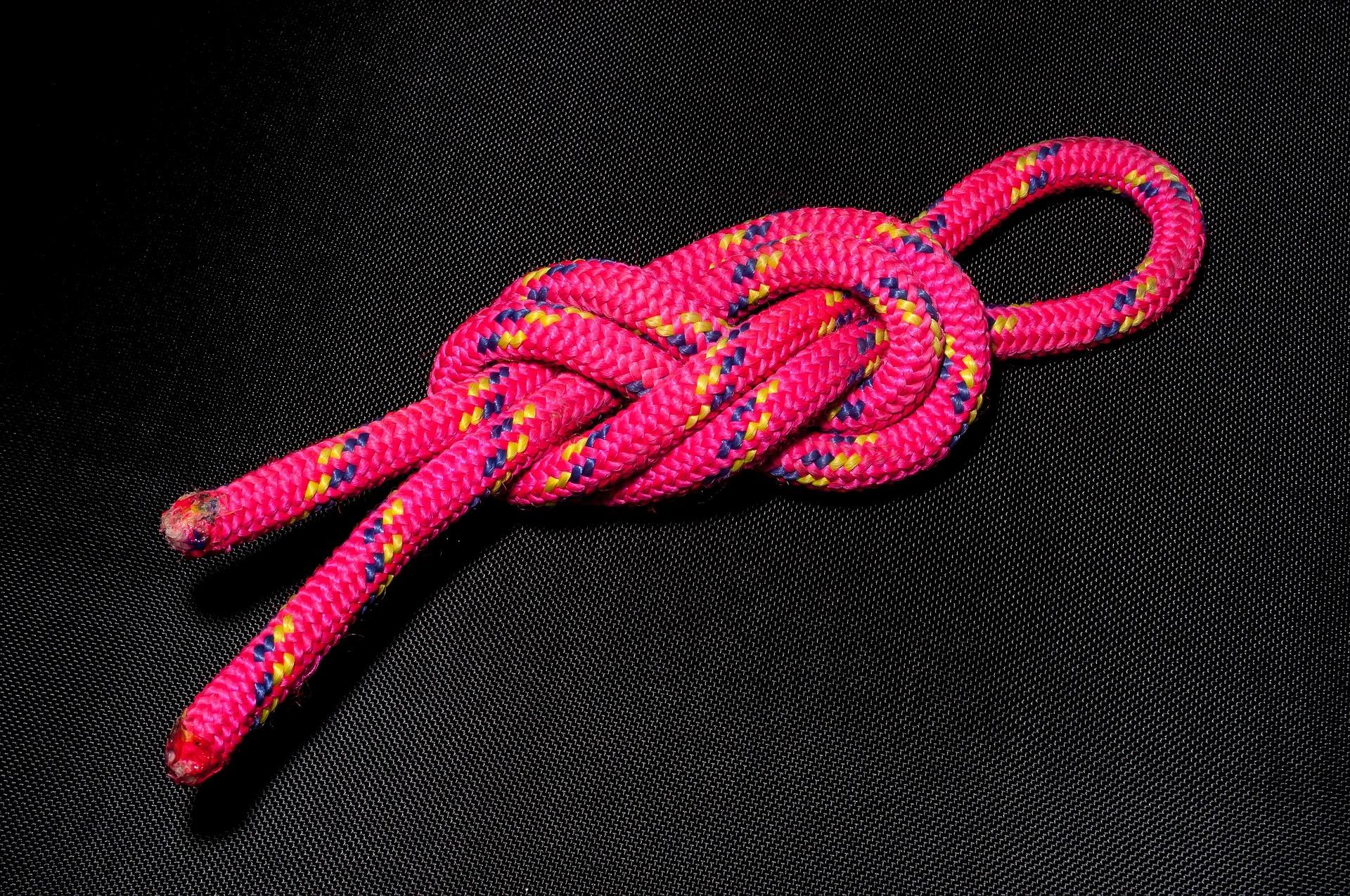
The figure-eight knot is a simple stopper knot.
It creates a larger knot at the end of a rope so that the rope is less likely to pass through a hole or piece of equipment.
Common uses
It’s also an excellent knot for Scouts to learn because it introduces the basic structure of the figure-eight family of knots.
Important: A basic figure-eight knot should not be confused with the more specialised figure-eight knots used in climbing systems.
8. Timber Hitch
The timber hitch is useful for attaching a rope to a log, pole or similar object.
It works particularly well when you want to pull or move a long object.
Common uses
It’s a great knot for Scouts because it demonstrates how a knot can be designed specifically around the shape and purpose of the object being handled.
9. Highwayman’s Hitch
The highwayman’s hitch is a quick-release hitch.
It’s designed so that the rope can be released by pulling the appropriate end.
Common uses
However, its quick-release nature is also why it shouldn’t be trusted for safety-critical applications.
It’s best treated as a campcraft and knot-learning exercise.
10. Alpine Butterfly
The alpine butterfly creates a secure loop in the middle of a rope.
Unlike the bowline, it doesn’t require access to the end of the rope.
Common uses
It’s a slightly more advanced knot than the others on this list, making it a good challenge for Scouts who have mastered the basics.
Quick Reference: 10 Scout Knots
|
Knot |
Main Purpose |
|---|---|
|
Reef Knot |
Joining similar ropes for simple tasks |
|
Clove Hitch |
Attaching rope to a post or pole |
|
Bowline |
Creating a fixed loop |
|
Sheet Bend |
Joining two ropes |
|
Round Turn & Two Half Hitches |
Securing rope to an anchor |
|
Taut-Line Hitch |
Creating an adjustable line |
|
Figure-Eight |
Stopper knot |
|
Timber Hitch |
Attaching rope to a log or pole |
|
Highwayman’s Hitch |
Quick-release campcraft knot |
|
Alpine Butterfly |
Creating a loop in the middle of a rope |
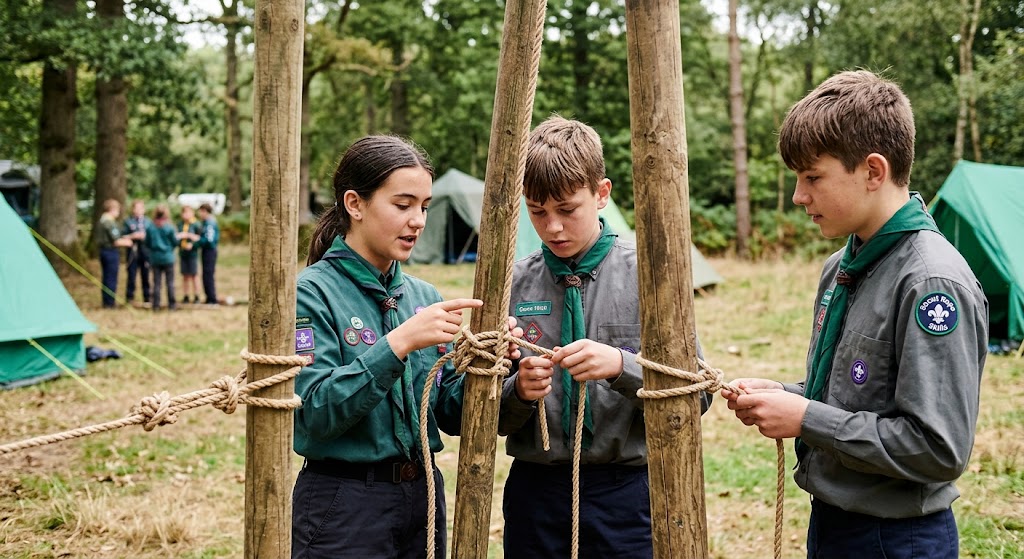
How Should Scouts Learn Knots?
Don’t try to teach all 10 in one session.
Start with the easiest and gradually increase the difficulty.
Beginner
Start with:
- Reef knot
- Clove hitch
- Figure-eight
- Bowline
Intermediate
Then move on to:
- Sheet bend
- Round turn and two half hitches
- Taut-line hitch
- Timber hitch
Challenge knots
Finish with:
- Highwayman’s hitch
- Alpine butterfly
This gives Scouts a sense of progression.
DON’T JUST TIE IT ONCE
The best way to learn knots is through repetition.
Give each Scout a short piece of rope and encourage them to practise until they can tie the knot without having to think about every step.
Make Knot Practice More Interesting
Knot practice doesn’t have to mean sitting around tying rope.
Turn it into a challenge.
Knot Relay
Put Scouts into teams.
Call out a knot and have one person from each team tie it correctly.
First correct knot wins the point.
Blindfold Challenge
Once Scouts are confident, see if they can identify and tie familiar knots by touch.
Only do this with harmless campcraft tasks, never where the rope is supporting a person.
Knot Memory
Show Scouts a knot for a few seconds.
Take it away.
Can they reproduce it?
Knot Race
Give everyone the same piece of rope and call out a series of knots.
For example:
Bowline → clove hitch → reef knot → sheet bend.
What Knot Is This?
Tie a knot and ask Scouts to identify it and explain its purpose.
This tests understanding rather than simple memorisation.
Learn the Purpose, Not Just the Name
One of the biggest mistakes when learning knots is memorising a list of names.
Instead, teach Scouts to associate each knot with a problem.
For example:
“I need a fixed loop.”
→ Bowline.
“I need to join two ropes.”
→ Sheet bend.
“I need an adjustable guy line.”
→ Taut-line hitch.
“I need to attach a rope to a pole.”
→ Clove hitch.
“I need a stopper knot.”
→ Figure-eight.
This makes the skill much easier to remember.
What Makes a Good Knot?
A good knot isn’t necessarily the most complicated one.
A useful knot should:
Scouts should also learn to leave enough working end beyond the knot.
🧠 REMEMBER
A knot isn’t strong simply because it looks complicated.
The correct knot, tied correctly, for the correct job is what matters.
Knots and Pioneering
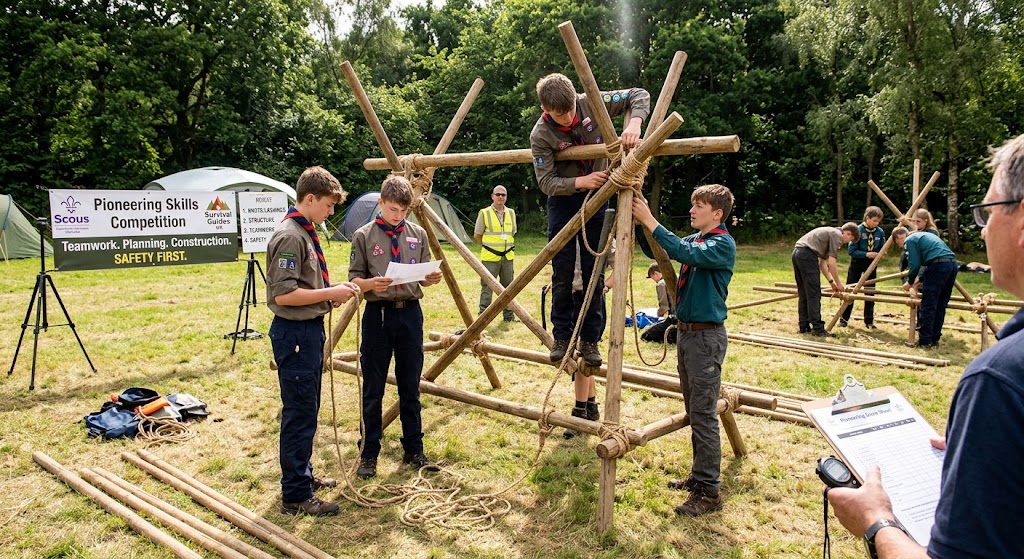
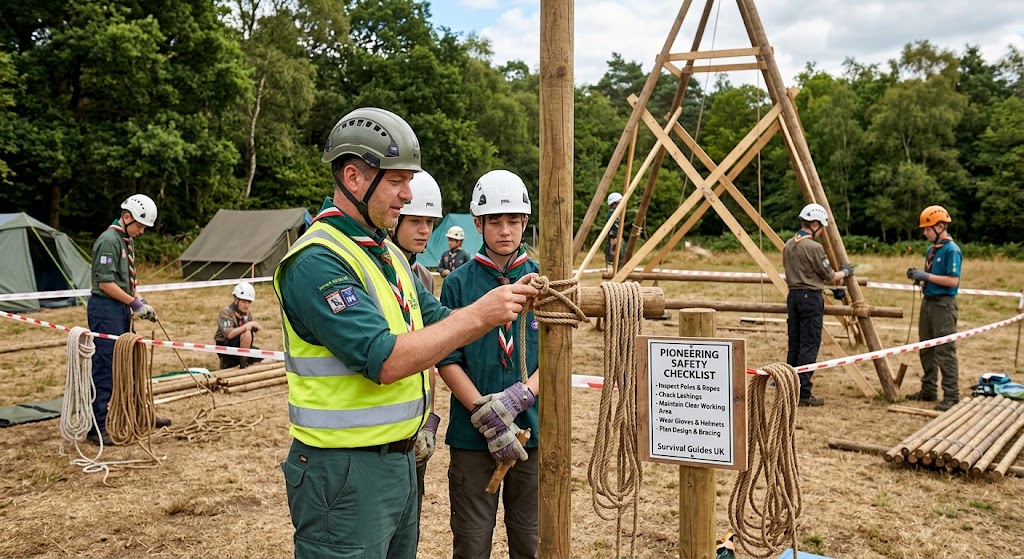
Knots are an important foundation for pioneering.
Once Scouts understand basic knots, they can begin exploring:
This is where knot tying becomes much more interesting.
Instead of simply tying a knot because a leader told them to, Scouts can see why the knot matters.
Knots and Tarp Shelters
Knots are also incredibly useful when setting up tarp shelters.
For example:
If you’re teaching Scouts tarp shelters, knot practice can be incorporated naturally into the activity.
Knots and Survival Skills
Knowing a few knots is useful beyond organised Scouting activities.
A person who understands knots can:
But remember that improvising with rope can be dangerous.
Never assume a knot is suitable for climbing, abseiling, rescue or supporting a person simply because it holds during a basic test.
Those activities require appropriate equipment and specialist training.
Final Thoughts
Scouts don’t need to know every knot in a knot book.
If they can confidently tie and explain 10 useful knots, they’ve got an excellent foundation.
The real skill isn’t memorising names.
It’s understanding:
What problem does this knot solve?
How do I tie it correctly?
How do I check it?
Can I untie it afterwards?
Once those ideas become second nature, Scouts can start using knots as part of bigger outdoor skills such as pioneering, camping, shelters and campcraft.
THE BIG IDEA
Don’t aim to know hundreds of knots.
Aim to know a handful really well — and understand when each one is the right tool for the job.
🔒Ready to test your survival skills?
Join Survival Guides UK for free, complete challenges, earn badges and increase your Survival Level.
JOIN FREE →
CRAIG BURR
FOUNDER · SURVIVAL GUIDES UK
I'm Craig, the person behind Survival Guides UK. I created SGUK because I wanted somewhere people could learn real outdoor skills in a practical, straightforward way — from lighting a fire and tying knots to navigation, campcraft and everything in between.
You can read more about the story behind SGUK here as well as our approach here.