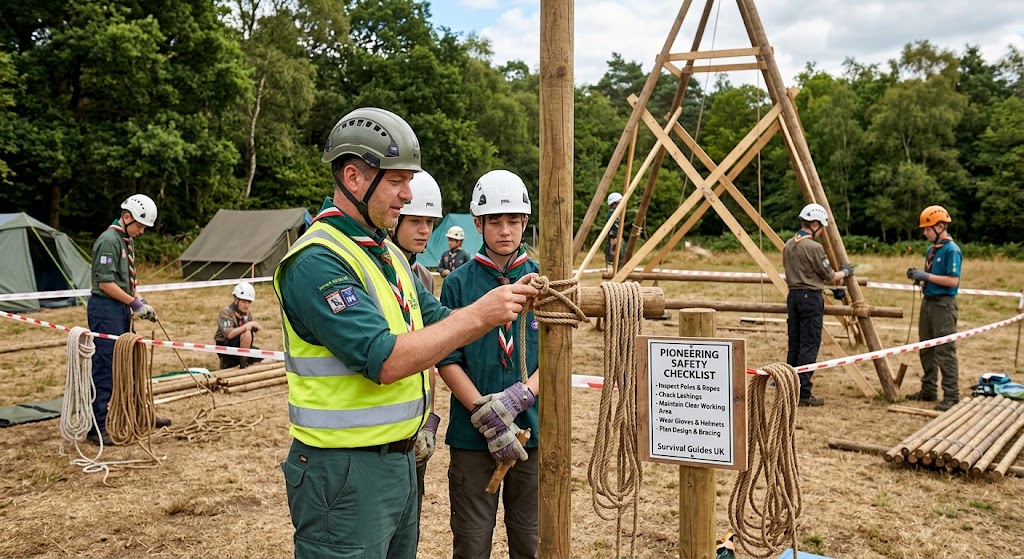
Pioneering Safety: Essential Scout Campcraft Guide
Activity Overview
Difficulty: Moderate
Time: 20–30 minutes to learn the basics; applied throughout a pioneering project
Location: Scout campsites and suitable outdoor activity areas
Best for: Cubs, Scouts, Explorers, Patrol Leaders and adult leaders
Skills: Risk awareness, ropework, lashings, teamwork, equipment care and safe construction
Pioneering safety is about planning the project, using suitable equipment, constructing it correctly and controlling what happens around the structure.
Pioneering can involve heavy poles, tensioned ropes, tools and structures that may collapse if poorly constructed. The larger or higher the structure, the greater the potential consequences of failure.
Good pioneering means knowing when something is safe to build, when it needs checking and when it should not be used.
What You’ll Learn
You’ll learn how to identify and manage the main hazards associated with pioneering.
You’ll also learn how to inspect poles and rope, work safely with lashings, establish a safe working area, manage structures during construction and test completed projects without taking unnecessary risks.
🟡 SAFETY – MODERATE TO HIGH RISK
The risk level depends heavily on the project.
Simple ground-level pioneering may present relatively modest risks, while towers, bridges, rafts and other load-bearing structures can become high-risk activities.
The most important rule is to match the activity to the competence of the people supervising it.
Don’t allow Scouts to climb, cross, ride or otherwise load a pioneering structure simply because they have finished building it.
Structures intended to support people require appropriate design, inspection, supervision and safety controls.
Equipment
The equipment varies considerably between projects.
Common pioneering equipment includes suitable poles, rope, pegs and other materials required by the design.
You may also need gloves, measuring equipment and appropriate hand tools.
Use equipment that is designed and maintained for pioneering.
Never use damaged poles, badly deteriorated rope or improvised materials where failure could cause injury.
Prerequisites
Scouts should understand the basic knots and lashings required for the project.
Before starting, everyone should know the working area, where equipment is being stored and who is supervising the construction.
For more advanced structures, the people responsible need appropriate knowledge of structural stability, loading and the specific activity being undertaken.
Instructions
1. Plan Before Building
Start with the design rather than the equipment.
Decide what the structure needs to do, how large it needs to be and what loads it is expected to support.
Consider what could happen if a pole, rope or lashing fails.
If you cannot explain why the structure will remain stable, don’t start building it.
2. Choose a Suitable Site
Select firm, stable ground with enough space for construction.
Avoid overhead hazards, unstable slopes, roads and areas close to water unless the project specifically requires them and has been appropriately planned.
The site should also provide enough space to establish an exclusion zone around the structure.
3. Inspect the Poles
Check poles for cracks, splits, rot, excessive bending and other damage.
Pay particular attention to areas around existing holes, attachment points and ends.
Don’t use a damaged pole because it is “only for bracing”.
Every part of a structure contributes to its behaviour.
4. Inspect the Rope
Check for cuts, severe abrasion, chemical damage, heat damage, mould or other deterioration.
Make sure the rope is appropriate for the intended task.
Don’t confuse ordinary campcraft rope with equipment designed for climbing or life-safety applications.
5. Use the Correct Lashing
Different joints require different types of lashings.
A square lashing is commonly used for poles crossing at approximately right angles, while a diagonal lashing is useful where poles meet diagonally.
Learn the correct technique and construct each lashing carefully.
A lashing that looks tidy isn’t necessarily correctly made.
6. Keep Lashings Under Control
Don’t leave loose lengths of rope lying across busy working areas.
Keep rope organised to reduce trip hazards and prevent it becoming tangled.
When tensioning rope, keep people clear of areas where a rope could suddenly move or fail.
7. Establish a Working Zone
Keep unnecessary people away from the construction area.
Large poles can swing unexpectedly when being moved, and structures can shift as they are assembled.
Everyone should know where they can safely stand.
8. Communicate While Building
Pioneering often involves several people moving heavy poles at the same time.
Don’t lift, rotate or release a pole without making sure everyone involved knows what is happening.
Simple verbal commands can prevent unexpected movements.
9. Don’t Work Under an Unstable Structure
As a structure becomes larger, the consequences of a collapse increase.
Don’t position people underneath unfinished sections or allow people to stand in areas where a falling pole could strike them.
Build progressively and keep the structure controlled.
10. Keep Tools Under Control
Axes, saws, knives and other tools need their own safety procedures.
Use them only when appropriate, maintain a clear working area and put them away when they aren’t being used.
Never leave sharp tools hidden in grass or underneath equipment.
11. Keep the Site Organised
Don’t allow poles, rope and tools to become scattered across the campsite.
A clear equipment area reduces trip hazards and makes it easier to identify missing or damaged equipment.
Good organisation is a genuine safety measure, not just tidiness.
12. Check the Structure as You Build
Don’t wait until the end to inspect the structure.
After each major stage, check alignment, lashings and stability.
Correct small problems before they become difficult to fix.
13. Brace the Structure Properly
Large pioneering structures need suitable bracing to prevent unwanted movement.
Don’t assume that adding more rope or poles automatically makes something stronger.
Bracing needs to be part of the design and correctly attached.
14. Never Assume a Finished Structure Is Safe
A structure standing upright has not necessarily been proved safe.
Inspect the completed structure before considering its intended use.
For structures supporting people, the inspection and approval process should be appropriate to the activity and carried out by someone with the necessary competence.
15. Test Gradually
If a structure is designed to carry a load, don’t immediately apply the maximum intended load.
Testing should be controlled and appropriate to the design.
Keep people clear of potential failure points and stop immediately if anything behaves unexpectedly.
16. Don’t Increase the Load
Never add extra people, equipment or activities to a pioneering structure simply because it appears strong.
An additional person can significantly change the forces acting on the structure.
Stay within the design and approved use.
17. Be Particularly Careful With Height
Height changes the consequences of even a small failure.
Towers, elevated platforms and high bridges should therefore be treated very differently from ground-level pioneering.
Structures involving people at height require appropriate specialist competence and safety controls.
18. Treat Water Projects Differently
Rafts and other water-based pioneering projects introduce additional hazards.
Buoyancy, stability, cold water, drowning and capsizing all need to be considered.
Don’t launch a pioneering structure on water simply to see whether it floats.
Any water-based use needs proper planning and supervision.
19. Stop When Conditions Change
Weather can affect pioneering.
Rain can make ground slippery, wind can make tall structures unstable and wet rope or poles can change how equipment behaves.
If conditions become unsuitable, stop the activity rather than trying to continue regardless.
20. Dismantle Safely
Dismantling can be just as hazardous as construction.
Remove loads and dismantle the structure in a planned sequence.
Don’t simply cut key lashings and allow the structure to collapse.
Keep everyone clear of sections that could move unexpectedly.
Common Pioneering Hazards
The main hazards to consider include falling poles, collapsing structures, rope failure, unstable ground, trip hazards, sharp tools, heavy lifting and uncontrolled movement.
Projects involving height or water add further risks.
The important thing is not to create a huge list of theoretical dangers. Identify the hazards that actually apply to the particular project and control them before work begins.
Pioneering Safety and Teamwork
Good communication is one of the simplest ways to make pioneering safer.
Everyone should know what they are doing before a heavy pole is moved or a section of the structure is raised.
A patrol should also feel comfortable stopping the project if something doesn’t look right.
A Scout who notices a loose lashing or damaged pole should be encouraged to speak up rather than assuming someone else will deal with it.
Inspecting Pioneering Equipment
Equipment should be checked before and after use.
Rope should be stored clean and dry where appropriate, while poles should be protected from conditions that could cause deterioration.
Damaged equipment should be clearly separated from usable equipment so that it isn’t accidentally returned to the equipment store for future use.
Pioneering Safety for Different Age Groups
Younger Scouts can learn basic knots, lashings and low-level construction under suitable supervision.
More advanced structures should be matched to the experience of the group.
The fact that a Scout understands how to tie a lashing doesn’t automatically mean they are ready to construct or use a large load-bearing structure.
Progression should come through experience, competence and supervision, not simply increasing the size of the project.
Final Tip
The most important pioneering skill isn’t a particular knot or lashing.
It’s knowing whether the structure you’re about to build is appropriate, how to build it safely and when to stop.
Keep the design within the team’s abilities, inspect materials and lashings carefully, control the working area and never assume that a completed structure is safe to use without proper inspection.
🔒Ready to test your survival skills?
Join Survival Guides UK for free, complete challenges, earn badges and increase your Survival Level.
JOIN FREE →
CRAIG BURR
FOUNDER · SURVIVAL GUIDES UK
I'm Craig, the person behind Survival Guides UK. I created SGUK because I wanted somewhere people could learn real outdoor skills in a practical, straightforward way — from lighting a fire and tying knots to navigation, campcraft and everything in between.
You can read more about the story behind SGUK here as well as our approach here.