10 Easy Survival Activities for Scout Leaders
Activity Overview
Difficulty: Beginner
Time: 1-3 hours depending on activities
Location: Suitable woodland, campsite or outdoor training area
Best for: Scout leaders, Explorers and outdoor instructors
Skills: Survival skills, leadership, teamwork, problem-solving, navigation, shelter building, fire safety and outdoor awareness
The best survival activities for Scout leaders are simple, practical exercises that teach useful skills without requiring complicated equipment or extreme conditions.
Good beginner activities include building a basic shelter, making natural tinder, practising navigation, creating an emergency signal, learning to identify safe water sources, packing a survival kit, improving ground insulation and running a simple survival scenario.
The aim isn’t to simulate a genuine emergency. Instead, use controlled activities to help young people develop calm decision-making, resourcefulness, teamwork and practical outdoor skills.
What You’ll Learn
By running these activities, Scout leaders can help young people practise:
🟡 SAFETY – MODERATE RISK
Most of these activities are low consequence when taught individually, but the session can involve outdoor shelter construction, fire lighting, natural materials and potentially sharp tools depending on how the activities are delivered.
Keep activities appropriate for the age and experience of the group.
Use a suitable site, establish boundaries and supervision arrangements, and carry out a proportionate risk assessment before starting.
If using fires, knives or other tools, treat those activities separately and apply appropriate supervision and safety controls.
Do not turn the session into a realistic emergency simulation where young people are placed in genuine danger.
Equipment
You can adapt the session to whatever equipment is available.
Useful equipment includes:
You don’t need all of this for every activity.
Prerequisites
Before starting, make sure participants understand:
- The boundaries of the activity area.
- What to do if they become separated from the group.
- How to attract the attention of a leader.
- Basic outdoor safety.
- Which equipment they are allowed to use.
- When an activity should be stopped.
For younger Scouts, demonstrate each new skill before asking them to try it themselves.
Instructions
1. Build a Simple Survival Shelter
Give small teams a tarp, cord and suitable natural anchor points and ask them to construct a basic shelter.
The challenge is not to build a perfect campsite shelter. Instead, ask the team to create something that provides reasonable protection from wind and light rain.
Afterwards, inspect each shelter together.
Ask:
This teaches young people to think about site selection and protection, rather than simply putting up a shelter.
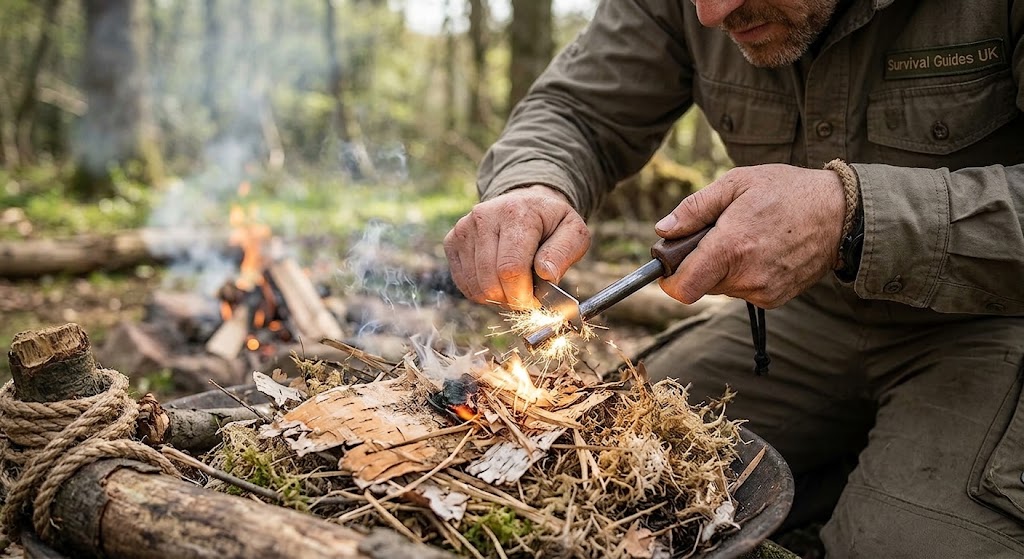
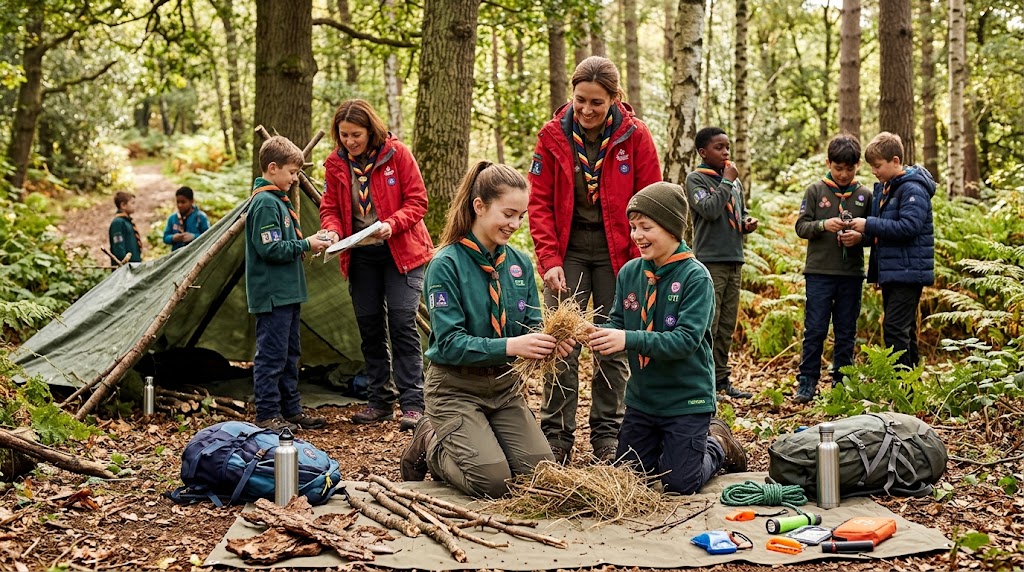
2. Make a Tinder Bundle
Give teams a selection of safe, dry natural materials and ask them to create a tinder bundle.
Suitable materials might include:
The important lesson is understanding what makes good tinder: dry, fine and easy to ignite.
If you progress to actually lighting it, treat that as a separate fire-lighting activity with appropriate supervision.
3. Run a Navigation Challenge
Give each team a map and a simple route to follow.
Start with obvious features such as paths, buildings, streams or woodland edges.
Gradually introduce compass bearings or simple grid references.
You can turn the activity into a challenge by placing several checkpoints around the area.
The team that reaches every checkpoint isn’t necessarily the winner. Reward accurate navigation, good teamwork and sensible decision-making.
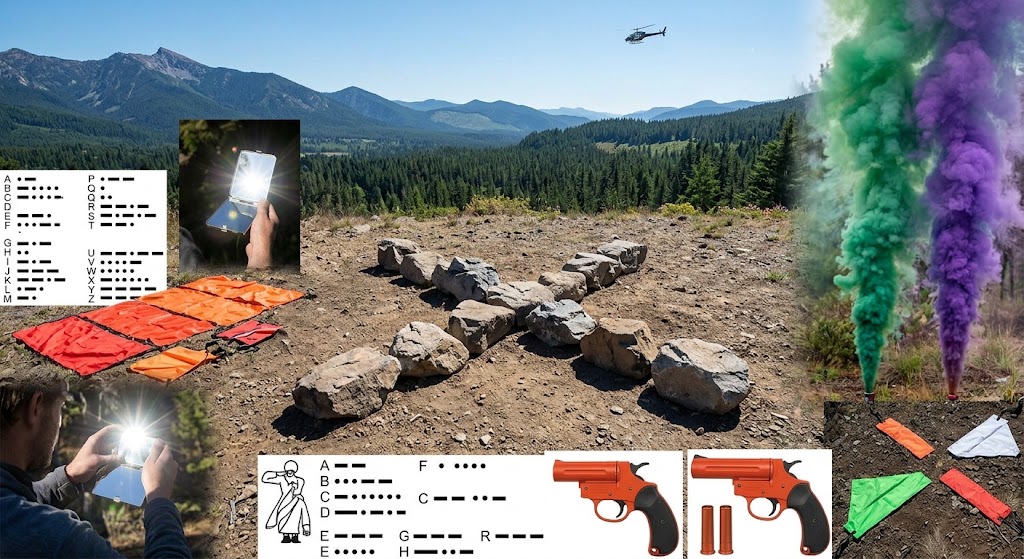
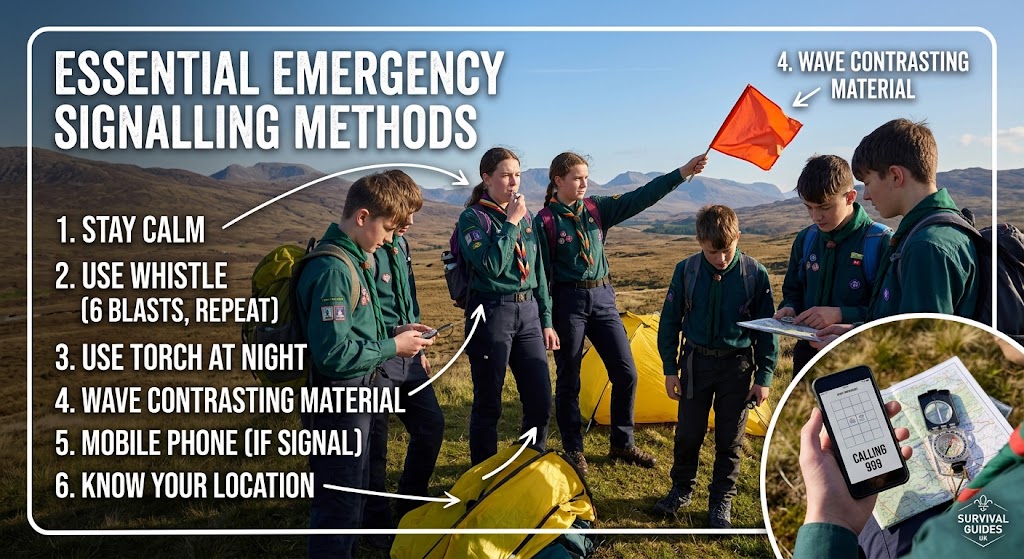
4. Create an Emergency Signal
Ask teams to design a signal that could attract attention from a distance.
They could use:
- A whistle.
- A torch.
- A brightly coloured item.
- A signal marker.
- A simple ground signal.
Explain that emergency signalling needs to be deliberate and recognisable.
A good exercise is to have one team create a signal while another team has to identify what it means.
5. Practise Finding Suitable Water
This activity is about water awareness rather than drinking untreated water.
Give teams several hypothetical water sources or photographs and ask them to decide which would be the most sensible starting point for obtaining water in an emergency.
Discuss:
The key lesson is that finding water and making water safe to drink are two different problems.
6. Build an Emergency Ground Insulator
Ask teams to create a small insulated sleeping area using available natural materials or equipment.
They could experiment with:
Explain that the ground can remove body heat surprisingly quickly.
The challenge is to compare different materials and decide which arrangement provides the best insulation.
This is a useful way of teaching the principle behind survival bedding without needing extreme weather.
7. Pack a Mini Survival Kit
Give each team a selection of everyday outdoor items and ask them to choose what they would carry in a small emergency kit.
Possible items include:
Then introduce a weight or size limit.
The team must decide what is genuinely useful and explain its choices.
This turns survival equipment into a decision-making exercise rather than a simple shopping list.
8. Run a Survival Priorities Challenge
Give the group a fictional scenario such as:
Your patrol has reached the wrong part of a campsite and daylight is beginning to fade. You have basic outdoor equipment but don’t know exactly where you are.
Ask the team to decide what they should do first.
Encourage them to consider:
The important lesson is that good survival decisions are usually about priorities, not clever tricks.
9. Run an Observation Challenge
Take the group on a short walk and ask them to pay attention to their surroundings.
At several points, stop and ask questions such as:
This develops the habit of actively observing the environment.
It also helps young people understand that survival skills begin before anything goes wrong.
10. Run a Team Survival Scenario
Finish the session with a simple team challenge combining several skills.
For example, give each team a fictional situation in which they must:
- Establish their location.
- Decide where they would shelter.
- Identify how they would communicate.
- Choose essential equipment.
- Explain how they would obtain safe water.
- Decide what their next action should be.
Don’t make the scenario deliberately frightening.
Instead, assess the team on communication, leadership, reasoning and calm decision-making.
Afterwards, discuss what worked and what they would change.
Final Tip
Don’t try to teach survival by making the activity unnecessarily extreme.
The most useful survival lessons are often simple:
Stop → Think → Assess → Communicate → Act.
If Scout leaders can turn basic outdoor skills into short, practical challenges, young people learn survival principles while also developing confidence, teamwork and good judgement.
🔒Ready to test your survival skills?
Join Survival Guides UK for free, complete challenges, earn badges and increase your Survival Level.
JOIN FREE →
CRAIG BURR
FOUNDER · SURVIVAL GUIDES UK
I'm Craig, the person behind Survival Guides UK. I created SGUK because I wanted somewhere people could learn real outdoor skills in a practical, straightforward way — from lighting a fire and tying knots to navigation, campcraft and everything in between.
You can read more about the story behind SGUK here as well as our approach here.