Compass Error Awareness: A Scout Guide to Accurate Navigation
What Is Compass Error Awareness?
Compass error awareness is the ability to recognise factors that can make a compass reading inaccurate or lead to a navigation mistake.
A compass is a valuable navigation tool, but it does not automatically guarantee an accurate direction. The way it is held, the surrounding environment and the difference between magnetic and grid directions can all affect navigation.
For Scouts, understanding compass errors is an important part of becoming a confident navigator.
The aim is not to distrust your compass. It is to understand its limitations and develop good habits for checking your navigation.
Why Compass Accuracy Matters
A small error in direction can become significant over a long distance.
If you walk several kilometres while consistently travelling slightly away from your intended bearing, you may finish a considerable distance from your target.
Compass accuracy is particularly important when:
Good navigation involves checking your position regularly rather than relying on one compass reading.
Magnetic North and Grid North
One of the most important sources of compass error awareness is understanding that magnetic north and grid north are not necessarily the same direction.
A magnetic compass points towards magnetic north, while the grid on an Ordnance Survey map is based on grid north.
The difference between these directions is called magnetic variation, sometimes known as magnetic declination.
The value changes over time and varies by location, so use the current information appropriate to your map and area when making precise adjustments.
Why Variation Matters
If you take a bearing from a map and transfer it directly to your compass without considering the relevant difference between grid and magnetic north, you may introduce an error.
For everyday navigation this may sometimes be small enough not to cause an obvious problem, but over longer distances the error can become important.
Always follow the method taught for the map, compass and navigation system you are using.
Nearby Metal Can Affect a Compass
A magnetic compass can be affected by nearby magnetic or ferrous objects.
Potential sources of interference include:
If your compass gives an unexpected reading, move away from the suspected source and take the bearing again.
A simple habit is to take important bearings in a clear area away from obvious metal objects.
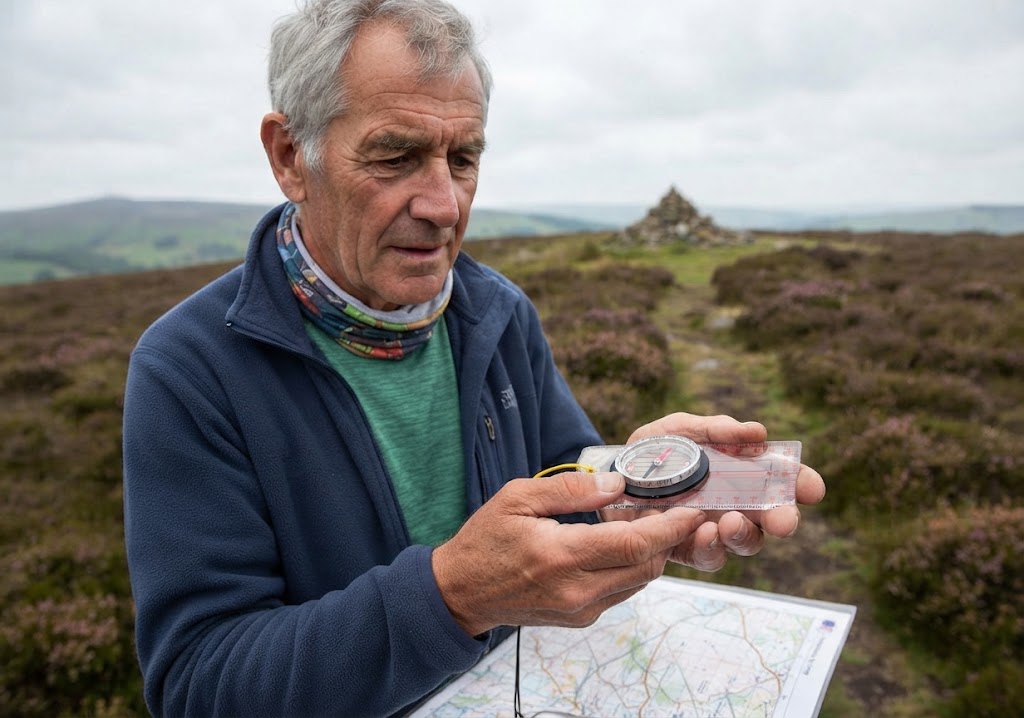
Holding the Compass Correctly
The way you hold a compass can also affect your navigation.
Hold it:
Avoid taking a bearing while the compass is tilted or swinging around.
Take a moment to allow the magnetic needle to settle before reading it.
Taking a Bearing Carefully
A bearing is a direction measured in degrees clockwise from north.
When taking a bearing, avoid rushing.
Step 1: Identify Your Starting Point
Make sure you know exactly where you are on the map.
A perfect compass bearing is of little use if you start from the wrong location.
Step 2: Set the Bearing
Use the map and compass carefully to establish the required direction.
Double-check the numbers before moving.
Step 3: Check the Compass
Make sure the compass is level and that the needle has settled.
Look for anything nearby that could cause magnetic interference.
Step 4: Identify a Landmark
Rather than staring continuously at the compass while walking, identify a suitable feature in the direction you need to travel.
Walk towards it while maintaining your intended direction.
Step 5: Check Your Position
Once you reach the feature, stop and check the map.
Confirm that the terrain matches what you expected before continuing.
Back Bearings
A back bearing is the opposite direction to your original bearing.
It can be useful for checking the direction you have travelled or for retracing a route.
To find the reciprocal bearing:
For example, the reciprocal of 70° is 250°, while the reciprocal of 250° is 70°.
Practising back bearings can help Scouts understand how compass directions relate to one another.
Common Compass Mistakes
Many navigation errors are caused by simple mistakes rather than faulty equipment.
Reading the Wrong Scale
Some compasses have multiple scales or markings.
Make sure you are reading the correct degree scale and not accidentally using another marking.
Turning the Wrong Way
When transferring bearings between a map and compass, it is possible to rotate the compass incorrectly.
Take your time and check the direction before walking.
Forgetting to Check the Map
A compass should work alongside the map rather than replacing it.
If the terrain does not match your map, stop and investigate rather than continuing simply because the compass says to do so.
Walking Too Far
Even an accurate bearing can become less useful if you travel beyond your intended point.
Use obvious features as checkpoints where possible.
Compass Error Challenge
Try this practical Scout activity.
Give each Scout or team a map, compass and a short route containing several bearings.
Introduce one deliberate complication at each stage, such as:
The challenge is not simply to reach the finish.
Scouts should identify what could cause an error and explain how they would check it.
The Two-Check Rule
A useful navigation habit is to avoid relying on a single indication of where you are.
Try to confirm your position using at least two sources of information, such as:
If two or more clues agree, you can have greater confidence in your position.
If they disagree, stop and investigate.
Practising Compass Error Awareness
Compass skills improve through regular practice.
Useful exercises include:
Start with simple exercises before introducing longer routes or difficult terrain.
Safety and Navigation
Navigation mistakes can become serious if they lead a group into unfamiliar or hazardous terrain.
Scouts should understand that a compass is a navigation aid, not a guarantee of safety.
Before heading outdoors:
If you become uncertain about your position, stop rather than continuing blindly.
Final Tips
For better compass error awareness:
Compass error awareness is an important part of becoming a confident Scout navigator. The best navigators do not simply follow a compass needle—they continually check their direction, position and surroundings to make sure the whole picture makes sense.
🔒Ready to test your survival skills?
Join Survival Guides UK for free, complete challenges, earn badges and increase your Survival Level.
JOIN FREE →
CRAIG BURR
FOUNDER · SURVIVAL GUIDES UK
I'm Craig, the person behind Survival Guides UK. I created SGUK because I wanted somewhere people could learn real outdoor skills in a practical, straightforward way — from lighting a fire and tying knots to navigation, campcraft and everything in between.
You can read more about the story behind SGUK here as well as our approach here.