How to Tell Which Direction You Are Travelling Without a Compass
You don’t always have a compass in your hand when you’re outdoors. Your equipment might have been left behind, you may be teaching someone the basics of navigation, or you might simply want to improve your ability to understand the landscape around you.
There are several ways to work out roughly which direction you are travelling without a compass. None should be treated as a magic trick that tells you your exact bearing, but together they can give you useful information and help you avoid becoming completely disorientated.
Start by Working Out Where You Are
Before trying to work out which way you are travelling, stop and look around.
Ask yourself what you already know. Do you recognise the path? Can you see a road, river, hill, building or other feature that you can identify on a map? Do you remember which direction you were travelling when you last knew your position?
Even a rough idea of your location can make direction finding much easier.
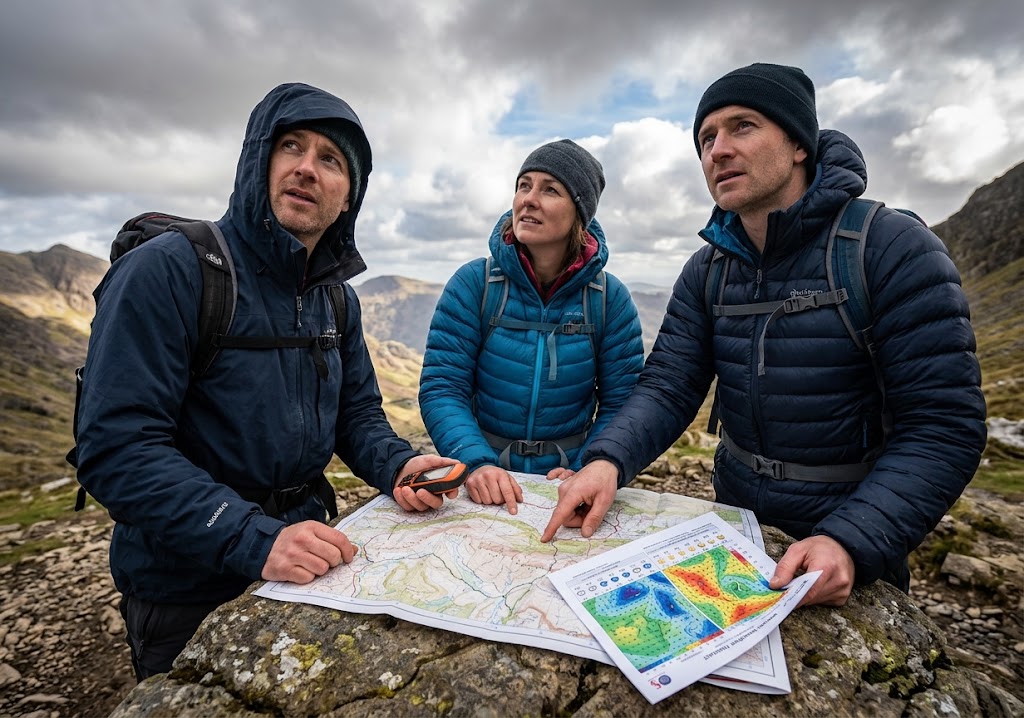
If you have a map available, use it. A map and the landscape can often tell you more reliably than trying to guess direction from nature alone.
Use the Sun
The sun is one of the most useful natural clues for working out direction, although you need to remember that its position changes throughout the day and across the seasons.
In the UK, the sun generally travels across the southern part of the sky. It rises roughly in the east and sets roughly in the west, although the exact position changes throughout the year.
If it is morning and the sun is roughly in front of you, you are likely to be travelling generally eastwards. If it is late afternoon and the sun is roughly in front of you, you are likely to be travelling generally westwards.
You can also use the sun behind you as a clue. In the morning, having the sun behind you would suggest you are travelling roughly westwards, while in the late afternoon it would suggest you are travelling roughly eastwards.
Don’t treat this as an exact bearing. It is a broad indication that becomes much more useful when combined with other clues, such as a map, landmarks and the shape of the surrounding landscape.
Use Shadows
Shadows can also provide a useful clue because they point in the opposite direction to the sun.
Find a reasonably straight stick and place it upright in the ground. Mark the end of its shadow. Wait for a while and mark the new position of the shadow.
The two marks give you a line running approximately west to east, with the first shadow position being towards the west and the later position towards the east.
The longer you wait between observations, the easier the movement is to see. This method works best when the sun is bright enough to produce a clear shadow and you have somewhere suitable to carry it out.
It is more useful for establishing a general direction than for obtaining a precise bearing.
Look for Known Landmarks
Sometimes the easiest way to work out your direction is simply to identify something you already know.
A distinctive hill, church tower, radio mast, coastline, road, railway line or large building can give you a strong reference point.
If you know that a particular landmark is north of where you are standing, for example, you immediately have a reference for working out the other directions.
This is one reason good navigation involves much more than looking at a compass. The more familiar you become with the landscape, the more information it gives you.
Use a Map and the Landscape Together
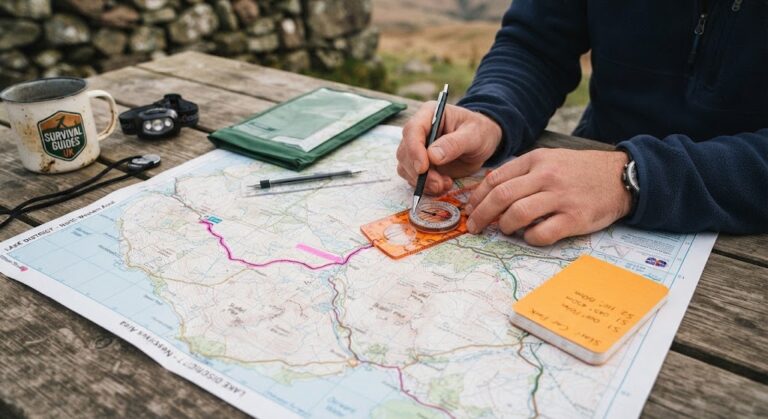
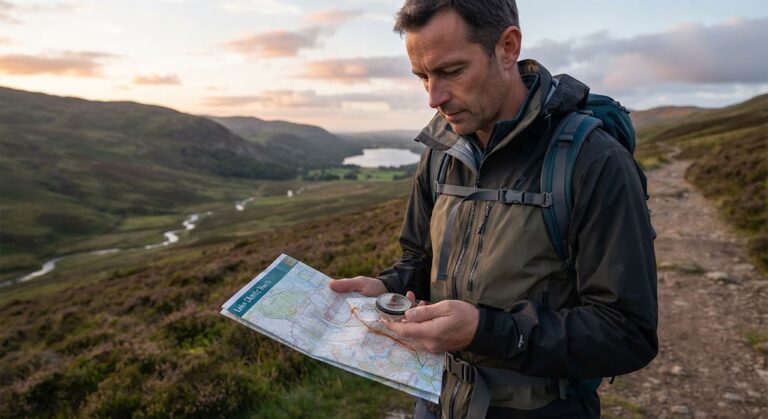
If you have a map but no compass, you can still use it to help establish your general direction.
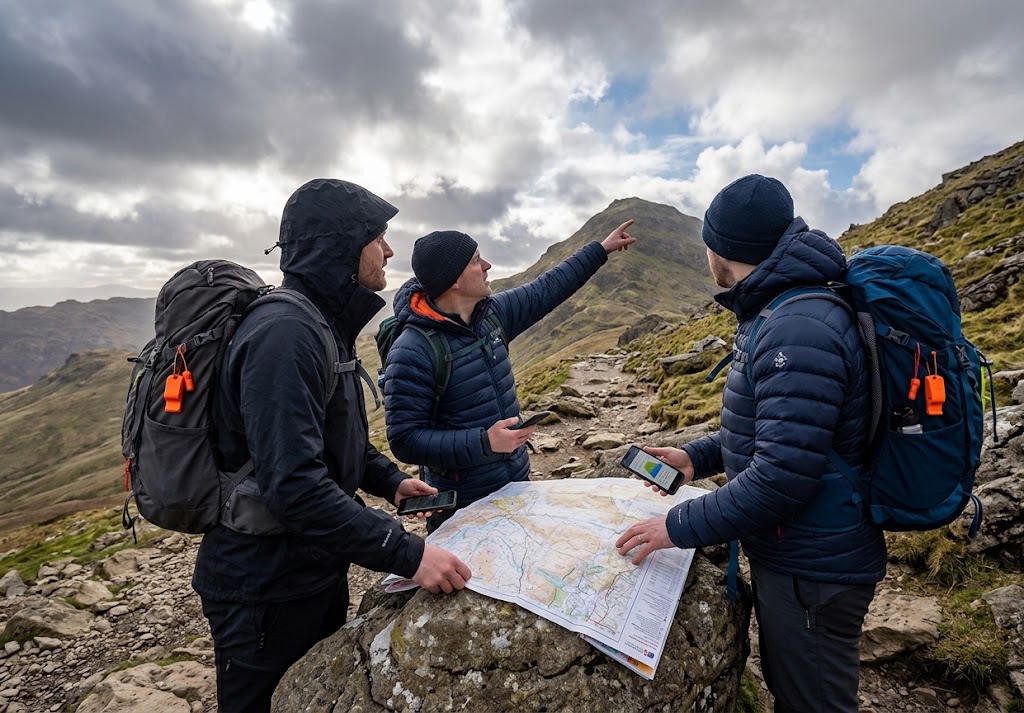
Look for features you can identify both on the map and on the ground. A bend in a river, a junction, a line of woodland or the shape of a valley can help you match the map to your surroundings.
Once you have identified several features, you may be able to work out which way you are facing and therefore which direction you are travelling.
This is particularly useful on paths where the surrounding landscape is distinctive.
Pay Attention to the Shape of the Land
Hills and valleys can provide surprisingly useful information.
If you know the route you are following and can identify a particular ridge, valley or summit, you can use its position to help establish your direction.
Even when you don’t know exactly where you are, noticing how the land changes around you can help you recognise when you have turned or started travelling in the wrong direction.
Don’t just look at what’s directly ahead. Occasionally turn around and look back at the landscape as well. The view behind you can sometimes make your position much easier to recognise.
Use Roads, Paths and Other Linear Features
Straight features can make useful reference lines.
A road, railway, wall, fence, river or long-established path may run in a broadly consistent direction for a considerable distance.
If you know that a particular road runs roughly east to west, for example, following it in one direction gives you a general indication of your own direction of travel.
Be careful, though. Roads and paths curve, rivers change direction and fences don’t necessarily follow the direction you expect. Treat them as clues rather than absolute proof.
Don’t Rely on Moss
You may have heard that moss grows on the north side of trees, so you can use it to find north.
It’s a popular piece of outdoor folklore, but it isn’t a reliable navigation method.
Moss growth depends on moisture, shade, humidity, shelter and local conditions. A tree can have moss growing on several sides, particularly in damp woodland.
It’s fine to notice moss as part of your surroundings, but don’t base an important navigation decision on it.
Don’t Rely on Animal Behaviour Either
There are plenty of other supposed natural navigation tricks involving birds, insects, tree growth and other features of the natural world.
Some may contain a small element of truth in particular circumstances, but they aren’t reliable enough to use as your main method of navigation.
Navigation works best when you use evidence that you can actually identify and check.
The sun, map, landscape, landmarks and your own route information can all be useful. A random tree with moss on one side isn’t going to give you the same confidence.
Keep Checking Your Direction
One of the biggest mistakes people make is trying to work out their direction once and then assuming it stays correct.
You can turn without noticing it. A path can curve. You can take a junction incorrectly. A distraction can cause you to walk several hundred metres before you realise you’ve changed direction.
Keep checking.
Every so often, look around and ask yourself where you think you are, which direction you’re travelling and what features support that conclusion.
If you have a map, compare what you’re seeing with what you expected to see.
Use More Than One Clue
The safest way to use natural direction finding is to combine several pieces of information.
Perhaps the sun is behind you, a road is running roughly east-west and you can see a hill that you know lies to the north. Those clues support each other.
If the sun suggests one direction but everything else suggests another, stop and investigate rather than simply choosing the answer you like best.
Good navigation is often about noticing when the information doesn’t agree.
Know When You Need a Proper Navigation Aid
Being able to work out direction without a compass is a useful skill, but it shouldn’t become an excuse to leave important navigation equipment behind.
For a serious walk, particularly in poor visibility, remote country or unfamiliar terrain, carry appropriate navigation equipment and know how to use it.
A compass gives you a much more dependable way of establishing direction than guessing from the environment.
The point of learning these techniques is to make you better at understanding where you are and what is around you, not to replace good navigation practice.
Practise Somewhere Familiar
The easiest way to learn is to practise when there is very little at stake.
Go somewhere you know well and deliberately try to work out which direction you are travelling. Check your answer against a map or compass afterwards.
Try it at different times of day and in different weather conditions. Notice how much easier it is when there are obvious landmarks and how much harder it becomes when everything looks similar.
Over time, you’ll become much better at building a picture of your surroundings.
Direction Is Only Part of Navigation
Knowing that you’re travelling roughly north doesn’t tell you whether you’re actually on the right path.
You also need to know where you are, where you want to go and whether the route you’re following makes sense.
That’s why the best navigators don’t simply ask, “Which direction am I going?”
They keep asking, “Where am I, where am I going, and what evidence tells me that I’m going the right way?”
Being able to answer those questions is far more useful than simply knowing how to find north.
🔒Ready to test your survival skills?
Join Survival Guides UK for free, complete challenges, earn badges and increase your Survival Level.
JOIN FREE →
CRAIG BURR
FOUNDER · SURVIVAL GUIDES UK
I'm Craig, the person behind Survival Guides UK. I created SGUK because I wanted somewhere people could learn real outdoor skills in a practical, straightforward way — from lighting a fire and tying knots to navigation, campcraft and everything in between.
You can read more about the story behind SGUK here as well as our approach here.