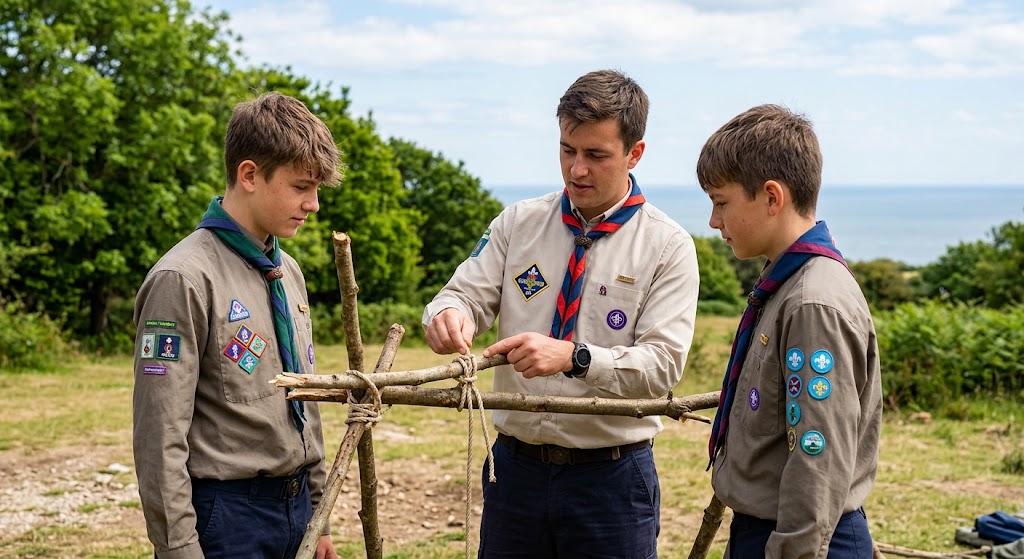
Pioneering Leadership
Activity Overview
Difficulty: Intermediate
Time: 45–60 minutes
Location: Campsite or suitable outdoor activity area
Best for: Scouts and Explorers
Skills: Leadership, communication, teamwork, problem-solving, planning, pioneering
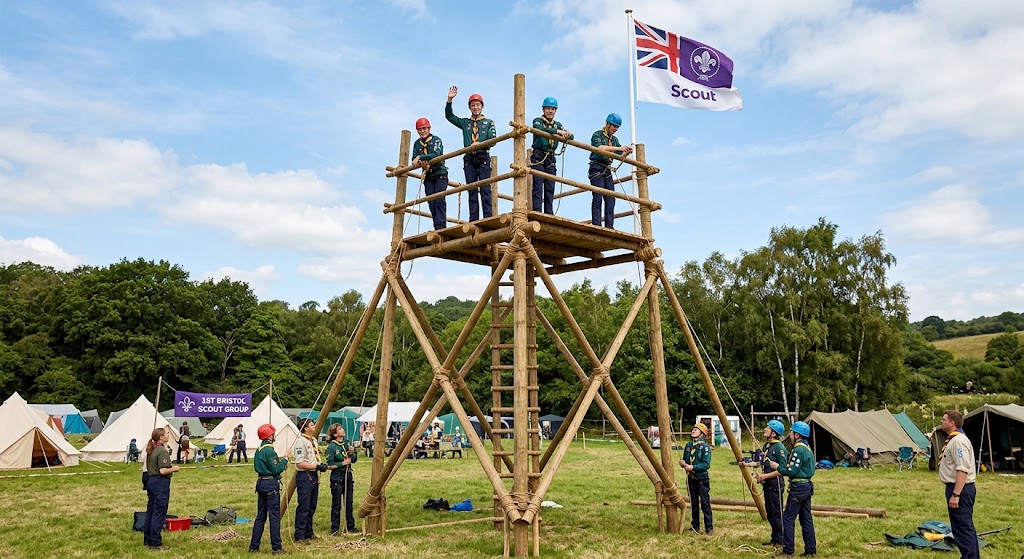
Pioneering leadership is about getting a team to work safely and effectively towards a shared goal. A good pioneering leader does not simply give orders. They help the team plan, allocate jobs, communicate clearly, solve problems and make safe decisions.
Pioneering is particularly useful for developing leadership because a successful structure depends on several people working together.
What You’ll Learn
You will learn how to lead a pioneering team, divide a project into manageable tasks, communicate instructions and involve other Scouts in decisions.
You will also practise recognising when to step in, when to delegate and when to let another team member take responsibility.
🟡 SAFETY – MODERATE TO HIGH RISK
Pioneering structures can create significant hazards, particularly when building towers, bridges, rafts or other large structures.
The leader should make sure the team understands the safety rules before work begins. The activity should be properly risk assessed, appropriate for the group’s experience and supervised by a competent adult.
Leadership never means taking unnecessary risks to complete a challenge. A good leader should be prepared to stop the project if something becomes unsafe.
Only use equipment and construction methods that the supervising leader has approved.
Equipment
You will need pioneering poles, ropes and suitable lashings for the chosen activity.
You may also need a pioneering plan or sketch, measuring equipment and a means of marking out the construction area.
The exact equipment will depend on the project being undertaken.
Prerequisites
Participants should understand basic pioneering safety and have experience with the knots and lashings required for the chosen construction.
The person leading the activity should understand the construction method well enough to coordinate the team and recognise problems.
Instructions
1. Understand the objective
Before starting, make sure everyone understands what the team is trying to build.
Explain the purpose of the structure, any important measurements and the requirements that must be met.
A clear objective gives the team something specific to work towards.
2. Plan before building
Do not rush straight into construction.
Look at the available materials, decide what needs to be built first and identify any difficult stages.
Discuss the plan with the team and encourage suggestions. Someone who spots a potential problem before construction begins may save considerable time later.
3. Allocate responsibilities
Divide the project into jobs that different Scouts can take responsibility for.
One person might organise poles, another might prepare ropes, while others construct particular sections.
Match responsibilities to people’s experience where possible, but also give less experienced Scouts opportunities to develop their skills.
4. Explain instructions clearly
Give short, specific instructions rather than trying to direct everyone at once.
Make sure the person receiving an instruction understands what is required before moving on to another task.
For larger projects, appoint smaller teams or individuals to take responsibility for particular sections.
5. Keep communication flowing
A leader should regularly check how the construction is progressing.
Ask questions such as whether the team has enough materials, whether a lashing is causing problems or whether one part of the structure needs to be changed.
Good communication should work in both directions. Listen to the team rather than assuming the original plan is always correct.
6. Lead by example
Demonstrate the standards you expect from the rest of the team.
Use equipment correctly, follow safety instructions and remain calm when something does not work.
A leader who ignores safety rules makes it much harder to expect the rest of the team to follow them.
7. Delegate rather than doing everything yourself
It can be tempting for a leader to take over difficult jobs.
Instead, explain the problem and give another Scout the opportunity to solve it where appropriate.
Your role is to help the team succeed, not to become the only person doing the important work.
8. Solve problems together
Pioneering rarely goes exactly according to plan.
If a pole is the wrong length or a structure is becoming unstable, stop and discuss the problem.
Ask the team for possible solutions before choosing one. This develops problem-solving skills and gives everyone ownership of the project.
9. Monitor safety continuously
Leadership includes watching for changing hazards.
Keep the working area organised, make sure poles and ropes are handled safely and prevent people from standing in dangerous positions.
Before a structure is used, the supervising adult should carry out any required inspection and give permission for it to be used.
10. Know when to stop
A good leader must be willing to stop construction when something is unsafe or the team no longer has the necessary control.
Do not continue simply because the group is close to finishing.
Stopping, reassessing and changing the plan is a leadership skill, not a failure.
11. Review the team’s performance
Once the project is complete, hold a short debrief.
Discuss what worked well, where communication could have been better and whether everyone had a useful role.
Ask the team what they would change if they built the same structure again.
Final Tip
The best pioneering leader builds the team, not just the structure. If everyone knows their role, feels listened to and understands the plan, the team will usually produce better pioneering—and develop stronger leadership skills along the way.
🔒Ready to test your survival skills?
Join Survival Guides UK for free, complete challenges, earn badges and increase your Survival Level.
JOIN FREE →
CRAIG BURR
FOUNDER · SURVIVAL GUIDES UK
I'm Craig, the person behind Survival Guides UK. I created SGUK because I wanted somewhere people could learn real outdoor skills in a practical, straightforward way — from lighting a fire and tying knots to navigation, campcraft and everything in between.
You can read more about the story behind SGUK here as well as our approach here.