How to Organise the Inside of Your Tent
Start With the Space You Actually Have
One of the easiest ways to make a tent feel untidy is to treat every bit of floor space as storage. It might seem harmless when you first arrive, but once your rucksack, boots, clothing, food and sleeping gear are all scattered around, you quickly run out of somewhere to put your feet.
Before you start unpacking everything, have a quick look at the space available. Decide where you are going to sleep, where your main kit will go and where you need to leave enough room to move around. In a small tent, this can make a surprisingly big difference.
Keep Your Sleeping Area Clear
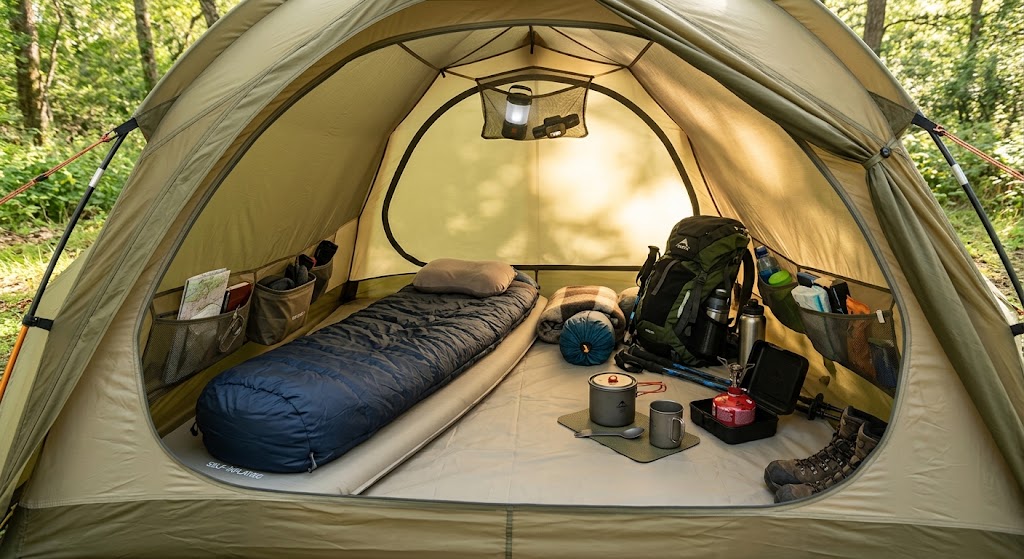
Your sleeping bag needs to be somewhere you can get into and out of without climbing over your equipment. Keeping the area around your sleeping mat reasonably clear also makes getting up during the night much easier.
Try not to use the space around your head as a general storage area. It is tempting to put clothing, water bottles and other bits there, but you will probably end up pushing them around every time you move.
Your sleeping area should be the one part of the tent that stays relatively uncluttered.
Give Everything a Place
You don’t need a complicated storage system. The important thing is knowing where things are.
Keep similar items together rather than emptying your entire rucksack onto the tent floor. A small dry bag might contain spare clothing, another could hold electronics and a separate bag could keep smaller items such as a headtorch, first aid supplies or toiletries together.
This becomes particularly useful when you arrive at camp tired. Instead of searching through several pockets and piles of equipment, you know roughly where to look.
Use Your Rucksack Properly
Your rucksack can take up a huge amount of space inside a tent, especially in a small two-person or one-person tent. You don’t necessarily need to empty it completely.
Once you’ve taken out what you need, keep the remaining kit packed and put the rucksack somewhere sensible. Depending on the tent and conditions, that might be in the porch, at the foot of your sleeping area or tucked against the side where it isn’t going to get in the way.
Be careful about pushing it hard against the tent walls, though. If it is pressing against the fabric, it can interfere with ventilation and potentially make condensation worse.
Use the Porch for the Messier Stuff
The porch is useful because it gives you somewhere to keep things that you don’t really want inside your sleeping space.
Wet boots, muddy gaiters and other dirty equipment can often stay in the porch rather than coming into the main tent. It also gives you somewhere to leave your footwear ready for the morning.
Just remember that a porch is not necessarily a completely dry storage area. Water can still blow in, particularly during bad weather, so anything that needs to stay dry should be protected.
Keep Wet Clothing Under Control
Wet clothing has a habit of taking over a tent.
If you have somewhere appropriate to dry clothing, use it, but don’t simply drape wet gear over every available surface. Wet clothes inside a poorly ventilated tent can add a lot of moisture to the air, increasing condensation and making the whole space feel damp.
If something is only slightly damp, keep it somewhere where it can dry without blocking ventilation. If it is genuinely wet, think about whether it is better to leave it somewhere suitable outside the sleeping area until conditions improve.
Keep Important Things Within Reach
There are a few things you don’t want to be searching for at two o’clock in the morning.
Your torch or headtorch should be somewhere you can reach easily. The same goes for your glasses, water bottle, phone if you carry one, and anything else you might genuinely need during the night.
I like to think of this as your tent’s small “essentials zone”. It doesn’t need to be elaborate. The point is simply that you should know exactly where those items are before you turn the lights off.
Don’t Leave Loose Items Everywhere
Small items are the easiest things to lose inside a tent. Once something falls into a dark corner underneath your sleeping mat or gets buried under clothing, finding it can become surprisingly difficult.
Keep small equipment together in a pouch or dry bag where possible. Even something as simple as putting all your charging cables in one small bag can stop them disappearing into the rest of your kit.
It also means you are less likely to leave something behind when you pack up.
Think About What You Will Need in the Morning
Organising your tent isn’t only about making tonight more comfortable. It can make the next morning much easier as well.
Before going to sleep, think about what you will need first. Put your clothing somewhere accessible, keep your footwear together and make sure your important equipment hasn’t been buried underneath everything else.
If you’re leaving early, this matters even more. Nobody wants to be rummaging around in a dark tent looking for a missing sock while everyone else is ready to leave.
Keep Food and Cooking Equipment Separate
Food, cooking equipment and fuel should have their own place and should be stored according to the manufacturer’s instructions and the conditions you are camping in.
Don’t turn the inside of your tent into a kitchen just because the weather is unpleasant. Cooking inside a tent creates serious fire and carbon monoxide risks, and tents are not designed to contain cooking flames safely.
Keeping food and cooking equipment separate from your sleeping kit also makes it much easier to keep the rest of your tent clean.
Use the Tent’s Built-In Features
Many tents have small storage pockets, gear loops or hanging points. Use them if they are suitable for the equipment you want to store.
A pocket near the head of the tent can be ideal for small essentials, while a hanging point can keep a lightweight item off the floor. You don’t need to fill every pocket just because it is there, though. The aim is to make useful things easier to reach, not to create another collection of stuff to sort through.
Leave Some Empty Space
This is probably the simplest tent organisation rule: don’t fill every available space.
Having a little empty floor area gives you somewhere to put something temporarily, get changed or organise your kit without having to move half your belongings first. It also makes the tent feel much less cramped.
A tent doesn’t need to look perfectly tidy. It just needs to be organised enough that you can find what you need and move around without constantly knocking things over.
Organise It Around Your Routine
The best tent layout is the one that works for you.
If you normally get into your sleeping bag as soon as you arrive, keep your sleeping equipment easy to access. If you tend to sit in the porch and sort your kit before getting into bed, organise your main storage around that routine.
After a few trips, you’ll probably notice which items you are always moving and which things are never where you want them. That’s useful information. Change the layout rather than putting up with it.
A Tidy Tent Makes Camping Easier
You don’t need expensive organisers or clever storage systems to keep a tent under control. Most of it comes down to giving your equipment a sensible place, keeping your sleeping area clear and thinking about what you will need before you actually need it.
The smaller the tent, the more noticeable good organisation becomes. When everything has a place, you get more usable space, spend less time searching for things and make the tent feel considerably more comfortable.
🔒Ready to test your survival skills?
Join Survival Guides UK for free, complete challenges, earn badges and increase your Survival Level.
JOIN FREE →
CRAIG BURR
FOUNDER · SURVIVAL GUIDES UK
I'm Craig, the person behind Survival Guides UK. I created SGUK because I wanted somewhere people could learn real outdoor skills in a practical, straightforward way — from lighting a fire and tying knots to navigation, campcraft and everything in between.
You can read more about the story behind SGUK here as well as our approach here.