Map Symbol Treasure Hunt
Activity Overview
Difficulty: Beginner
Time: 60 minutes
Group size: 6-10
Best for: Cubs
Skills: Map reading, observation, navigation, teamwork, communication
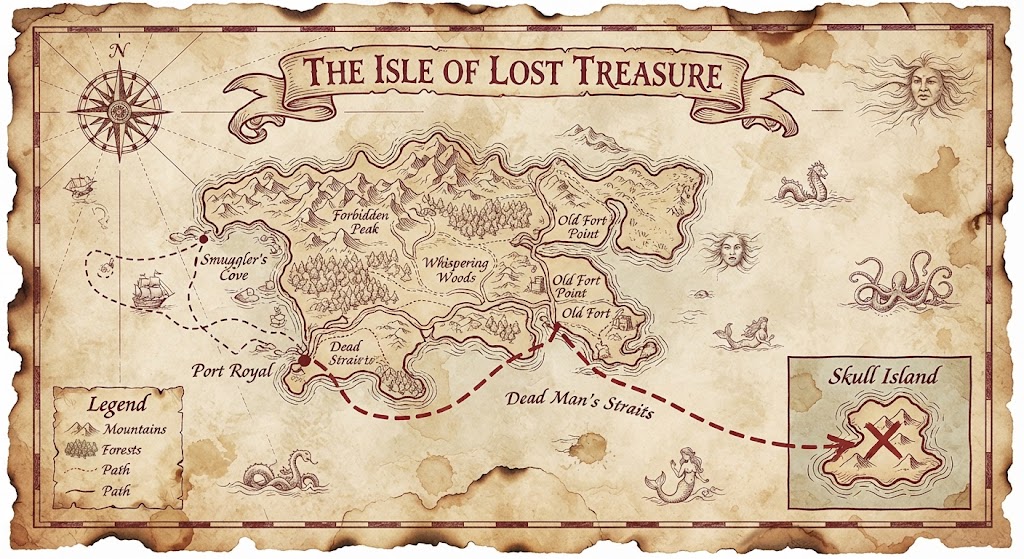
Turn map-reading practice into a treasure hunt. Cubs learn to recognise common map symbols and use them to find locations around an outdoor area.
The activity starts with a short introduction to symbols before the Cubs use a simple map to find a series of marked locations.
What You’ll Learn
Cubs will learn:
- What common map symbols represent
- How to orientate a simple map
- How to match map features with the real world
- How to follow a simple route
- How to work together when navigating
- Why maps are useful for finding your way
🟢 SAFETY – LOW RISK
Use a familiar, suitable area with clearly defined boundaries.
Consider:
- Uneven or slippery ground
- Roads, car parks and vehicle access
- Water features
- Slopes
- Weather conditions
- Keeping teams within the agreed area
Make sure Cubs understand the boundaries before starting and remain appropriately supervised.
Equipment
- Simple maps of the activity area
- Map symbol cards
- Pens or pencils
- Clipboards
- Cones or markers
- Small treasure or rewards
- Optional: compasses
Prerequisites
No previous navigation experience is required.
Cubs should be introduced to the map symbols being used before beginning the treasure hunt.
Instructions
- Prepare a simple map of the activity area and mark several locations on it.
- Place a symbol or small marker at each location.
- Before starting, show the Cubs a selection of common map symbols and explain what they represent.
- Divide the Cubs into small teams.
- Give each team a map and a list of symbols or locations they need to find.
- Explain the boundaries and the rules for moving around the area.
- Teams use their maps to locate the marked points.
- At each point, they can find a letter, number or symbol to record on their sheet.
- Once they have visited all the points, they can use the collected information to solve the final clue.
- Bring everyone together and go through the answers.
- Ask the Cubs to identify some of the real-world features they found on their maps.
Make It Harder
Give teams a map without the locations already marked and provide grid references or simple clues instead.
You can also introduce a compass and require teams to orientate their maps before starting.
Make It Easier
Use large, clear maps and only include five or six easily recognisable symbols.
Run the first part as a whole-group activity before allowing the Cubs to navigate in smaller teams.
Final Tip
Choose an area with obvious real-world features such as paths, buildings, trees and fences. Cubs will understand map symbols much more quickly when they can immediately connect the symbol with something they can see.
🔒Ready to test your survival skills?
Join Survival Guides UK for free, complete challenges, earn badges and increase your Survival Level.
JOIN FREE →
CRAIG BURR
FOUNDER · SURVIVAL GUIDES UK
I'm Craig, the person behind Survival Guides UK. I created SGUK because I wanted somewhere people could learn real outdoor skills in a practical, straightforward way — from lighting a fire and tying knots to navigation, campcraft and everything in between.
You can read more about the story behind SGUK here as well as our approach here.