Compass Basics Challenge
Activity Overview
Difficulty: Intermediate
Time: 60 minutes
Group size: 2-5
Best for: Scouts
Skills: Compass use, navigation, bearings, direction finding, teamwork
Give Scouts a practical introduction to using a compass by setting a series of simple direction-finding challenges.
They will learn how to identify directions, take and follow basic bearings, and use a compass to navigate between points.
What You’ll Learn
Scouts will learn:
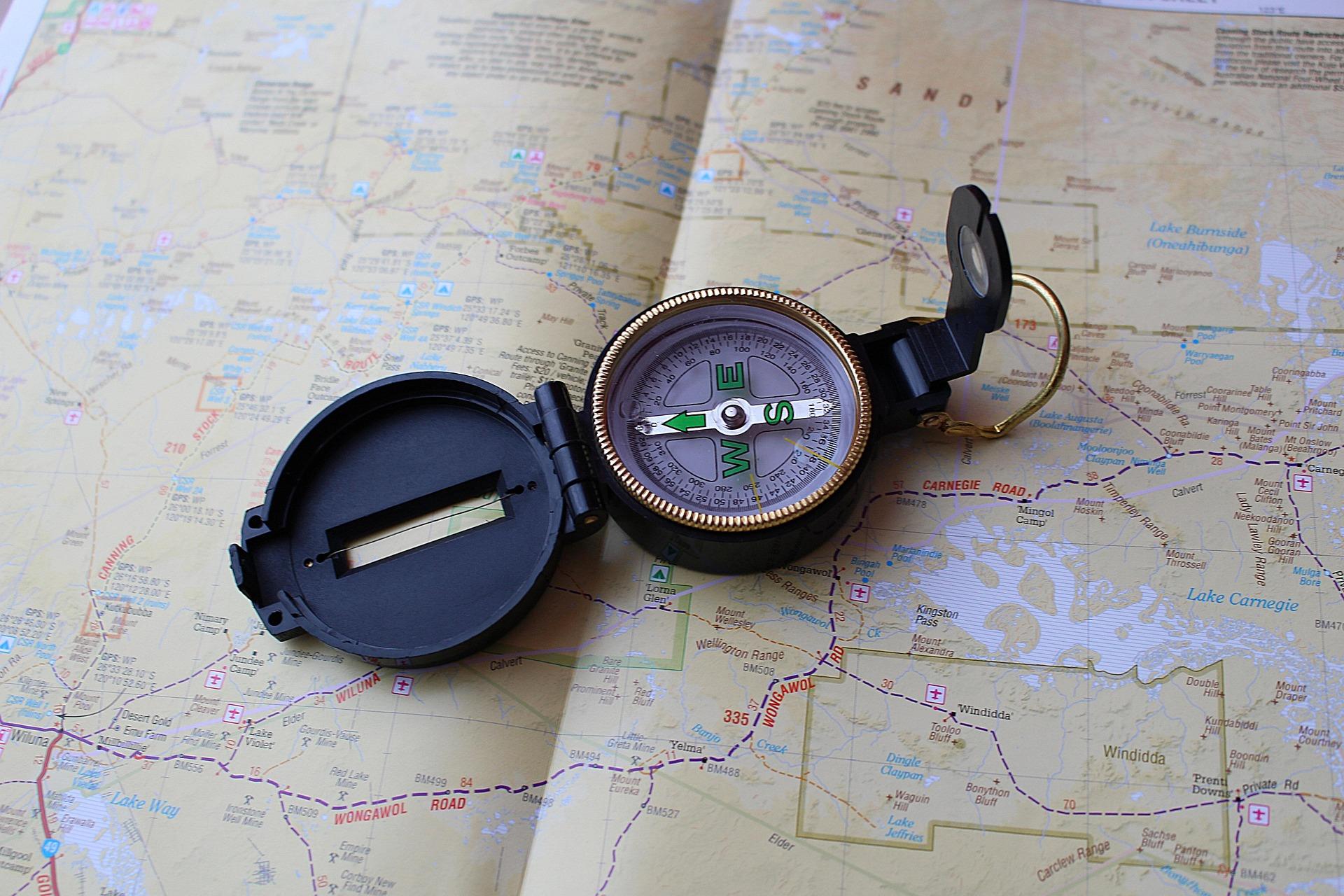
- The main parts of a compass
- How to identify north, south, east and west
- How to take a simple bearing
- How to follow a bearing
- How to estimate distance
- How to check that they are travelling in the correct direction
🟡 SAFETY – MODERATE RISK
Use a familiar outdoor area with clear boundaries and suitable terrain.
Consider:
- Uneven or slippery ground
- Roads and vehicle areas
- Slopes and obstacles
- Weather conditions
- Teams becoming separated
- Participants leaving the agreed area
Set clear boundaries before beginning and ensure the activity is appropriately supervised.
Equipment
For each team:
- Compass
- Simple activity map
- Pencil and paper
- Measuring tape or marked rope
- Cones or markers
Optional:
- Bearing challenge cards
- Clipboards
- Flag markers
Prerequisites
Scouts should be able to recognise the four main compass directions.
No previous experience with bearings is required.
Instructions
- Start by giving each Scout a compass and explain its main parts.
- Ask the group to identify north, then use the compass to find south, east and west.
- Demonstrate how to hold the compass flat and turn the direction of travel arrow towards the direction they want to travel.
- Explain that a bearing is a direction given as a number of degrees around a circle.
- Give each team a simple bearing, such as 090°.
- Ask them to use their compass to identify the direction of travel.
- Place markers around the activity area and give each team a series of bearings to follow.
- For example:
- Walk 090° for approximately 20 metres.
- Turn to 180° and walk 15 metres.
- Turn to 270° and walk 20 metres.
- Find the marker.
- Allow teams to work through the course independently.
- Once everyone has finished, give them a new set of bearings and ask them to create their own short course for another team.
- Finish by discussing why it is important to keep checking the compass and your surroundings rather than simply walking without looking.
Make It Harder
Introduce four-figure or six-figure grid references and ask Scouts to combine map reading with compass bearings.
You can also give teams a bearing and distance and ask them to predict where they will finish before starting.
Make It Easier
Use only the four main directions initially.
Instead of using degree bearings, give instructions such as:
Walk north for 20 metres, then east for 15 metres.
Once they are comfortable, introduce bearings such as 090° and 180°.
Final Tip
Teach Scouts to stop, check and re-check rather than rushing. A compass is most useful when combined with awareness of the terrain and surroundings.
🔒Ready to test your survival skills?
Join Survival Guides UK for free, complete challenges, earn badges and increase your Survival Level.
JOIN FREE →
CRAIG BURR
FOUNDER · SURVIVAL GUIDES UK
I'm Craig, the person behind Survival Guides UK. I created SGUK because I wanted somewhere people could learn real outdoor skills in a practical, straightforward way — from lighting a fire and tying knots to navigation, campcraft and everything in between.
You can read more about the story behind SGUK here as well as our approach here.