
60-Minute Activity Plan: Map Memory Mission
Looking for a practical map reading activity for Scouts? Map Memory Mission turns basic navigation skills into an engaging 60-minute team challenge. Young people practise map symbols, route planning, memory and decision-making while working together to solve increasingly difficult navigation problems.
Learning to use a map doesn’t always have to involve a long hike. Map Memory Mission turns basic navigation into a fast-paced team challenge, helping young people practise map reading, observation, memory and route planning in a way that’s easy to run at a weekly meeting.
The activity can be adapted for Beavers, Cubs or Scouts, with older sections taking on more complicated routes and navigation decisions.
Activity Overview
Time: 60 minutes
Group size: 8–24 young people
Suitable for: Beavers, Cubs and Scouts
Location: Indoors or outdoors
Main skills: Map reading, navigation, memory, teamwork and decision-making
Teams are shown a simple map and given a short time to study it. The map is then removed, and they must reconstruct a route from memory.
As the activity progresses, the challenges become more demanding. By the end, teams need to combine map-reading skills with communication and route planning.
Before You Start
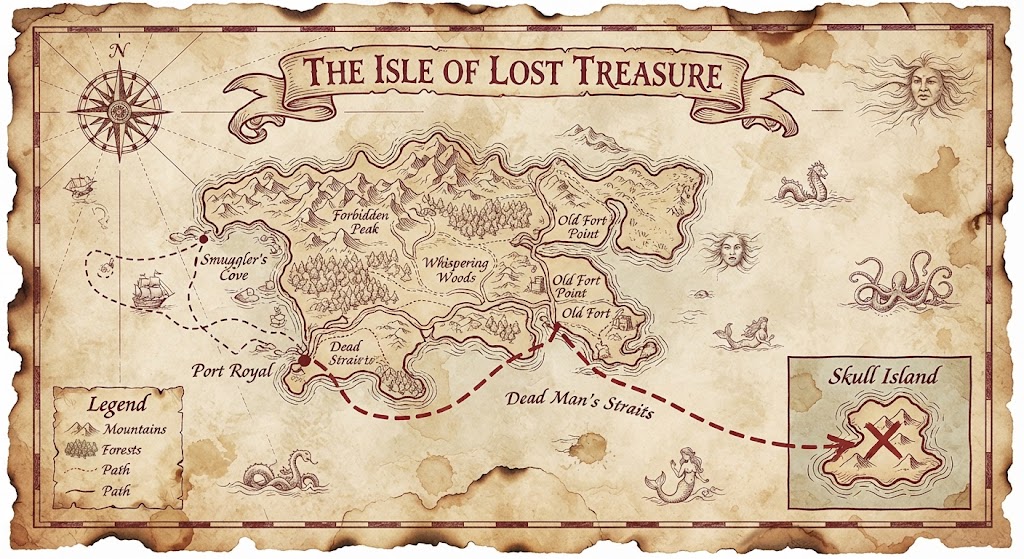
Choose a simple map that matches the age and experience of the group. A local area map, simple site map or specially prepared fictional map can all work.
For younger groups, use large symbols and obvious landmarks. For Scouts, use a genuine Ordnance Survey-style map or a more detailed route map if the group already understands basic map symbols.
Prepare several route cards before the session. Each card should contain a short route or a destination that can be found on the map.
You’ll also need pencils and paper for teams to record their answers.
If working outdoors, establish clear boundaries and make sure the activity doesn’t turn into an unsupervised navigation exercise.
Safety
Keep the activity within a clearly defined area.
For an indoor session, make sure maps, chairs and other equipment don’t create trip hazards.
If you take the activity outdoors, young people should remain within the boundaries established by the leader and should be supervised according to your normal ratios and procedures.
Don’t send young people off independently into unfamiliar areas simply to make the activity more realistic. The navigation challenge can be completed entirely within a controlled meeting area.
0–10 Minutes: Map Detective
Start by giving everyone a map.
Don’t immediately explain every symbol. Instead, ask the group what they can find.
Can they locate:
Introduce a few key map symbols appropriate to the age group.
For Beavers, focus on recognising familiar features.
For Cubs, introduce a wider selection of symbols.
For Scouts, recap contour lines, grid references and map orientation where appropriate.
The aim is to get everyone looking closely at the map before the competitive part begins.
10–20 Minutes: Memory Minute
Give each team a map showing a short route.
Allow them one minute to study it.
Then take the map away.
Ask the team to draw the route they remember.
Don’t worry about artistic ability. You’re looking for the important features: turns, landmarks, crossings and destination.
After a few minutes, return the original map and let teams compare their drawings.
Ask:
“What did you remember first?”
“Which details were easiest to forget?”
This introduces the idea that good navigation isn’t about remembering everything. It’s about recognising the information that matters.
20–35 Minutes: Route Builder
Now give teams a more detailed map.
Each team receives a destination and must work out a suitable route to reach it.
They should mark the route on their map and explain why they chose it.
For younger groups, give them two possible routes and ask which one they would choose.
For Cubs, allow them to choose between several routes.
For Scouts, introduce additional considerations such as distance, terrain, crossings or avoiding a particular feature.
Ask teams to think about the difference between the shortest route and the best route.
This creates a useful discussion about navigation and decision-making.
35–48 Minutes: The Missing Map
Now increase the challenge.
Give each team a series of instructions, but only some of the information they need.
For example:
Start at the church. Travel north to the junction. Follow the path until you reach the stream. Turn towards the woods and find the marked point.
The team must use the map to work out exactly where the destination is.
For Scouts, use four-figure or six-figure grid references if they are ready for them.
For Cubs, use recognisable landmarks and simple directions.
The first team to identify the correct location doesn’t automatically win. Ask them to explain how they know.
This prevents guessing from becoming the main strategy.
48–55 Minutes: Navigation Challenge
Give every team one final problem.
For example:
“You need to reach the campsite, but the main path is closed. Find another route.”
Teams have five minutes to plan an alternative.
For younger sections, provide a simple map with the blocked route clearly marked.
For Scouts, allow them to identify the alternative themselves.
Ask teams to consider safety, distance and terrain rather than simply finding any route that works.
55–60 Minutes: Quick Navigation Review
Bring everyone together and ask what they found most useful.
Talk briefly about how maps provide information that isn’t immediately obvious.
A good navigator doesn’t simply follow a line on a map. They look ahead, identify landmarks, check their position and think about what might happen next.
Finish by asking each team to name one map-reading skill they would like to practise again.
Adapting for Different Ages
Beavers
Keep the map simple and colourful.
Use familiar places such as the meeting hall, playground or campsite.
Focus on recognising symbols, remembering landmarks and following very simple routes.
The challenge should feel like a treasure hunt rather than a formal navigation lesson.
Cubs
Introduce basic compass directions and simple grid references.
Give Cubs opportunities to choose between routes and explain their decisions.
You can also introduce a small treasure or token at the final destination to make the activity more tangible.
Scouts
Increase the navigation element considerably.
Use real maps, grid references, contours and route planning.
You could give Scouts a scenario such as planning the safest route for a group travelling through unfamiliar countryside.
If the group is experienced, introduce time and distance calculations as an additional challenge.
Leader Notes
Don’t try to teach every navigation skill in one session.
The strength of this activity is that it gets young people using a map rather than simply listening to an explanation of one.
If your group is new to navigation, spend more time on the opening section and simplify the later challenges.
For experienced Scouts, you can make the activity considerably harder simply by giving them less information.
Another useful variation is to have one team member study the map and then explain the route to the rest of their team without showing them the map. This introduces another communication challenge while reinforcing the need to understand a route rather than simply memorise it.
Learning Outcomes
By the end of the activity, young people should have had opportunities to:
Final Thought for Leaders
Map reading becomes much more enjoyable when young people have a reason to use the map.
Rather than spending an hour explaining symbols and grid references, Map Memory Mission gets them looking, remembering, planning and making decisions.
Keep the difficulty appropriate for the section, and gradually increase the amount of information they need to interpret. By the end, they should be thinking less about “How do I read this map?” and more about “Where am I, where am I going and what’s the best way to get there?”
🔒Ready to test your survival skills?
Join Survival Guides UK for free, complete challenges, earn badges and increase your Survival Level.
JOIN FREE →
CRAIG BURR
FOUNDER · SURVIVAL GUIDES UK
I'm Craig, the person behind Survival Guides UK. I created SGUK because I wanted somewhere people could learn real outdoor skills in a practical, straightforward way — from lighting a fire and tying knots to navigation, campcraft and everything in between.
You can read more about the story behind SGUK here as well as our approach here.