60-Minute Activity Plan: The Silent Expedition
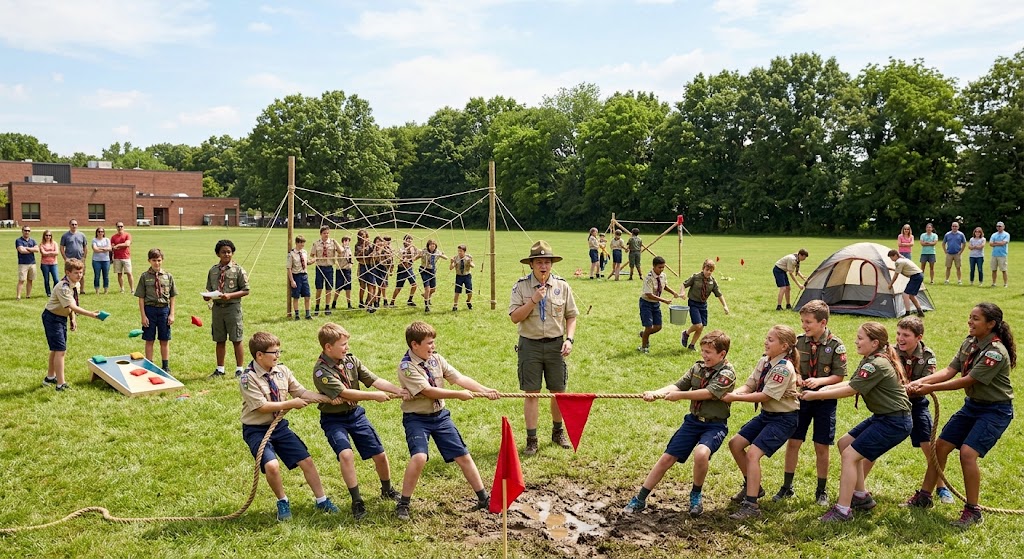
A teamwork challenge with a twist: teams must complete a series of outdoor tasks while communication is restricted. The activity encourages young people to think carefully, use non-verbal communication and adapt when their usual way of working isn’t available.
It needs very little equipment and works particularly well when you want an energetic session without simply turning it into a race.
Activity Overview
Time: 60 minutes
Group size: 8–24 young people
Suitable for: Beavers, Cubs and Scouts
Location: Indoors or outdoors
Main skills: Communication, teamwork, observation, leadership and problem-solving
The group works through a series of challenges where speaking is either restricted or temporarily removed altogether.
The important part isn’t whether they complete every challenge perfectly. It’s watching how they adapt, share responsibility and find alternative ways to communicate.
Before You Start
Choose a safe, clearly defined activity area and prepare three or four simple challenges.
You might use cups or containers, ropes, balls, cones, picture cards or other everyday equipment. Nothing needs to be particularly complicated.
The key is to make sure every challenge can be completed safely without verbal communication.
For younger children, use straightforward construction or sorting tasks. Older Scouts can be given more complicated problems requiring planning and cooperation.
Explain before starting that silence is part of the game, but safety always comes first. Anyone can speak if they need to warn someone about a genuine safety issue.
Safety
Use a clear, obstacle-free area and avoid challenges involving climbing, blindfolds, running at speed or carrying heavy objects.
Do not use blindfolds as a substitute for communication. Removing sight while young people are already unable to speak can introduce unnecessary risks.
Make sure equipment is suitable for the age group and doesn’t create trip hazards.
If anyone becomes frustrated or uncomfortable with the communication restriction, allow them to step out or speak to a leader.
The leader should remain able to stop the activity immediately if a safety issue arises.
0–10 Minutes: The Communication Experiment
Begin with everyone sitting or standing together.
Ask the group to complete a very simple task without speaking.
For example:
“Without talking, arrange yourselves in birthday-month order.”
Don’t give them any further instructions.
Let them experiment.
Once they have finished, ask how they communicated.
You’ll probably see pointing, hand signals, facial expressions and plenty of confused looks.
Explain that the main activity will explore what happens when a team can’t rely on its usual method of communication.
10–20 Minutes: Silent Sorting
Divide the group into small teams.
Give each team a collection of objects or picture cards.
Their task is to arrange them according to a rule, such as size, weight, colour, category or sequence.
They aren’t told the rule verbally. Instead, give them a card explaining what they need to achieve, and then impose the no-talking rule.
For Beavers, make the sorting rule obvious.
For Cubs, introduce two categories.
For Scouts, give them a sequence or classification problem where they need to agree on an order.
Once finished, allow them to speak again briefly and discuss what worked.
Then the silence returns.
20–35 Minutes: The Build Challenge
Give each team a small collection of materials.
Cups, cards, blocks, newspaper, string or similar items can all work.
Their task is to construct something specific—for example, a tower that can support a particular object.
The team must plan and build without talking.
Watch how different people naturally take on roles.
Some may become leaders, some may demonstrate ideas, while others may simply wait for instructions.
Don’t intervene unless necessary.
At the end, let everyone speak again and ask:
“What was difficult when you couldn’t explain your idea?”
“Did one person end up making all the decisions?”
“How did you know what someone else wanted you to do?”
These questions often produce more useful discussion than the challenge itself.
35–48 Minutes: The Silent Rescue
Now introduce a scenario.
Tell the teams:
“Your team is preparing for an expedition. You have discovered that your route instructions have been mixed up. You need to put them back into the correct order.”
Give each team a collection of route cards.
Some can contain simple pictures, arrows, landmarks or instructions.
The team must put them into the correct sequence without speaking.
For older Scouts, make the challenge more interesting by giving different team members different pieces of information. They will have to find ways to communicate what they know without words.
This version works particularly well because one person may hold information that the rest of the team needs.
48–55 Minutes: One Final Challenge
Give the teams one final task, but this time allow only one person to speak.
The speaker can see the task but cannot touch the equipment.
Everyone else can touch and move the equipment but cannot talk.
Give them a simple construction or arrangement challenge.
This creates a very different communication problem.
The speaker has to give clear instructions, while everyone else has to listen carefully and interpret them.
For Scouts, make the task more precise by giving a target arrangement that must be reproduced exactly.
55–60 Minutes: Debrief
Bring everyone together and remove all communication restrictions.
Ask the group which version they found easiest.
Most will probably say that everyone being able to talk was easiest—but ask whether it was necessarily the best communication.
Discuss how people sometimes talk over one another, assume others understand them or fail to listen.
The activity demonstrates that communication isn’t simply about speaking. Good teamwork also involves watching, listening, checking understanding and giving other people space to contribute.
Adapting for Different Ages
Beavers
Keep the challenges short and visual.
Use sorting, stacking and matching games rather than complicated instructions.
You can allow some limited communication through gestures from the beginning so the activity doesn’t become frustrating.
The main lesson is simply discovering that you can communicate without words.
Cubs
Give Cubs several different challenges and let them discover their own communication methods.
Introduce simple restrictions such as no talking, then one person speaking.
Encourage them to reflect on which method helped their team most.
Scouts
Make the challenges more complex and introduce information that is deliberately divided between team members.
Scouts can also take turns being the designated communicator or leader.
Afterwards, discuss leadership, active listening and the difference between giving instructions and actually communicating effectively.
Leader Notes
Don’t worry if the teams struggle.
In fact, a certain amount of frustration is useful because it makes the eventual discussion much more meaningful.
However, keep the challenges achievable. The objective isn’t to make communication impossible; it’s to make the young people think about how they communicate.
Try not to give teams hints too early. Instead, observe and make notes about interesting behaviours.
You may find that one young person naturally takes over, another has good ideas but struggles to get them across, or a quieter member becomes particularly effective once normal conversation disappears.
These observations can make the final discussion much more personal and useful.
Learning Outcomes
By the end of the activity, young people should have had opportunities to:
Final Thought for Leaders
Good communication isn’t measured by how much a team talks.
Sometimes the most effective team is the one that knows when to speak, when to listen and when to pay attention to what everyone else is doing.
The Silent Expedition gives young people a memorable way to discover that for themselves—and the lessons can easily transfer into hiking, camping, pioneering and everyday teamwork.
🔒Ready to test your survival skills?
Join Survival Guides UK for free, complete challenges, earn badges and increase your Survival Level.
JOIN FREE →
CRAIG BURR
FOUNDER · SURVIVAL GUIDES UK
I'm Craig, the person behind Survival Guides UK. I created SGUK because I wanted somewhere people could learn real outdoor skills in a practical, straightforward way — from lighting a fire and tying knots to navigation, campcraft and everything in between.
You can read more about the story behind SGUK here as well as our approach here.